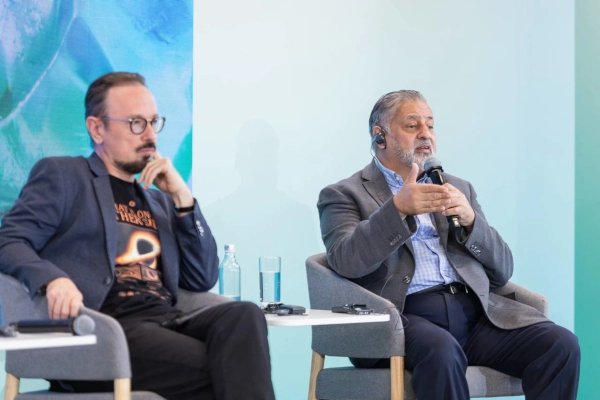
Artificial intelligence is likely to reshape business, robotics, healthcare, education, agriculture, cities and space over the next decade, but the pace of change will differ sharply across sectors, according to futurist Rohit Talwar.
Speaking at the Moscow Startup Summit during the foresight session “Code 2035: Visionaries on Five Technology Sectors of the Future,” the CEO of Fast Future outlined how artificial intelligence could move from a productivity tool into a deeper layer of economic and social infrastructure. His central argument was that AI will not transform every industry in the same way or at the same speed, with smaller companies and creative businesses likely to adapt more quickly than large corporations constrained by governance, accountability and risk concerns.
AI Could Reshape Business at Different Speeds
Talwar divided the business impact of artificial intelligence into three broad areas: personal productivity, small companies and creative industries, and large corporations.
At the individual level, he expects AI tools to help people work faster and process information more efficiently. Smaller businesses and creative industries, he argued, could undergo even faster transformation because they tend to have simpler structures, fewer layers of approval and greater freedom to experiment with new technologies.
Large corporations are likely to move more cautiously. Talwar said the main barriers are not simply technical capability but questions of responsibility and control. Business leaders may be comfortable using AI for tasks such as drafting reports or analysing data, but fully autonomous decision-making creates more difficult questions about accountability when something goes wrong.
Robotics Will Matter Most When Machines Perform Real Work
Talwar expects robotics to make its biggest impact when machines move beyond demonstrations and begin performing economically useful tasks at scale.
He highlighted three areas in particular: robots capable of precise control in factories, warehouses and logistics centres; machines designed for construction and maintenance; and intelligent drones used for inspection and hazardous environments.
These systems could include drones inspecting buildings and agricultural land or entering burning structures where human access would be dangerous. Talwar argued that entertainment-focused robotics may continue attracting attention, but the deeper transformation will come when intelligent machines become reliable tools for everyday industrial work.
China Could Push Humanoid Robots Towards Mass Adoption
China featured prominently in Talwar’s assessment of the future of robotics.
He said the country is pursuing a model in which artificial intelligence and robotics are introduced while attempting to avoid large-scale employment displacement. One element of this approach is support for very small or even one-person companies that can use automated systems to expand their capabilities.
Talwar suggested that China could eventually drive the cost of humanoid robots down dramatically, potentially making them affordable for much wider commercial use. His comments underline the role that scale, manufacturing capacity and government policy could play in determining which countries shape the global robotics market over the next decade.
Autonomous Farms Could Change Food Production
Artificial intelligence is also expected to become more deeply embedded in agriculture.
Over the next two to three years, Talwar expects wider use of drones, sensors, AI-based data analysis and weather forecasting to improve decisions on planting, irrigation and crop management.
Further ahead, he sees a path towards highly automated farms, greater use of vertical agriculture and more sophisticated bioengineering. Such systems could allow agricultural production to become more precise while reducing waste and improving the use of water, fertiliser and other inputs.
The transition, however, will depend on the ability to combine digital systems with machinery, biological research and local farming knowledge.
Medicine Could Move Towards Deeper Personalisation
Talwar described healthcare as one of the most significant areas for AI-driven change.
Artificial intelligence is already being used to accelerate parts of the drug-discovery process, but he expects its role to expand into surgery, diagnostics and personalised treatment.
Robotic surgery and advanced machine vision could become more capable, while future systems may move towards increasingly autonomous surgical assistance. The longer-term goal, in Talwar’s view, is medicine that is more closely adapted to the physiology of individual patients rather than designed primarily around broad population averages.
Such a shift would require progress not only in AI but also in genomics, diagnostics, regulation and medical data systems.
Every Student Could Gain Access to a Personal AI Tutor
Education was another area where Talwar expects major change between now and 2035.
He argued that AI could provide each student with a personalised tutor capable of adjusting explanations, pace and teaching methods to individual needs. In a conventional classroom, a teacher must divide attention among many students, while an AI tutor could provide continuous individual support and repeat explanations without the time constraints faced by human teachers.
Talwar did not frame this as a replacement for teachers. He also emphasised the role of AI in helping educators prepare lessons, develop alternative teaching methods and monitor learning progress more effectively.
Education Could Move Towards Lifelong Learning
Talwar also questioned whether schools, colleges and universities are being used efficiently.
He noted that many educational facilities remain underused for large parts of the day and suggested that they could support continuous adult learning as economies and technologies evolve.
He proposed alternative financing models in which education could be provided with little or no upfront cost, with learners contributing a percentage of future income. The idea reflects a wider question that will become increasingly important as AI changes labour markets: how societies can make reskilling and lifelong education available at much greater scale.
Cities Could Become More Automated and Adaptive
Looking at the future of cities, Talwar highlighted modular construction, prefabrication, automated infrastructure and more intelligent use of energy and materials.
He pointed to rapid developments in low-cost construction and suggested that future buildings could become increasingly self-managing, adjusting their use of energy, water and waste systems automatically.
He also envisaged infrastructure capable of responding dynamically to accidents, congestion and flooding. Other possibilities include self-healing construction materials, solar-integrated roads and maintenance robots that can respond rapidly to damage or disruption.
The broader trend is towards urban systems that do more than simply collect data and instead begin making operational adjustments in real time.
Space Could Become a Laboratory for Radical Ideas
Talwar reserved some of his most ambitious forecasts for space.
He discussed concepts such as space elevators, giant orbital mirrors designed to reflect solar radiation and permanent or semi-permanent human settlements beyond Earth.
He also highlighted the possibility of using microgravity to develop materials, foods or medical treatments that may be difficult or impossible to produce under terrestrial conditions.
Many of these ideas remain speculative and technologically distant, but Talwar’s broader point was that space could become an increasingly important environment for experimentation. Technologies developed there could eventually influence industries on Earth as well.
AI Could Progress Towards Much More Powerful Systems
Talwar described artificial intelligence as moving through several stages.
The current generation is already strong in areas such as text, image generation and information processing but remains limited in many physical and real-world tasks.
The next stage, in his view, could involve systems capable of performing a far wider range of human tasks while improving continuously. Beyond that lies the possibility of artificial superintelligence, systems significantly more capable than humans across many domains.
Talwar presented this as both an opportunity and a source of profound uncertainty. If such systems emerge, he argued, they could create entirely new economic sectors and potentially help address some of the world’s most persistent problems.
Technology Will Matter Most When It Solves Real Problems
Talwar linked the future of AI to wider global challenges rather than treating technology as an end in itself.
He pointed to persistent poverty and large-scale food waste as examples of problems that advanced systems could help address if innovation is directed towards practical outcomes.
This emphasis ran through much of his presentation. In business, robotics, medicine and education, the value of AI ultimately depends on whether it improves productivity, access, safety and quality of life.
The next decade may therefore be defined not simply by how powerful artificial intelligence becomes, but by how effectively societies apply it to real-world needs.
Moscow Startup Summit Focuses on Five Technology Sectors
The foresight session formed part of the Moscow Startup Summit held on September 29 and 30 at SberCity.
The 2026 summit focused on five broad areas being transformed by startup-driven innovation: medicine and biotechnology, education and creative industries, agriculture and food production, construction and urban development, and smart devices and robotics.
The programme included startup pitches, technology exhibitions, investor engagement and presentations from entrepreneurs and innovation leaders. More than 100 Russian and international startups participated across stages ranging from early development to pre-IPO.
The summit was organised by the Government of Moscow and Sber with the aim of connecting startups, investors and corporations while shortening the path from emerging technology to practical deployment.
From AI Tools to an AI-Shaped Economy
Talwar’s outlook for 2035 presents artificial intelligence not as a single industry but as a technological layer spreading across multiple parts of the economy.
The most significant changes may come where AI is combined with robotics, biotechnology, education, infrastructure and advanced manufacturing rather than used only as a software assistant.
The pace of adoption will vary, and many of the more ambitious ideas remain uncertain. But the direction is already visible: artificial intelligence is moving steadily from isolated applications towards systems that influence how companies operate, how people learn, how medicine is delivered and how machines interact with the physical world.
References
Sber Press Office — “Code 2035: Futurist Rohit Talwar Explains How AI Will Change Business, Robots, Medicine, Education, and Space,” Moscow Startup Summit, September 2026.
Moscow Startup Summit — Official event programme, September 29–30, 2026.
Fast Future — Official information on Rohit Talwar and foresight research.
Sberbank — Official corporate information.
You may also like
-
Bharat Skytech and Evercell Showcase Made-in-India Drone Power Systems in New Delhi
-
ARKin Labs Showcases Indigenous UAV Avionics for Defence, Agriculture and Enterprise Drones
-
ShepHertz Showcases Made-in-India Sovereign AI Platform for Intelligent Drone Operations
-
India Prepares New National Steel Policy With 600 Million Tonne Capacity Goal for 2047
-
Essar-Backed Mesabi Metallics Announces $18 Billion US Steel Investment Linking Minnesota Mine With Iowa Plant
