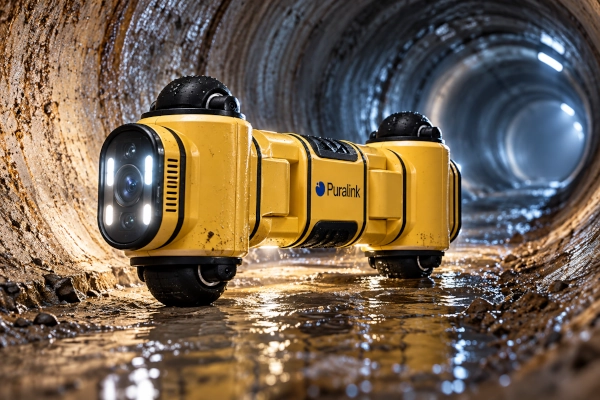
Australian robotics company Puralink is developing an autonomous pipe-inspection platform designed to navigate complex underground networks, collect high-resolution condition data and create detailed maps of infrastructure that is normally difficult to inspect.
The company’s core system, called Ferret, combines robotics, LiDAR, HD CCTV, positional mapping and autonomous navigation in a compact machine capable of moving through underground pipe networks with minimal operator input. Puralink says the platform is designed to give infrastructure operators more complete information about pipe condition, geometry and location while reducing the limitations of conventional inspection crawlers.
Ferret Designed for Complex Underground Networks
Traditional pipe-inspection robots are generally effective in straight sections but can struggle when networks include bends, junctions, gradients, manholes and vertical sections. Puralink has designed Ferret specifically for these environments.
The robot uses a patented drive architecture combined with an active suspension system that allows it to maintain traction against pipe walls while adjusting its profile to different conditions. According to the company, Ferret can navigate corners, intersections and manholes while inspecting networks extending up to one kilometre from a single access point.
The platform is intended for pipes with diameters of 150 millimetres and above. In pipes between 150 mm and 300 mm, the active suspension system can expand against the walls and allow the robot to traverse vertical sections. In larger pipes, it operates as a crawler.
HD CCTV, LiDAR and Mapping in One Platform
Ferret is designed to gather multiple types of inspection information during a single deployment. The robot captures high-definition CCTV footage, LiDAR depth data and positional mapping information from onboard sensors.
Combining these different sensing technologies allows operators to examine both the physical condition of a pipe and its geometry within the surrounding network. Puralink says this approach can produce millimetre-scale spatial mapping and more detailed infrastructure records than conventional CCTV inspection alone.
The collected data is managed through PuralinkOS, the company’s cloud-based data platform. Operators can review inspection footage, mapping information, robot telemetry and asset-condition records from a centralised interface.
Autonomous Navigation Reduces Manual Driving
Ferret does not operate without human oversight, but it is designed to handle much of the navigation process autonomously.
An operator remains present during inspections to monitor the robot, examine pipe condition and make decisions when complex situations arise. Unlike conventional crawlers that often require continuous manual steering, Ferret can manage routine navigation using onboard sensors and autonomous software.
This shifts more of the operator’s attention towards interpreting inspection data rather than physically driving the machine through the network.
Active Suspension Helps Robot Cross Difficult Sections
Underground pipe systems frequently contain debris, misalignments, defects and uneven surfaces. Puralink’s active suspension architecture is intended to help Ferret maintain stability and traction across these conditions.
The robot can alter its physical profile while moving through a pipe, allowing it to negotiate obstacles and maintain contact with the surrounding surface. If the system encounters an obstruction that cannot be safely crossed, it can stop and request operator input.
Puralink says the robot can also contract to a smaller profile if it becomes constrained, helping it reverse away from difficult sections. A tether provides an additional communication and retrieval mechanism from the surface.
Modular Architecture Allows Future Sensor Upgrades
Puralink has developed Ferret around a modular architecture rather than a fixed hardware configuration.
The company says individual modules can be replaced or serviced without taking the entire platform out of operation for extended periods. The same architecture is also intended to support additional sensors and payloads as new inspection requirements emerge.
This modular design gives operators the ability to upgrade the robot over time instead of replacing the entire system when new sensing or computing technologies become available.
Long-Endurance Platform for Field Operations
Ferret uses replaceable battery modules and is designed for extended field operation. Puralink states that the platform can support up to around 20 hours of battery operation depending on configuration and mission conditions.
The system is deployed through conventional pipe-access points such as manholes. A surface base station incorporates the tether reel and operator controls, while the robot itself carries the battery and onboard computing systems required for navigation and sensing.
This arrangement allows the robot to operate independently inside the pipe while retaining a live connection with the surface team.
Initial Focus on Wastewater and Sewer Networks
Puralink is initially targeting wastewater and sewer infrastructure, where operators manage extensive underground networks that can be difficult and expensive to inspect.
The company also sees applications across utilities, energy, mining and industrial infrastructure. These sectors frequently depend on buried pipe systems where failures can result in water loss, environmental damage, production disruption or costly emergency repairs.
Improved inspection data can help asset owners identify deterioration earlier, prioritise maintenance and build more accurate digital records of infrastructure that may have been installed decades earlier.
From University Research to Commercial Robotics
Puralink has strong links with the University of Technology Sydney ecosystem. The company emerged through university-linked startup activity, and a large proportion of its team includes UTS alumni and students.
The company’s patented robotics architecture was developed around the challenge of creating compact machines capable of operating inside small-diameter underground infrastructure. The technology combines mechanical engineering, sensing, autonomous navigation and embedded computing in a constrained environment where conventional robotic systems are difficult to deploy.
Puralink has since grown into a dedicated robotics company headquartered in Sydney, Australia.
Peak XV Backing Supports Scale-Up
Puralink raised more than A$2 million in a funding round led by Peak XV Partners, formerly Sequoia Capital India and Southeast Asia.
The funding is being used to scale production of the Ferret platform and move the technology towards broader commercial deployment. The company has also participated in accelerator and startup programmes as it transitions from engineering development into field operations.
Its relationship with Peak XV is particularly notable because the investment firm has increasingly expanded its exposure to deep-tech companies developing physical systems rather than purely software products.
Real-World Trials Through Design Partner Programme
Puralink has established a Design Partner Programme through which infrastructure operators work directly with the company during field deployments.
Participants include contractors and organisations involved in maintaining utility, government, industrial and municipal infrastructure. The programme allows Puralink engineers to gather operational feedback while customers receive early access to the Ferret system.
The company has also carried out deployments in university infrastructure environments, including trials at Monash University, providing further opportunities to test the robot under real underground conditions.
Building a New Generation of Infrastructure Robotics
Puralink’s Ferret represents a broader shift towards autonomous systems for infrastructure inspection. Underground utilities have traditionally been difficult to monitor because much of the network remains inaccessible until a failure occurs or a specialised inspection is commissioned.
Combining robotics, LiDAR, computer vision, mapping and autonomous navigation allows infrastructure operators to collect more detailed information before problems become critical.
As Ferret moves from design-partner deployments towards wider commercial use, Puralink is positioning its technology as a platform for continuous underground infrastructure intelligence rather than a conventional inspection crawler. The approach could improve how utilities and industrial operators monitor ageing pipe networks while demonstrating how autonomous robotics can address infrastructure challenges that are largely invisible from the surface.
References
Puralink — Official website, Ferret Autonomous Pipe Inspection Robot.
Puralink — Official Pipe Inspection Robot FAQs.
Puralink — Design Partner Programme.
University of Technology Sydney — Puralink startup and robotics development profile.
Puralink — Official company communications on autonomous navigation, robotics and infrastructure inspection.
You may also like
-
India’s National Highway Network Expands 61% to More Than 1.46 Lakh Kilometres
-
ULOOK Develops Space-Based RF Intelligence Platform as It Joins Peak XV Surge 12
-
TDB Backs Multi Nano Sense With ₹37.51 Crore to Build Indigenous Multi-Gas Sensor Platform
-
Textiles Ministry Plans 5,000–10,000 New Exporters as India Expands District-Led Textile Export Push
-
India and Jordan Target US$5 Billion Bilateral Trade by 2030 as Economic Cooperation Expands
