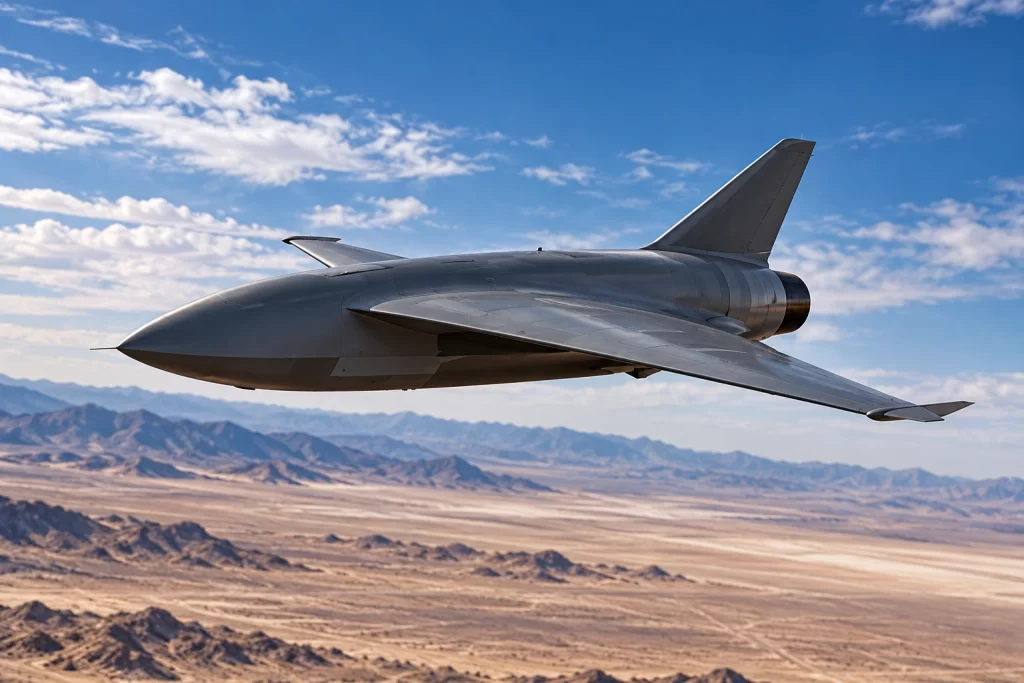
Bharat Forge has showcased a new indigenous long-range unmanned aerial vehicle capability developed in collaboration with Bengaluru-based Kadet Defence Systems during the Indian Air Force’s Dronothon 2026 at Chandan in Jaisalmer, Rajasthan. The demonstration places the partnership among the latest Indian industry efforts aimed at developing longer-range unmanned systems for future military requirements.
Bharat Forge confirmed through its official communication that its Aerospace Division participated in Dronothon 2026 and displayed an indigenous turbojet engine alongside long-range UAV capabilities developed with Kadet Defence Systems. The company did not publish the UAV’s complete technical specifications, but the demonstration indicates a wider effort to combine Indian airframe, propulsion and mission-system capabilities within the domestic unmanned aerial systems ecosystem.
Bharat Forge and Kadet Defence Demonstrate Long-Range UAV Capability
The Dronothon 2026 event was conducted by the Indian Air Force at Chandan, near Jaisalmer, providing Indian defence companies with an operational environment in which to demonstrate unmanned aerial technologies.
Bharat Forge stated that it showcased an indigenous and distinctive long-range UAV capability in collaboration with Kadet Defence Systems. The company linked the demonstration to its broader objective of strengthening India’s defence and aerospace manufacturing ecosystem through indigenous technology and strategic partnerships.
The official announcement does not presently identify the aircraft by a publicly confirmed designation or disclose details such as maximum take-off weight, operational radius, payload capacity, flight ceiling or endurance. It also does not formally describe the propulsion architecture of the demonstrated aircraft. These details should therefore remain separate from the confirmed information released by Bharat Forge.
Indigenous Turbojet Engine Displayed Alongside UAV Programme
One of the important elements of Bharat Forge’s Dronothon participation was the display of its indigenous turbojet technology. The company has been developing small gas-turbine engines at its Gas Turbine and Technology Development Centre in Bengaluru as part of a broader move into indigenous aerospace propulsion.
Bharat Forge has previously confirmed that its Bengaluru centre developed and validated the Kalyani Gas Turbine 45, a 45 kgf-class indigenous engine intended for applications including UAVs, target drones, cruise missiles and range extenders. The company has also stated that it is developing small jet engines across the 40 kgf to 200 kgf thrust range for unmanned and other aerospace applications.
The development of domestic propulsion technology is particularly important for long-range UAV programmes because the propulsion system directly affects endurance, speed, payload capacity and operational reach. Indigenous engines can also reduce dependence on imported powerplants and strengthen control over future production, upgrades and maintenance.
NPD-1 Completes Five-Hour ISR Sortie
Bharat Forge used Dronothon 2026 to demonstrate more than one unmanned platform. The company confirmed that its NPD-1 UAV completed a continuous five-hour endurance sortie during the event, demonstrating its intelligence, surveillance and reconnaissance capability.
A five-hour continuous flight provides useful evidence of the platform’s endurance in an operational demonstration environment rather than only under laboratory conditions. Bharat Forge has not disclosed the complete sensor configuration or mission payload associated with the sortie, but the demonstration adds another operationally relevant UAV capability to the company’s expanding unmanned systems portfolio.
The NPD-1 demonstration also shows that Bharat Forge is pursuing unmanned aircraft across different mission classes rather than focusing solely on propulsion technologies or high-speed platforms.
Omega One Demonstrates More Than 50-Kilometre Range
The company also demonstrated its Omega One unmanned aircraft on September 16 during Dronothon 2026. Bharat Forge described the aircraft as a premium platform with a maximum take-off weight below five kilograms.
According to the company, Omega One flew beyond 50 kilometres during the demonstration while showcasing its ISR capability over the Pokhran region. Achieving such range from a sub-five-kilogram platform highlights the growing sophistication of compact Indian UAV systems designed for surveillance and reconnaissance missions.
The demonstration of Omega One alongside NPD-1 and the new long-range UAV capability gives Bharat Forge a portfolio extending from lightweight ISR platforms to more advanced long-range unmanned aircraft technologies.
Bharat Forge Expands Its Aerospace Propulsion Capability
Bharat Forge’s aerospace programme has steadily expanded beyond conventional component manufacturing into indigenous systems, propulsion technology and complete unmanned solutions. Its Aerospace Business Unit now includes dedicated facilities for gas-turbine design, simulation, manufacturing, assembly and testing.
The company says its Bengaluru development centre is capable of carrying out engine performance analysis, compressor and combustor development, turbine design, mechanical integrity assessment and engine-control system development. These capabilities provide a foundation for developing indigenous powerplants specifically tailored for UAVs and other unmanned aerospace applications.
Bharat Forge has previously stated that its defence and aerospace operations include competencies in metallurgy, material science, embedded electronics, control systems, artificial intelligence, data analytics and unmanned platforms. The combination of these disciplines allows the company to move progressively from component manufacturing towards integrated defence products.
Collaboration Strengthens India’s Private-Sector UAV Ecosystem
The collaboration with Kadet Defence Systems adds specialised unmanned-system expertise to Bharat Forge’s manufacturing and propulsion capabilities. Indian defence companies are increasingly forming such partnerships to shorten development cycles and combine expertise that would otherwise have to be built within a single organisation.
For Bharat Forge, indigenous jet engines and high-end manufacturing capabilities provide a strong technological base. Kadet Defence contributes experience in unmanned aircraft and related systems, allowing the partnership to concentrate on integrated long-range UAV solutions.
The Dronothon demonstration therefore represents more than the appearance of another unmanned aircraft. It reflects the broader evolution of India’s private defence industry toward collaborative development of complete aerospace systems, including aircraft, propulsion, sensors and mission technologies.
Dronothon 2026 Provides Operational Testing Environment
The Indian Air Force’s Dronothon initiative provides domestic companies with a platform to demonstrate UAV technologies under conditions closer to military operations than conventional exhibition displays.
Testing aircraft in the Jaisalmer and Pokhran environment exposes unmanned systems to high temperatures, desert terrain, long-distance communications requirements and demanding operational conditions. Such demonstrations can help developers validate performance, identify limitations and refine systems according to service requirements.
For Indian UAV manufacturers, this type of interaction with the armed forces is increasingly important as the domestic industry moves from prototype development toward mature systems capable of sustained military deployment.
A Broader Push Towards Indigenous Unmanned Systems
Bharat Forge’s latest demonstrations fit within its wider strategy of expanding into indigenous unmanned and aerospace technologies. The company has previously collaborated with Indian and international partners on UAV programmes while simultaneously developing its own propulsion systems and aerospace manufacturing capabilities.
Its growing work in micro jet engines is particularly significant because propulsion remains one of the more technically demanding elements of unmanned aircraft development. Bharat Forge has stated that its defence aerospace programme intends to build increasingly capable indigenous engines for UAVs, target drones and other high-speed aerial systems.
The combination of the new long-range UAV capability, the five-hour NPD-1 sortie, the Omega One long-range demonstration and indigenous turbojet development shows Bharat Forge building a wider unmanned aviation portfolio rather than pursuing a single platform. Collaboration with Kadet Defence adds another important layer to this effort and strengthens India’s capacity to develop advanced UAV technologies within the domestic defence-industrial ecosystem.
References
Bharat Forge Limited — Official Dronothon 2026 Update: Indigenous Turbojet Engine, Long-Range UAV Capability with Kadet Defence Systems, NPD-1 and Omega One
https://www.linkedin.com/company/bharat-forge-ltd/
Bharat Forge Limited — Defence Aerospace Business Unit and Gas Turbine Technology Development Centre
https://www.bharatforge.com/aerospace/defence
Bharat Forge Limited — Aerospace Business Unit
https://www.bharatforge.com/businesses/aerospace
Bharat Forge Limited — Annual Report 2025-26, Defence and Aerospace Capabilities
https://www.bharatforge.com/AR2026/about-bharat-forge.html
Bharat Forge Limited — Management Discussion and Analysis 2024-25, Micro Jet Engines for UAV Applications
https://www.bharatforge.com/AR2025/pdf/management-discussion-and-analysis.pdf
You may also like
-
HAL and SkyPulse Plan 30-Helicopter Leasing Ecosystem Around Made-in-India Civil Aircraft
-
HAL-Russia Civil Aircraft Cooperation Advances as SJ-100 Manufacturing Plan and IL-114 Localisation
-
Paras Defence Wins ₹26.59 Crore DRDO Order for Hyperspectral Mission Optics
-
Indian Air Force Floats Tender for Inflatable Aircraft Decoys With IR Signatures
-
Kaveri Dry Engine Moves Toward Flying-Testbed Certification as DRDO Targets 49 kN for India’s UCAV Programme
