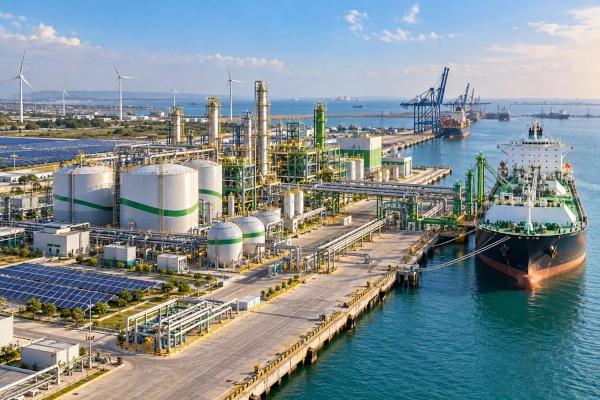
India has taken a major step towards developing a domestic green maritime fuel ecosystem with the foundation stone being laid for the country’s first port-based e-methanol production facility at Deendayal Port Authority in Kandla, Gujarat. The ₹2,300-crore project is designed to manufacture green methanol for ships operating on major international trade routes while building a new clean-energy industrial ecosystem around one of India’s most important ports.
Gujarat Chief Minister Bhupendra Patel, Union Minister for Ports, Shipping and Waterways Sarbananda Sonowal and Assam Chief Minister Himanta Biswa Sarma jointly laid the foundation stone for the facility at Gandhidham on September 26, 2026. The project brings together Deendayal Port Authority and Assam Petro-Chemicals Limited in an initiative intended to combine renewable energy, green hydrogen and biogenic carbon dioxide for large-scale production of low-carbon maritime fuel.
150-Tonne-Per-Day Green Methanol Facility
The Kandla e-methanol plant will eventually have a production capacity of 150 tonnes per day. It will use renewable electricity, water and biogenic carbon dioxide as key inputs, with green hydrogen forming an important part of the production chain.
Unlike conventional methanol, which is generally produced using fossil-derived feedstocks, e-methanol can be manufactured by combining renewable hydrogen with captured carbon dioxide. When renewable energy and sustainably sourced carbon are used, the resulting fuel can significantly reduce lifecycle greenhouse-gas emissions compared with conventional marine fuels.
For India, the project represents more than the establishment of another renewable-energy plant. Its location inside a major commercial port creates the foundation for producing, storing, handling and supplying green maritime fuel directly to visiting vessels.
Kandla Positioned on the Asia-Europe Shipping Corridor
Deendayal Port Authority occupies an important location on shipping routes connecting Asia with Europe. The government expects the new facility to eventually supply green methanol to vessels operating along international maritime trade corridors, including routes connecting Asian ports with European markets.
Kandla could therefore emerge as an Indian bunkering hub for alternative marine fuels at a time when international shipping companies are gradually introducing vessels capable of operating on methanol and other low-carbon fuels.
The project also fits into a broader global effort to reduce emissions from maritime transport. Shipping remains heavily dependent on conventional bunker fuels, making the development of commercially viable green alternatives one of the industry’s major technological and infrastructure challenges.
Green Methanol Targeted at $750 Per Tonne
One of the most significant claims associated with the Kandla project concerns production cost. According to the Ministry of Ports, Shipping and Waterways, the facility is expected to produce green methanol at approximately $750 per tonne.
The government compares this with prevailing international green methanol production costs of around $1,300 per tonne. Achieving the targeted cost would considerably strengthen India’s competitiveness as a producer and exporter of green maritime fuels.
The economics of the project will depend on several factors, including renewable electricity prices, green hydrogen costs, carbon dioxide availability, electrolyser efficiency, plant utilisation and logistics. Kandla’s access to port infrastructure and renewable-energy resources could provide important advantages as production scales up.
Project to Be Developed in Two Phases
The ₹2,300-crore facility will be developed through scalable production modules rather than as a single large plant.
Phase I involves an investment of approximately ₹1,200 crore and will establish production capacity of 50 tonnes per day. According to the announced schedule, this phase is targeted for completion by January 2027.
Phase II will involve another ₹1,100 crore investment and add 100 tonnes per day of production capacity. Completion is targeted for March 2027, after which the plant would reach its planned capacity of 150 tonnes per day.
The modular approach could allow operating experience from the initial plant to be incorporated into subsequent capacity additions while reducing some of the risks associated with commissioning an entirely new green-fuel production chain.
DPA and Assam Petro-Chemicals Join Forces
The project is being developed jointly by Deendayal Port Authority and Assam Petro-Chemicals Limited, a state-sector enterprise based at Namrup in Assam.
The equity participation between the partners has been structured in a 76:24 ratio between DPA and APCL. Deendayal Port Authority’s contribution includes ₹567.32 crore in equity along with approximately 75 acres of land, desalinated water and access to renewable-energy infrastructure required for green hydrogen production.
The partnership also gives Assam Petro-Chemicals an opportunity to extend its chemical manufacturing expertise into India’s emerging green-molecule economy while connecting an industrial enterprise from Northeast India directly with an international maritime hub on the western coast.
More Than 3,500 Jobs Expected
The Kandla green methanol project is expected to generate more than 3,500 direct and indirect employment opportunities.
Its economic impact could extend beyond the plant itself. Production of green methanol requires renewable electricity, hydrogen generation, carbon dioxide handling, water treatment, specialised storage systems, fuel transportation, port bunkering infrastructure, engineering services and maintenance capabilities.
A functioning green-methanol industry at Kandla could therefore encourage the development of a wider industrial cluster involving suppliers, logistics operators, equipment manufacturers and specialised maritime-service companies.
Supporting India’s Net-Zero 2070 Target
The project forms part of India’s broader effort to reduce dependence on imported fossil fuels while developing domestic clean-energy technologies. India has committed to achieving net-zero greenhouse-gas emissions by 2070 and has simultaneously been expanding renewable-energy generation, green hydrogen production and alternative fuels.
Green methanol occupies an important position within this transition because sectors such as shipping cannot be completely electrified using conventional batteries. Energy-dense liquid fuels derived from renewable sources could therefore become an important part of maritime decarbonisation.
Developing such fuels domestically would also support India’s Atmanirbhar Bharat objectives by creating local production capabilities in an industry likely to expand considerably as international shipping emissions standards become stricter.
India Builds a Wider Green Maritime Ecosystem
The e-methanol project comes as India is expanding investment in ports, shipbuilding and the merchant marine.
The government intends to add around 100 ships to the Indian merchant fleet over the next five years and has set the longer-term objective of making India one of the world’s five largest ship-owning nations by 2047.
International shipping companies are also beginning to source more equipment from India. Maersk has placed orders for shipping containers manufactured in the country, reflecting India’s increasing participation in global maritime supply chains.
At Deendayal Port Authority itself, additional maritime infrastructure projects are moving forward. A DPA-Cochin Shipyard Limited shipbuilding project at Vadinar involving an estimated investment of ₹1,520 crore is under development, while a proposed greenfield shipbuilding and repair cluster at Kuchhadi in Porbandar has received in-principle approval.
Together, these initiatives indicate an attempt to build an integrated maritime ecosystem encompassing shipbuilding, ports, logistics, marine manufacturing and alternative fuels rather than treating each sector separately.
Gujarat Could Become a Green-Fuel Gateway
Gujarat’s long coastline, extensive port infrastructure and expanding renewable-energy capacity make the state an important location for India’s emerging green hydrogen and green-fuels economy.
Chief Minister Bhupendra Patel described the Kandla project as part of Gujarat’s transition from being primarily a commercial gateway to becoming a centre for exporting green energy. Renewable power generated within the state could increasingly be converted into hydrogen, methanol and other energy carriers that can be transported internationally.
For Kutch in particular, the combination of land availability, solar resources, wind-energy potential, ports and industrial infrastructure provides conditions suitable for large-scale green-energy projects.
Assam Enters the Green-Energy Value Chain
The participation of Assam Petro-Chemicals also gives the project an important geographical dimension.
Assam has historically been closely associated with India’s petroleum, natural gas and petrochemical industries. Through APCL’s participation in the Kandla project, the state’s industrial capabilities are now being extended into renewable fuels and green chemical production.
Himanta Biswa Sarma said Assam’s hydropower resources, solar potential and industrial experience could allow the Northeast to play a growing role in India’s clean-energy transition. The collaboration between an Assam-based company and a Gujarat port was also presented as an example of industrial cooperation between different regions of the country.
From Green Hydrogen to Green Maritime Fuel
India’s renewable-energy transition is increasingly moving beyond electricity generation towards the production of green molecules that can be used by heavy industry, transport and international shipping.
Green hydrogen is expected to become a critical building block in this transition, but transporting hydrogen itself remains technically difficult and expensive. Converting renewable hydrogen into methanol creates a liquid fuel that can be stored and transported using infrastructure broadly similar to that already employed by the chemical and petroleum industries.
For maritime transport, this characteristic makes green methanol particularly attractive. A growing number of shipping companies are ordering methanol-capable vessels, creating the possibility of substantial long-term demand for competitively priced renewable methanol.
By establishing production capacity directly at Kandla, India is positioning itself not only as a future consumer of green shipping fuels but also as a potential supplier to the international maritime industry.
Kandla Could Become a Model for Other Indian Ports
The significance of the project could eventually extend beyond Gujarat. If the Kandla facility demonstrates that port-based green methanol can be produced and supplied commercially at competitive prices, similar projects could be developed at other major Indian ports.
Ports located close to renewable-energy resources could become centres where green hydrogen is converted into methanol, ammonia and other fuels before being supplied to domestic and international vessels.
The Kandla project therefore represents an early attempt to connect India’s renewable-energy expansion directly with the global shipping economy. Its progress over the coming years will provide an important test of whether India can translate its advantages in renewable power, port infrastructure and industrial scale into a competitive green maritime fuel industry.
References
Press Information Bureau, Ministry of Ports, Shipping and Waterways — “India’s First Port-based e-Methanol Production Facility to Produce and Supply Green Fuel to Ships,” 26 September 2026.
Deendayal Port Authority — Kandla green methanol and maritime infrastructure project information.
Ministry of Ports, Shipping and Waterways — India’s maritime development, shipbuilding and green-port initiatives.
Assam Petro-Chemicals Limited — Corporate and project information relating to the Kandla e-methanol partnership.
You may also like
-
India’s Recent Oil and Gas Discoveries: New Finds, Offshore Frontiers and How Much Crude India Produces at Home
-
India’s Hidden Gold Mountain: How Households Came to Own an Estimated 31,000 Tonnes of Gold
-
India–Afghanistan Air Cargo Corridor Returns to Focus as Both Sides Push for Stronger Trade Connectivity
-
India’s Defence Shipyards Build Common Indigenous Supply Chain for Specialised Naval Cables
-
Maruti Suzuki Commissions 300 kW Green Hydrogen Plant at Manesar to Cut Manufacturing Emissions
