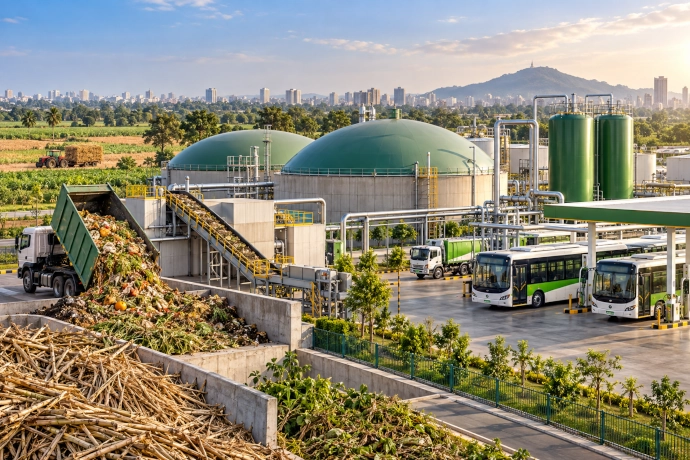
India is steadily expanding its waste-to-fuel and alternative energy programmes, with Nagpur now producing around 28 tonnes of compressed natural gas from waste every day. Union Minister for Road Transport and Highways Nitin Gadkari has highlighted the model as an example of how municipal and agricultural waste can be converted into usable fuel while reducing pollution and dependence on imported petroleum.
Speaking in Madhya Pradesh, Gadkari said thousands of similar projects are being taken up across the country as the government promotes Bio-CNG, ethanol, electric mobility and hydrogen as part of a broader shift towards cleaner transport and domestic energy production.
Nagpur Turns Waste into Transport Fuel
Nagpur has emerged as one of India’s better-known examples of waste-to-CNG conversion, where biodegradable waste is processed to produce fuel that can be used in transport.
The model addresses two problems at the same time. It reduces the burden of municipal waste while producing a domestic fuel that can substitute part of the demand for conventional fossil fuels.
The idea also fits into the government’s wider waste-to-wealth strategy, which treats organic waste as an economic resource rather than only as a disposal problem.
Thousands of Waste-to-Fuel Projects Planned Across India
Gadkari said around 4,000 similar projects are being planned or developed across the country.
These projects form part of a larger ecosystem that includes compressed biogas plants, biomethanation facilities and agricultural residue processing units. Programmes such as GOBARdhan, SATAT and Swachh Bharat Mission-Urban have encouraged the use of cattle dung, municipal waste, crop residue and other biodegradable material for fuel production.
The expansion of such projects could create a decentralised source of clean energy while reducing the amount of organic waste reaching landfills.
Farmers Could Gain a New Source of Income
One of the strongest themes in Gadkari’s alternative-fuel push is the role of farmers in the energy economy.
Agricultural waste, crop residue, cattle dung and other rural by-products can be used as feedstock for Bio-CNG, ethanol and other biofuels. This gives farmers an additional source of income beyond the sale of food crops.
The shift also changes the way agriculture is viewed within the energy system. Farmers are no longer seen only as food producers, but increasingly as potential suppliers of raw material for fuel production.
Ethanol Expansion Has Created New Demand for Maize
Gadkari also pointed to the expansion of ethanol production as an example of how alternative fuels can create new agricultural demand.
He said maize prices had risen from around ₹1,200 per quintal to ₹2,600 per quintal as ethanol production expanded and created another market for the crop.
The broader ethanol programme has been designed to reduce petrol consumption, increase domestic fuel production and strengthen linkages between agriculture and energy.
India has also been encouraging flex-fuel vehicles, which are capable of operating on higher ethanol blends and can reduce dependence on conventional petrol.
Reducing India’s Petroleum Import Dependence
India’s high petroleum import bill remains one of the central arguments behind the push for alternative fuels.
Gadkari has said the country spends around ₹22 lakh crore on petroleum imports, underlining the scale of India’s dependence on foreign crude oil and fuel supplies.
Greater use of Bio-CNG, ethanol, electric vehicles and hydrogen can reduce part of that dependence while retaining more energy-related expenditure within the domestic economy.
The policy direction is therefore not limited to environmental goals. It also includes energy security, rural income, industrial development and foreign-exchange savings.
Hydrogen and Electric Mobility Form Part of the Same Transition
Alongside Bio-CNG and ethanol, the government is also supporting hydrogen-powered vehicles and electric mobility.
Gadkari has repeatedly referred to hydrogen as a potential future transport fuel, especially for heavy vehicles and long-distance mobility. Hydrogen fuel-cell vehicles are already being tested in India, while buses and other commercial platforms are being examined for future deployment.
Electric mobility is developing in parallel, particularly in public transport and urban mobility, where lower operating costs and reduced local emissions can provide immediate benefits.
Madhya Pradesh Plans Hydrogen Buses
During the programme, Gadkari also referred to plans for hydrogen-powered buses on 10 routes in Madhya Pradesh.
The state’s new public transport initiative is intended to improve affordability, safety and service quality while reducing dependence on diesel-based mobility.
The government is also looking at cleaner vehicle technologies that can reduce pollution without making public transport more expensive for passengers.
Public Transport Standards Are Being Tightened
Gadkari said the government is strengthening bus safety and quality standards, including stricter testing before registration.
Design standards are also being improved to make buses easier to use for senior citizens and persons with disabilities.
The broader objective is to make public transport safer, cleaner and more attractive so that more passengers shift away from private vehicles.
Vehicle Scrapping and Driver Training Support the Wider Reform
The government is also expanding the network of vehicle scrapping centres and automated testing facilities as part of its transport reform programme.
Older vehicles, particularly those with poor emissions and safety performance, are being progressively removed from the road under the vehicle scrappage policy.
Gadkari also referred to the shortage of trained drivers and said 32 driving centres have been established in Madhya Pradesh to improve driver availability and road safety.
Waste-to-CNG Becomes Part of India’s Energy Strategy
Nagpur’s production of 28 tonnes of CNG from waste every day shows how waste management can be integrated with transport and energy policy.
The larger national programme is now bringing together municipal waste, agricultural residue, ethanol, Bio-CNG, hydrogen and electric mobility rather than depending on a single alternative-fuel solution.
The economic logic is equally important. Waste can become fuel, farmers can gain new income streams, cities can reduce landfill pressure and India can gradually reduce part of its petroleum import dependence.
Nagpur’s model therefore represents more than a municipal waste project. It reflects a broader transition in which waste, agriculture and clean transport are increasingly being connected within India’s domestic energy economy.
References
Ministry of Road Transport and Highways, Government of India — Official statements and speeches by Union Minister Nitin Gadkari on waste-to-fuel, Bio-CNG and alternative transport fuels.
Press Information Bureau, Government of India — Official releases on Nagpur Bio-CNG projects and waste-to-wealth initiatives.
Department of Drinking Water and Sanitation, Ministry of Jal Shakti — GOBARdhan programme and national biogas/CBG project data.
Ministry of Petroleum and Natural Gas, Government of India — SATAT, ethanol blending and alternative fuel initiatives.
Ministry of New and Renewable Energy, Government of India — Hydrogen mobility and clean-energy programmes.
Government of Madhya Pradesh — Official information on public transport expansion, hydrogen bus plans and driving training centres.
You may also like
-
India’s Defence Shipyards Build Common Indigenous Supply Chain for Specialised Naval Cables
-
Maruti Suzuki Commissions 300 kW Green Hydrogen Plant at Manesar to Cut Manufacturing Emissions
-
India Could Reach ₹50,000 Crore Defence Export Target by 2028 as Missile and Artillery Demand Rises
-
GI-Tagged Gulbarga Tur Dal Reaches Maldives, Giving Karnataka Farmers a Higher-Value Export Market
-
TDB Backs Agnikul Cosmos With ₹200 Crore to Develop Fully Reusable Agnibaan Launch Vehicle
