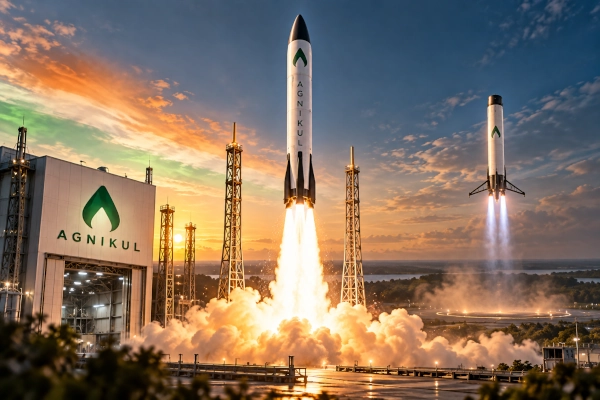
India’s private space sector has received a major boost with the Technology Development Board (TDB) under the Department of Science & Technology (DST) signing an agreement with Agnikul Cosmos Private Limited for ₹200 crore in financial support to develop a fully reusable Agnibaan launch vehicle.
The support is being extended under the Research Development and Innovation Fund, with the programme aimed at advancing Agnikul’s reusable launch vehicle technology from Technology Readiness Level 4 and above towards TRL-8. The project represents a significant step in India’s effort to build indigenous reusable space transportation systems capable of reducing launch costs and increasing launch frequency.
Agnibaan RLV to Target Full-System Reusability
The new project focuses on the development of the Agnibaan Reusable Launch Vehicle, or Agnibaan RLV, with an architecture designed to move beyond conventional reusable launch systems that recover only the first stage.
Agnikul’s approach is intended to support full-system reusability, combining reusable propulsion, ascent, orbital insertion, descent and recovery technologies within a single launch architecture.
The broader objective is to enable high-frequency, repeatable access to space while reducing both manufacturing costs and the need to discard major vehicle components after each mission. Greater reusability could also help reduce the generation of space debris associated with expendable launch systems.
₹200 Crore Support Through Optionally Convertible Debentures
The ₹200 crore RDI support will be provided through Optionally Convertible Debentures, giving the programme long-term financial backing as it progresses through higher technology readiness levels.
The RDI Fund is intended to support advanced indigenous technologies that require sustained investment before they can reach operational deployment. In Agnikul’s case, the funding is expected to support the development and validation of technologies needed for a reusable orbital launch system.
The project falls within the RDI Fund’s priority area covering advanced and reusable launch vehicles and propulsion technologies.
Semi-Cryogenic Propulsion at the Core of the Vehicle
A key element of the Agnibaan RLV programme is its semi-cryogenic liquid propulsion system, which is being developed with capabilities such as deep throttling and engine restart.
These capabilities are particularly important for reusable launch vehicles because an engine used during ascent may also need to restart during descent, reduce thrust precisely and support controlled recovery operations.
Deep throttling allows the engine to operate across a wide range of thrust levels, while restart capability enables multiple ignition cycles during a single mission. Together, these technologies can support more precise control during orbital insertion, descent and landing.
Lightweight Upper Stage and Precise Orbital Insertion
The proposed launch architecture also includes a lightweight upper stage and systems designed for precise orbital insertion.
Reducing upper-stage mass can improve payload efficiency, while precision guidance and orbital insertion systems can increase mission flexibility. Agnikul’s design seeks to integrate these capabilities with reusable propulsion and recovery systems rather than treating each stage as a separate expendable component.
The company is therefore moving towards a launch vehicle architecture built around repeatability, recoverability and operational efficiency from the outset.
Controlled Descent and Recovery Form a Major Technology Challenge
The Agnibaan RLV development programme includes work on a reusable upper-stage architecture and descent propulsion system.
Controlled descent requires the vehicle to survive atmospheric re-entry or return trajectories while maintaining stability, managing thermal and aerodynamic loads and executing precise propulsion manoeuvres. Recovery also requires guidance, navigation and control systems capable of bringing the vehicle safely back from high velocity.
The programme will therefore require the integration of propulsion, vehicle design, guidance, recovery systems and mission operations into a highly coordinated reusable platform.
Agnikul Builds on Earlier Agnibaan and Agnilet Development
The new programme builds on technologies that Agnikul Cosmos has already developed through its earlier launch-vehicle and propulsion programmes.
The company has developed Agnibaan, its configurable orbital-class launch vehicle designed primarily for small-satellite missions, along with the Agnilet engine, an indigenous single-piece 3D-printed rocket engine developed and manufactured in-house.
Agnikul’s use of additive manufacturing has been one of the distinctive elements of its propulsion programme. Single-piece engine manufacturing can reduce the number of joints and components while potentially simplifying production and shortening manufacturing cycles.
TDB had previously supported Agnikul in the development and commercialisation of its modular launch vehicle for small-satellite missions. The latest programme expands that partnership into the more demanding field of reusable launch technology.
From Launch Vehicle Development to Reusable Space Transportation
The new RDI-backed programme marks an important transition in Agnikul’s technology roadmap.
Rather than focusing only on reaching orbit, the company is now working towards a launch system that can potentially return, recover and fly again.
Such a capability could fundamentally alter the economics of small-satellite launch services. Conventional launch vehicles require substantial reconstruction or replacement after each flight, while reusable systems aim to distribute hardware costs across multiple missions.
If successfully developed and operationalised, reusable launch vehicles could support faster turnaround times and more frequent launch schedules for commercial, scientific and strategic missions.
India Expands Investment in Reusable Launch Technologies
Reusable launch vehicles are becoming an important technological frontier in the global space industry because they offer the possibility of reducing the cost of placing satellites and other payloads into orbit.
India is pursuing reusable technologies through both government programmes and private-sector initiatives. The Agnibaan RLV programme adds a significant private-space component to this broader effort.
According to TDB Secretary Rajesh Kumar Pathak, the next phase of India’s space development will require technologies capable of reaching orbit with greater frequency, flexibility and efficiency. He described reusability as an important technological frontier and said the RDI Fund is intended to support ambitious indigenous technologies as they move towards deployment.
A Major Step for India’s Private Space Ecosystem
The ₹200 crore agreement signals increasing institutional support for Indian private companies working on complex launch vehicle, propulsion and space transportation technologies.
For Agnikul, the programme represents a shift from demonstrating individual technologies towards building an integrated reusable launch platform capable of repeated missions.
The company’s promoters have emphasised that reusability requires the integration of propulsion systems, vehicle architecture, guidance, recovery and mission operations into a highly reliable system. The new support is expected to help advance these technologies towards operational maturity.
If the project progresses successfully from TRL-4 and above to TRL-8, Agnikul could move significantly closer to developing an operational reusable launch system made in India.
The programme also reflects the wider evolution of India’s private space sector, where companies are increasingly moving beyond components and experimental systems towards complete platforms capable of addressing the global launch market.
References
Press Information Bureau, Department of Science & Technology, Government of India — “TDB-DST signs agreement with Agnikul Cosmos for ₹200 crore RDI support to develop fully reusable Agnibaan launch vehicle,” published September 25, 2026.
Technology Development Board, Department of Science & Technology, Government of India.
Agnikul Cosmos Private Limited.
You may also like
-
Maruti Suzuki Commissions 300 kW Green Hydrogen Plant at Manesar to Cut Manufacturing Emissions
-
Nagpur Produces 28 Tonnes of CNG Daily from Waste as India Expands Waste-to-Fuel Projects
-
India Could Reach ₹50,000 Crore Defence Export Target by 2028 as Missile and Artillery Demand Rises
-
GI-Tagged Gulbarga Tur Dal Reaches Maldives, Giving Karnataka Farmers a Higher-Value Export Market
-
70,000 Rural Youth to Begin Skill Training Under DDU-GKY 2.0 Across India From October 2026
