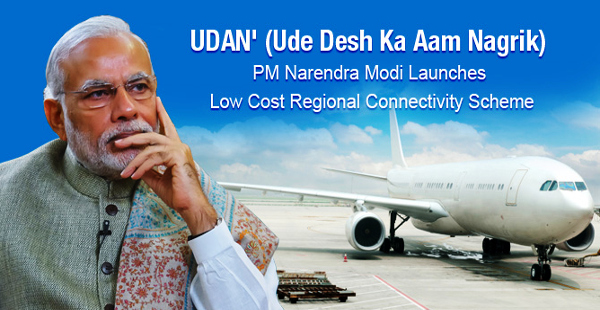
India’s next phase of regional aviation expansion has moved into implementation, with the Ministry of Civil Aviation signing 21 Memoranda of Understanding with participating States and Union Territories under the Modified UDAN scheme. The agreements bring the Centre, State and Union Territory administrations and the Airports Authority of India together under a structured framework for identifying, developing and operationalising aviation infrastructure according to regional connectivity requirements.
The agreements were signed at an event in New Delhi on September 22, 2026, where Civil Aviation Minister Kinjarapu Ram Mohan Naidu also launched the Challenge Mode Portal for Aerodrome Development and released the Scheme Document for the next phase of UDAN route bidding. The Ministry described the developments as the transition of the new UDAN phase from policy consultations towards implementation on the ground.
Modified UDAN Begins Its Next Implementation Stage
The present expansion follows the Union Cabinet’s approval of the Regional Connectivity Scheme – Modified UDAN in March 2026. The scheme will operate for ten years from FY 2026-27 to FY 2035-36 and carries a total outlay of ₹28,840 crore with budgetary support from the Government of India.
Modified UDAN was formally launched by Prime Minister Narendra Modi at Jodhpur on July 4, 2026. This was followed by a stakeholder workshop organised by the Ministry of Civil Aviation at Vigyan Bhawan on July 16, where airlines, airport operators, State governments and other aviation stakeholders discussed the implementation framework for the expanded programme.
According to the Civil Aviation Ministry, the modified programme rests on four principal areas: maintaining affordable air travel, improving the sustainability of regional operations, introducing a transparent Challenge Mode framework for infrastructure projects and supporting indigenous aviation manufacturing.
The next stage will concentrate on stronger cooperation between the Centre and States or Union Territories, creation and upgrading of aviation infrastructure, and expansion of regional air services into areas that remain unserved or underserved.
21 MoUs Establish Centre-State Framework for Regional Aviation
The 21 MoUs have been signed between the Ministry of Civil Aviation, participating States and Union Territories and the Airports Authority of India, which serves as the implementing agency for UDAN.
Rather than treating regional airport development exclusively as a centrally identified programme, the new framework gives States and Union Territories a greater role in identifying locations where aviation connectivity is required. The participating governments can work with the Centre and AAI to identify aviation assets, determine development priorities and move suitable projects towards operationalisation.
The Ministry expects this coordinated approach to align aviation infrastructure more closely with regional requirements, particularly in locations where conventional commercial aviation has not yet developed sufficiently to support regular services.
Challenge Mode Allows States to Nominate Airstrips and Helipads
One of the important changes introduced with the latest phase is the Challenge Mode for aerodrome development. Through the newly launched dedicated portal, State governments and Union Territory administrations will be able to nominate airstrips and helipads that they consider suitable for development under Modified UDAN.
This gives local administrations a direct mechanism to identify locations with potential demand for aviation services. Projects selected through the framework can involve the creation of new infrastructure or upgrading existing facilities according to local connectivity requirements.
Challenge Mode therefore connects regional infrastructure planning with the wider objectives of UDAN instead of relying entirely on a centrally determined list of projects. The approach is particularly relevant for remote, hilly, island and aspirational regions where conventional airport development may not always provide the most appropriate connectivity solution.
100 Airports and 200 Modern Helipads Planned
The scale of Modified UDAN is considerably larger than the infrastructure programme associated with the original scheme. Under the Cabinet-approved framework, the government proposes to develop 100 airports from existing unserved airstrips, with ₹12,159 crore allocated for this component over eight years.
Another major component is the development of 200 modern helipads, particularly in hilly, remote, island and aspirational regions. The government has estimated a requirement of ₹3,661 crore for this programme, with the helipads intended to improve last-mile connectivity as well as emergency response capabilities.
The scheme also provides support for the operation and maintenance of regional aviation infrastructure. Regional Connectivity Scheme-only aerodromes often have limited commercial revenue while facing substantial recurring costs. Modified UDAN therefore provides three years of operation and maintenance assistance, capped at ₹3.06 crore annually for an airport and ₹90 lakh annually for a heliport or water aerodrome.
Around ₹2,577 crore has been provided for operation and maintenance support covering approximately 441 aerodromes.
120 New Destinations and Four Crore Additional Passengers Targeted
The government expects the expanded programme to extend regional aviation to 120 new destinations and facilitate travel by another four crore passengers over the next ten years.
The programme builds on the network created since UDAN was introduced in 2016. According to figures released by the Civil Aviation Ministry on September 22, UDAN has now operationalised 687 routes and 95 aerodromes. More than 3.66 lakh flights have operated under the programme, carrying approximately 1.71 crore passengers.
The government sees the next phase as an opportunity to take regional connectivity further into locations where commercial air services remain limited. Airports such as Tezu in Arunachal Pradesh and Purnea in Bihar were cited by the Civil Aviation Minister as examples of locations where improved aviation access can contribute to regional economic activity.
Airlines to Compete for New UDAN Routes
Infrastructure development will be accompanied by a new route-bidding process. Airlines will be invited to compete for identified UDAN routes, allowing routes and operators to be selected through a transparent and competitive mechanism.
The government intends the process to bring additional services to unserved and underserved regions while improving accessibility and mobility. Better regional aviation links are also expected to support tourism, trade, employment and economic activity in areas that previously lacked convenient air connections.
Modified UDAN retains Viability Gap Funding as an important mechanism for supporting regional airline operations. The Cabinet-approved scheme provides ₹10,043 crore in VGF support over ten years, recognising that many new regional routes require financial assistance while passenger markets develop.
Indigenous Aircraft Become Part of the Regional Connectivity Strategy
Modified UDAN also introduces an indigenous aircraft component into the regional connectivity programme. The government has approved the acquisition of two HAL Dhruv helicopters for Pawan Hans and two HAL Dornier aircraft for Alliance Air.
The measure is intended to address the shortage of smaller aircraft and helicopters suitable for operating in remote and difficult terrain while simultaneously supporting domestic aerospace manufacturing.
The Civil Aviation Ministry has linked this element of Modified UDAN with the broader objective of developing an ecosystem capable of eventually supporting Made-in-India civil aircraft. Indigenous manufacturing has consequently been incorporated as one of the four principal pillars of the modified programme alongside affordability, operational sustainability and the Challenge Mode infrastructure framework.
UDAN Shifts From Route Expansion to a Wider Regional Aviation Ecosystem
The original UDAN programme, launched in October 2016, concentrated on making air travel affordable while connecting Tier-II, Tier-III and previously underserved locations. The next phase substantially expands that model by combining airport and helipad development, operational support, airline subsidies, competitive route allocation and indigenous aircraft procurement within a single regional aviation framework.
The signing of MoUs with 21 States and Union Territories is therefore more than another round of route expansion. It establishes a mechanism through which regional governments can identify their own aviation priorities and work with the Centre and AAI to develop the necessary infrastructure.
With the Challenge Mode Portal now operational and the next route-bidding framework released, Modified UDAN has entered the stage where the ₹28,840-crore programme begins moving from its approved policy framework towards individual airports, helipads and air routes across the country.
References
Press Information Bureau, Ministry of Civil Aviation — Civil Aviation Minister Ram Mohan Naidu launches Challenge Mode for Aerodrome Development: Next Phase of UDAN Takes Off with MoUs Signed with 21 States/UTs, 22 September 2026, Release ID 2313612.
Press Information Bureau, Cabinet — Cabinet approves Regional Connectivity Scheme – Modified UDAN with a total outlay of Rs. 28,840 crore, 25 March 2026, Release ID 2245099.
Press Information Bureau, Ministry of Civil Aviation — Civil Aviation Minister Ram Mohan Naidu inaugurates stakeholder workshop on Modified UDAN, 16 July 2026, Release ID 2285420.
You may also like
-
INOX India Enters Semiconductor Fab Infrastructure With First Orbital-Welding Order
-
Raymond Enters Aircraft Structures Manufacturing Through Indigenous Fighter Aircraft Programme
-
From Sea to Fuel: How Indian Startups Are Building the Foundations of a Seaweed Bioenergy Industry
-
Prostarm Builds 1.2 GWh BESS Manufacturing Base in Haryana as Indian Grid-Storage Orders Expand
-
Hughes Precision Raises ₹250+ Crore to Expand Ammunition Manufacturing, Enters Medium-Calibre Segment
