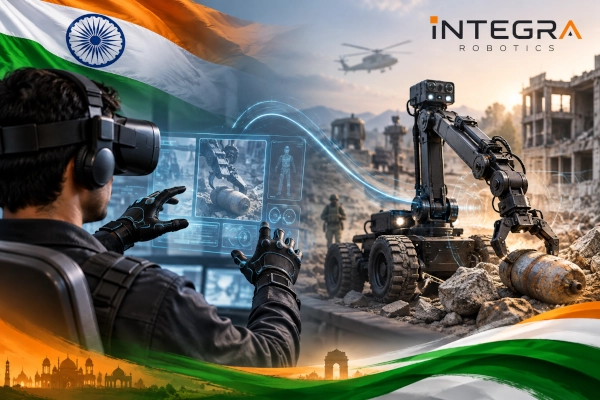
Bengaluru-based deep-tech company Integra Robotics, formerly known as Social Hardware, has secured an Indian patent for an immersive robotic teleoperation system designed to allow humans to remotely control robotic platforms while remaining physically separated from hazardous environments.
The company has confirmed the grant of Indian Patent No. IN597459 B1, titled “A System and a Method for Manipulation of a Robotic Platform.” The patented architecture combines virtual-reality visualisation, human-motion tracking, robotic manipulation and electronic feedback to reproduce an operator’s movements on a remotely located robotic system. The technology has potential applications across defence, hazardous industrial operations, inspection, emergency response and other environments where direct human presence may involve significant risk.
Human Movements Translated Into Robotic Actions
At the centre of the patented system is a teleoperation architecture that enables a human operator to control a robot through natural body movements rather than depending entirely on conventional joysticks and control panels.
According to Integra Robotics, the system can track movements involving the operator’s hands, arms, head, neck and spine. Its Bio-Inverse Kinematics architecture then translates these movements into corresponding commands for the robotic platform, allowing robotic manipulators to reproduce the operator’s intended actions at a remote location.
The approach retains human judgement and dexterity while separating the operator from the physical environment in which the robot is working. This becomes particularly useful when a task is too complex for full automation but too dangerous for direct human intervention.
Virtual Reality Creates an Immersive Remote Workspace
Virtual reality forms another important component of the technology. Cameras and sensing systems installed on the robotic platform provide the operator with visual information from the remote environment, including depth information needed to judge the location and distance of surrounding objects.
Instead of controlling a robot solely by watching conventional video feeds on a monitor, the operator can use an immersive visual interface that more closely represents the robot’s working environment.
The patented architecture brings together a VR headset, motion sensors, processing systems, communications equipment and robotic manipulators. These components operate as an integrated system in which human movement is captured, interpreted and transmitted to the remotely located machine.
Gesture Gloves Provide Additional Control
The system also incorporates gesture-based control technology capable of detecting movements of the operator’s hands and fingers. This enables more precise manipulation than would be possible through large arm movements alone.
Electronic feedback can return information from the robotic system to the operator, creating a two-way interaction between human and machine. The operator provides movement commands while the robot sends information about its interaction with the surrounding environment.
The underlying architecture can support robotic arms, dexterous manipulation systems, mobile robotic platforms and specialised end-effectors depending on the intended application.
Designed for Hazardous Environments
One of the most important potential applications of the patented technology is handling objects in environments where direct human exposure would be dangerous.
Integra Robotics has identified ordnance disposal as one such application. A trained specialist could remain at a safer location while controlling a robotic platform positioned near a potentially hazardous object.
Similar technology could be used for industrial inspection, hazardous-material handling, disaster response, security operations and maintenance work involving dangerous machinery or environments.
The objective is not simply to replace the human operator with automation. Instead, the system physically separates the operator from the danger while preserving human decision-making and manual control.
Potential Defence Applications
The technology has clear relevance to defence and security operations because military personnel frequently encounter situations in which equipment must be inspected, handled or manipulated without exposing soldiers directly to danger.
Unmanned ground vehicles equipped with remotely operated manipulators could potentially be used for explosive-ordnance disposal, suspicious-object inspection, hazardous-material handling and operations in areas exposed to chemical, radiological or other threats.
Teleoperated robots could also assist with reconnaissance and engineering activities in environments that are difficult or dangerous for personnel to enter.
The effectiveness of such systems ultimately depends on factors including communications reliability, situational awareness, robotic dexterity, control latency and the ability of the operator to accurately understand the remote environment.
Designed to Work With Limited Communications
Integra Robotics says its teleoperation architecture has been designed with low-latency operation over relatively constrained communication networks in mind.
This is particularly relevant to field applications because high-bandwidth connectivity cannot always be guaranteed in industrial sites, disaster zones or military environments.
Even relatively small communication delays can make precise robotic manipulation difficult. Designing the control system around realistic communications limitations could therefore increase its usefulness outside controlled laboratory environments.
Indigenous Robotics Technology Developed in Bengaluru
Integra Robotics is a Bengaluru-based robotics company that traces its origins to Social Hardware, which was founded in 2017. The company subsequently adopted the Integra Robotics identity as its work expanded into integrated robotic systems, teleoperation, computer vision and embodied artificial intelligence.
Its technology development spans robotic manipulators, unmanned ground platforms, perception systems and software capable of integrating human operators with remotely deployed machines.
The company’s approach increasingly centres on developing common technologies that can be adapted across different robotic platforms rather than treating every robot as an entirely separate system.
Patent Protects a Specific Indian-Developed Architecture
The granting of IN597459 B1 does not represent a patent over the broad concept of robotic teleoperation, which has existed internationally for decades. Instead, the intellectual property covers the specific system and methods described in Integra Robotics’ patent.
The protected architecture brings together human-motion mapping, robotic execution, immersive visual information and feedback mechanisms within a remote manipulation system.
This distinction is important because advanced robotics increasingly depends on the integration of multiple technologies. Competitive advantage often comes not from inventing an individual camera, robotic arm or VR headset, but from developing a reliable architecture that allows those technologies to operate together as a complete system.
Moving Towards More Adaptable Robotic Control
Integra Robotics is also developing additional approaches intended to make teleoperation adaptable across different robotic platforms.
One direction involves translating an operator’s movements into a more general representation of the intended action before converting that intention into commands suitable for a particular robot.
Such an approach could eventually allow similar operator movements to control machines fitted with very different manipulators. A grasping action, for example, could potentially be translated differently depending on whether a robot carries a dexterous hand, industrial gripper or specialised tool.
These subsequent developments should be distinguished from the newly granted patent. Patent applications represent technologies for which protection has been sought, while IN597459 B1 represents intellectual property for which an Indian patent has been granted.
Building Indian Intellectual Property in Advanced Robotics
The patent is significant for India’s emerging robotics industry because it represents domestically developed intellectual property combining robotics, virtual reality, electronics, sensing, communications and human-machine interaction.
Remote manipulation is likely to become increasingly important in environments where human expertise remains necessary but direct physical presence is undesirable. Defence personnel could use such systems for hazardous-object handling, while industrial operators could undertake inspection or maintenance around dangerous machinery and materials. Disaster-response teams could similarly deploy remotely operated machines into areas considered unsafe for personnel.
Integra Robotics’ patented architecture follows a model in which robotics extends human capability rather than simply replacing it. Human judgement remains at the centre of the operation, while the robotic platform provides the physical reach required to enter dangerous environments.
The granting of Indian Patent IN597459 B1 gives the Bengaluru company an indigenous intellectual-property foundation as it develops this technology further for industrial and mission-critical applications.
References
Intellectual Property India — Office of the Controller General of Patents, Designs & Trade Marks — Indian patent records and Patent Journal.
Integra Robotics — Official announcement confirming Indian Patent IN597459 B1, A System and a Method for Manipulation of a Robotic Platform.
Integra Robotics — Official company information on robotic teleoperation, integrated robotics and embodied artificial intelligence.
Integra Robotics — Company technology portfolio and Bengaluru operations.
You may also like
-
India Makes BIS Standards Mandatory for Smartphone Screen Protectors From April 2027
-
Netrasemi Advances Indigenous Edge AI With 12-nm Vision and Surveillance SoC
-
Addverb Expands Beyond Warehouses as Indian Semiconductor Fabs Open New Market for Precision Robotics
-
Indian Deep-Tech Startup Hylenr Completes Phase-I Fusion Reactor Validation at Texas A&M University
-
Lohum Targets Tenfold Nickel Expansion as Indian Critical-Minerals Company Looks Overseas for Mines
