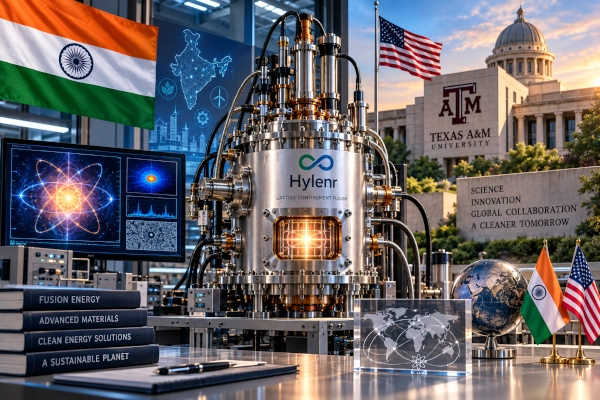
Hyderabad-based Indian deep-tech startup Hylenr has completed the first phase of an external validation programme for its Lattice Confinement Fusion (LCF) reactor technology at Texas A&M University in the United States, taking an important step from company-led development towards independent scientific evaluation.
The programme examined Hylenr’s BRT-NiUCS-2 experimental reactor using laboratory measurements covering thermal behaviour, residual gases, radiation and post-reaction material characteristics. For the Indian startup, the significance of the programme lies not simply in the experimental observations but in its decision to take an unconventional energy technology developed in India to an established overseas university laboratory for scrutiny.
Indian Fusion-Energy Startup Moves Beyond Internal Testing
Hylenr has been developing compact energy systems based on hydrogen-loaded metallic materials and lattice confinement. Rather than restricting evaluation to its own laboratories, the company has moved the BRT-NiUCS-2 into a structured external research programme involving the Department of Nuclear Engineering at Texas A&M University.
That transition is particularly relevant for an emerging Indian fusion-energy startup working in a technically challenging field. Experimental claims surrounding new nuclear-energy technologies ultimately depend on repeatability, measurement quality and independent examination. External evaluation provides an opportunity for researchers outside the company to examine the reactor, experimental methodology and observed results.
Hylenr co-founder and CEO Ram Ramaseshan has described the programme as part of the company’s effort to move beyond internal observations and generate independently examined experimental data.
BRT-NiUCS-2 Reactor Undergoes Multiple Laboratory Tests
Phase I examined Hylenr’s BRT-NiUCS-2 reactor, which uses hydrogen-loaded nickel-palladium catalyst materials. Researchers evaluated four principal areas: thermal performance, residual-gas composition, radiation signatures and changes in catalyst materials after reactor operation.
The work was subsequently presented in the study titled Validation of Anomalous Heat and Nuclear Signatures in the BRT-NiUCS-2 Reactor: Phase 1 LCF Investigation at the 27th International Conference on Condensed Matter Nuclear Science (ICCF-27), held at Niagara Falls, Canada, from 31 August to 4 September 2026.
This gives Hylenr’s technology an international research exposure extending beyond the company’s Hyderabad development programme.
Thermal Behaviour Examined Against Calibration Device
Researchers compared the thermal behaviour of the active BRT-NiUCS-2 reactor with a calibration device under comparable electrical input conditions.
According to the Phase-I findings, the active reactor operated at consistently higher temperatures than the calibration device. Thermocouples and calibrated infrared imaging were among the techniques used to examine its thermal behaviour.
The observation does not by itself demonstrate that fusion produced the additional heat. More precise calorimetry and repeated experiments are required to establish the magnitude, consistency and physical origin of any excess thermal output.
That requirement is expected to form an important part of the next stage of Hylenr’s external validation programme.
Elevated Helium, Argon and Neon Signals Reported
The researchers also conducted Residual Gas Analysis under high-vacuum conditions using an SRS RGA 100 system.
The active reactor reportedly produced elevated helium, argon and neon signals compared with background measurements. Helium and argon signals were reported at approximately two to three orders of magnitude above background levels.
Researchers did not observe a corresponding increase in nitrogen, an observation used in the study when considering whether ordinary atmospheric leakage could account for the gas measurements.
The presence of these gases does not independently establish a nuclear reaction. Determining their origin and establishing whether the observations can be reproduced consistently will require further controlled experiments and isotopic analysis.
Catalyst Materials Examined After Reactor Operation
The nickel-palladium catalyst materials were also examined after the experiments using Scanning Electron Microscopy (SEM) and Energy-Dispersive X-ray Spectroscopy (EDS).
Researchers reported morphological and compositional changes in the materials following reactor operation. These observations provide another set of experimental data that can be compared across future reactor runs.
Material analysis is expected to become more detailed during subsequent testing as researchers investigate whether any observed changes repeatedly correspond with the reactor’s thermal and gas measurements.
No Detectable Gamma or X-Ray Emissions
Radiation monitoring produced an important negative result. Geiger-Müller and neutron detectors recorded no detectable gamma or X-ray emissions associated with reactor operation.
Neutron measurements conducted over approximately five days also remained statistically indistinguishable from background levels.
The combination of reported thermal, gas and material observations without corresponding conventional radiation signatures leaves the underlying mechanism requiring considerably more investigation. The Phase-I programme therefore represents an initial experimental assessment rather than confirmation of a commercially viable fusion process.
Texas A&M Evaluation Opens the Door to Phase II
The next stage will place considerably greater emphasis on reproducibility and quantitative measurement.
Hylenr’s Phase-II programme is expected to involve multiple independent reactors, allowing researchers to determine whether observations made with one experimental unit can be reproduced across separate systems.
More rigorous quantitative calorimetry is planned to measure thermal output, while hydrogen-loading conditions will be investigated in greater detail. Researchers also intend to introduce isotopic-ratio measurements and analytical techniques including Secondary Ion Mass Spectrometry (SIMS) and Inductively Coupled Plasma Mass Spectrometry (ICP-MS).
Reproducing the same measurable effects across independently operated reactors would provide substantially stronger experimental evidence than observations from a single reactor configuration.
Hyderabad Startup Takes Indian Deep Tech to an International Laboratory
Hylenr’s decision to seek external evaluation is an important part of the company’s development trajectory. India has an expanding deep-tech startup ecosystem across semiconductors, space technology, artificial intelligence, advanced materials, robotics, quantum technologies and clean energy. Fusion and advanced nuclear-energy technologies remain a much smaller and scientifically demanding segment of that ecosystem.
Hylenr is attempting to enter this field with an India-developed compact reactor platform rather than limiting itself to conventional energy technologies.
Taking the BRT-NiUCS-2 to Texas A&M University also exposes the technology to laboratory infrastructure, nuclear-engineering expertise and experimental procedures outside the startup’s own organisation. For an early-stage deep-tech company, such external evaluation can provide data needed to refine both the technology and the experimental methodology.
The company will still need to demonstrate repeatability, independently measurable excess energy, reliable calorimetry and a scientifically supported explanation for the observed phenomena before the technology can progress towards claims of practical fusion-energy generation.
From Indian Prototype to Independent Scientific Scrutiny
The completion of Phase I therefore represents a different kind of milestone from a prototype unveiling or laboratory demonstration.
An Indian deep-tech startup has taken its experimental fusion reactor outside its own facilities and placed it within an international university research environment for evaluation. The first phase has generated thermal, gas and material observations that now provide targets for more rigorous testing.
The more consequential stage will be Phase II. Multiple reactor units, quantitative calorimetry, isotopic measurements and expanded materials analysis should provide a stronger test of whether the Phase-I observations are reproducible.
For Hylenr, success will ultimately depend not on individual experimental anomalies but on whether independent researchers can repeatedly measure and verify the same physical effects. By taking its Indian-developed Lattice Confinement Fusion technology into an external evaluation programme, the Hyderabad startup has begun that process.
References
Hylenr — Hylenr Completes Phase 1 LCF Reactor Validation at Texas A&M University, September 2026.
Hylenr and Texas A&M University — Validation of Anomalous Heat and Nuclear Signatures in the BRT-NiUCS-2 Reactor: Phase 1 LCF Investigation.
ICCF-27 — 27th International Conference on Condensed Matter Nuclear Science, Niagara Falls, Canada, 31 August–4 September 2026.
Hylenr — BRT-NiUCS reactor and Lattice Confinement Fusion technology documentation.
You may also like
-
Addverb Expands Beyond Warehouses as Indian Semiconductor Fabs Open New Market for Precision Robotics
-
Integra Robotics Secures Indian Patent for VR-Controlled Remote Robotic Manipulation Technology
-
Lohum Targets Tenfold Nickel Expansion as Indian Critical-Minerals Company Looks Overseas for Mines
-
Engineers India Secures Over $450-Million Dangote Contract for 700,000-BPD Kenya Refinery
-
NTPC Renewable Energy Adds 56.7 MW of New Wind Power Capacity in Gujarat
