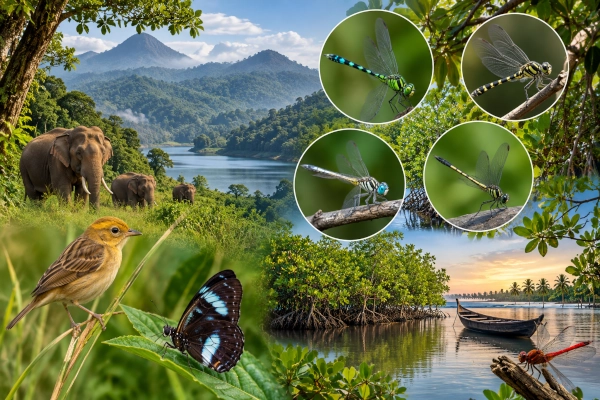
Two biodiversity studies released in September 2026 have added fresh detail to Kerala’s wildlife record, from the mountain forests and grasslands of the Periyar Tiger Reserve to the mangrove-lined estuary of Thuruthi in Kannur.
A four-day faunal survey in Periyar Tiger Reserve recorded six species never previously documented within the reserve, including a bird, a butterfly and four species of dragonflies and damselflies. Farther north, fieldwork associated with the Wildlife Trust of India’s Kannur Kandal Project documented 12 odonate species around the mangroves, freshwater pockets and brackish waters of Thuruthi.
Together, the observations cover two very different Kerala landscapes. Periyar represents the forested and high-elevation ecosystems of the southern Western Ghats, while Thuruthi lies within a tidal coastal system shaped by the Perumba River, mangroves and the meeting of fresh and saline water.
Six New Wildlife Records From Periyar Tiger Reserve
The Periyar survey was conducted over four days with teams examining birds, butterflies, odonates and several other groups across the reserve. The exercise involved 75 participants representing 21 NGOs, academic and research institutions, together with Forest Department officials and frontline personnel.
Among the most notable observations was the Golden-headed Cisticola (Cisticola exilis), which had not previously been recorded from Periyar Tiger Reserve. The small grassland bird is associated with open grassy habitats and has a scattered distribution in India.
Researchers documented 174 bird species during the survey. With the addition of the Golden-headed Cisticola, the cumulative bird checklist for Periyar Tiger Reserve has increased to 347 species.
The observation is particularly interesting because Periyar encompasses a considerable elevational range and a mosaic of evergreen forests, grasslands and transitional habitats. Kalesh Sadasivan of the Travancore Nature History Society noted that the Golden-headed Cisticola is a rare species generally associated with higher elevations.
Common Onyx Added to Periyar’s Butterfly List
The survey also produced a new butterfly record for the reserve — the Common Onyx (Horaga onyx).
Researchers recorded 192 butterfly species during the four-day exercise, while the addition of the Common Onyx increased Periyar Tiger Reserve’s cumulative butterfly checklist to 284 species.
The butterfly belongs to the Lycaenidae family, a large group that includes blues, hairstreaks and related butterflies. Its detection demonstrates how repeated surveys can continue to expand the known species inventory even within a protected landscape that has been studied for decades.
Four New Dragonfly and Damselfly Records
Odonates produced the largest number of new additions at Periyar. Four species were documented within the reserve for the first time: the Parakeet Darner (Gynacantha millardi), Fraser’s Clubtail (Acrogomphus fraseri), Spiny Horntail (Burmagomphus chaukulensis) and Nilgiri Clawtail (Lamelligomphus nilgiriensis).
A total of 68 odonate species were recorded during the survey. With the four additions, the consolidated checklist of dragonflies and damselflies known from Periyar Tiger Reserve has reached 111 species.
Several of these insects depend closely on particular freshwater environments during their larval stages. Streams, forest pools, clean water, riparian vegetation and undisturbed aquatic microhabitats therefore influence which species can survive within a landscape.
Researchers associated with the survey linked Periyar’s continuing additions to its relatively healthy aquatic ecosystems and variety of habitats. Regular surveys conducted over the past decade have continued to add species to the reserve’s known fauna.
Survey Extends Beyond Birds and Insects
The Periyar exercise was broader than the six newly recorded species. Teams documented 15 mammal species, 30 spider species, 34 ant species and five cicada species, in addition to the extensive bird, butterfly and odonate observations.
Such composite surveys provide a wider picture of a protected area’s biodiversity than assessments centred only on large mammals. Periyar is best known publicly for elephants, tigers and other large wildlife, but much of the reserve’s biological diversity lies among insects, arachnids, birds and smaller organisms occupying specialised habitats.
The findings also give reserve managers updated baseline information that can be compared with subsequent surveys to identify changes in distribution, habitat use and species composition.
12 Odonate Species Documented at Thuruthi
While researchers were documenting forest and freshwater species at Periyar, another study was examining dragonflies and damselflies in a dramatically different environment in northern Kerala.
At Thuruthi in Kannur, fieldwork undertaken through the Wildlife Trust of India’s Kannur Kandal Project documented 12 species of Odonata within a landscape where the Perumba River slows before meeting brackish coastal waters.
Thuruthi contains a mixture of mangroves, estuarine channels, freshwater runoff, shallow water and surrounding vegetation. These overlapping habitats create small ecological niches suitable for dragonflies and damselflies despite the tidal and saline influence of the larger estuarine system.
The field study involved repeated observations with students, with visits undertaken in the morning and evening. Researchers spent approximately one and a half hours on each field visit observing the insects and the habitats in which they occurred.
Mangroves, Fresh Water and Dragonflies
The Thuruthi observations are closely connected to the structure of the wetland itself. Mangrove roots stabilise shallow margins, vegetation provides hunting and resting sites, while freshwater pockets and runoff channels provide aquatic environments used during the immature stages of different odonate species.
Among the species photographed and highlighted during the study were the Little Bloodtail (Lyriothemis acigastra), Common Picture Wing (Rhyothemis variegata) and Green Marsh Hawk (Orthetrum sabina).
The study did not present the 12 species as newly discovered species or necessarily as new records for Kerala. Instead, it represents a systematic documentation of the odonate community occupying the Thuruthi wetland. That distinction separates it from the Periyar findings, where four odonates were explicitly recorded within the tiger reserve for the first time.
Dragonflies as Indicators of Wetland Conditions
Dragonflies and damselflies spend an important part of their life cycle in water. Their larvae develop in aquatic habitats before emerging and transforming into the familiar winged adults seen around rivers, ponds, streams, marshes and wetlands.
Different species tolerate different combinations of water quality, vegetation, flow, temperature and habitat disturbance. Changes in an odonate community can consequently provide information about changes taking place within an aquatic ecosystem.
At Thuruthi, the presence of 12 documented species across the mangrove-estuarine landscape provides a baseline from which future observations can examine whether the community remains stable or changes as the wetland responds to human activity and environmental pressures.
Periyar provides the same principle on a much larger scale. The reserve’s 111 documented odonate species, including the four latest additions, reflect the diversity of streams, forest waterways and other aquatic habitats found across its elevational gradient.
Kerala’s Odonate Diversity Extends Across Very Different Landscapes
Kerala occupies an unusually varied geographical strip between the Western Ghats and the Arabian Sea. Over relatively short distances, habitats change from high-elevation grasslands and evergreen forests to rivers, lowland wetlands, mangroves and estuaries.
The state’s dragonfly and damselfly diversity reflects this variation. Scientific assessments have documented a particularly rich odonate fauna in Kerala and the wider Western Ghats, including numerous species restricted to the mountain chain.
The latest observations demonstrate that this diversity is not confined to protected forests. Periyar’s newly recorded species were found inside one of Kerala’s most important protected landscapes, whereas the Thuruthi observations come from a coastal wetland where mangrove conservation and community-based biodiversity work have continued for years.
From Onathumpi to Modern Biodiversity Surveys
The Wildlife Trust of India’s Thuruthi account also records the deep cultural association between dragonflies and Kerala’s landscape. The migratory Globe Skimmer is traditionally known as Onathumpi, its appearance around the monsoon and harvest period becoming intertwined with local observations of seasonal change and Onam folklore.
Older agricultural communities watched insects, birds, clouds and winds as environmental signals long before modern forecasting became readily available. The appearance of large numbers of dragonflies consequently entered local memory alongside their ecological presence in fields and wetlands.
Modern biodiversity surveys give those observations a scientific framework. Species identification, repeated field counts and habitat documentation can turn the presence or disappearance of these insects into measurable information about environmental conditions.
The September findings from Periyar and Thuruthi capture both ends of that relationship. In the Western Ghats, systematic surveying has expanded Periyar’s known wildlife inventory with six previously undocumented species. On Kerala’s northern coast, close observation of a mangrove wetland has documented a community of 12 dragonfly and damselfly species living where river, freshwater runoff, mangroves and the sea meet.
References
Wildlife Trust of India — Wings over Water: Unveiling the Odonates of Thuruthi, Vimal Lakshmanan N. V., Kannur Kandal Project, 22 September 2026.
Periyar Tiger Reserve / Kerala Forest Department — Four-day faunal survey of Periyar Tiger Reserve, September 2026.
Travancore Nature History Society — Scientific participation and observations from the Periyar Tiger Reserve faunal survey.
Society for Odonate Studies — List of Odonates of Kerala, updated checklist and taxonomic resources.
The Hindu — Survey discovers six new species from Periyar Tiger Reserve in Kerala, 22 September 2026.
You may also like
-
Delhi Biodiversity Survey Records Two Dragonfly and Damselfly Species for the First Time
-
Rare Leafless Orchid Gastrodia keyiensis Discovered in Arunachal Pradesh’s Keyi Valley
-
Indian Grey Hornbill Returns to Gir After Six Decades, Marking a Major Conservation Success
-
Indian Scientists Discover New Deep-Sea Conger Eel 300 Metres Below Arabian Sea Off Kerala
-
Black-Headed Ibis Flock Turns Tirunavaya Paddy Fields Into a Spectacular Bird Haven
