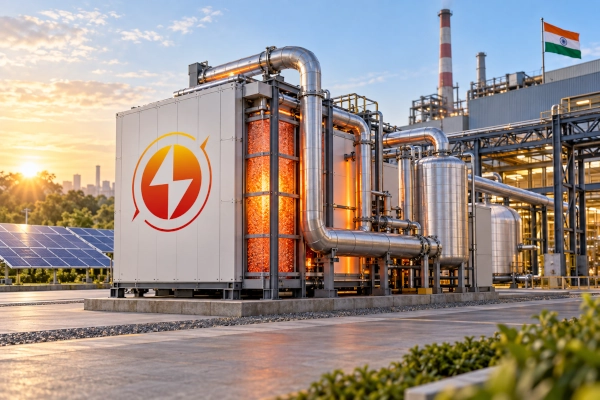
A Bengaluru-based deep-tech startup incubated at the Indian Institute of Science is developing a different kind of battery for one of the hardest parts of the energy transition: industrial heat.
Voltanova Energy is building thermal energy storage systems that store renewable electricity as high-temperature heat and deliver that heat when factories need it. Instead of relying on conventional electrochemical batteries to supply electricity alone, the company is targeting industrial processes that consume large quantities of coal, gas, furnace oil and biomass simply to generate heat.
The approach addresses a major gap in industrial decarbonisation. Steel, cement, textiles, chemicals, paper, food processing and other industries require reliable heat for many hours every day, including at times when solar and wind power are not available. Voltanova’s system is designed to absorb renewable electricity when it is available, store the energy thermally and discharge it later as usable industrial heat.
From Laboratory Work to Commercial Deployment
Voltanova is no longer operating only at the research stage. The company has moved towards commercial deployment and has reported more than ₹50 crore in order interest for its Thermal Battery Energy Storage System.
In March 2025, the company announced that it was preparing for commercial deployments after receiving industrial interest in the technology. The system is being positioned as an alternative to fossil-fuel boilers and other heat-generation systems used across manufacturing.
The company is incubated at the Foundation for Science, Innovation and Development at IISc Bengaluru, placing it within one of India’s strongest university-linked deep-tech ecosystems. A recent Financial Express report highlighted Voltanova among IISc-incubated ventures moving scientific technologies towards real-world commercial applications.
Thermal Batteries Store Heat Instead of Electricity
The central idea behind Voltanova’s technology is straightforward. Renewable electricity is converted into heat and stored inside a thermal storage medium made from widely available materials.
When a factory requires energy, the stored heat can be delivered into industrial processes. This allows renewable electricity generated during sunny or windy periods to be used hours later without first converting all of the stored energy back into electricity.
For industries whose main requirement is heat, this can be more efficient and potentially cheaper than using lithium-ion batteries to store electricity and then converting that electricity into heat.
Voltanova says its storage system uses materials that are widely available and does not depend on rare-earth materials. The company is also designing the system to support continuous charging and discharging so that it can operate alongside industrial production rather than functioning merely as emergency storage.
Why Industrial Heat Is Such a Difficult Problem
Electricity generation is becoming progressively easier to decarbonise as solar and wind capacity expands. Industrial heat is more difficult.
Factories often need heat continuously, sometimes at high temperatures, and cannot simply stop production when renewable electricity becomes unavailable. Fossil fuels therefore remain deeply embedded in industrial boilers, furnaces, kilns and dryers.
Conventional batteries can help supply electricity, but storing enough electrical energy for many hours or days can become expensive. Thermal storage takes a different route by storing the energy in the form in which many industries ultimately need it.
This is why thermal batteries are increasingly attracting attention as a possible solution for sectors where heat rather than electricity dominates energy consumption.
Voltanova Targets Steel, Cement, Textiles and Chemicals
Voltanova is positioning its technology across industries that consume large quantities of thermal energy.
The company lists steel and iron, cement, aluminium, ceramics, paper and pulp, chemicals, pharmaceuticals, textiles, food and beverage among its principal target sectors.
These sectors have very different temperature requirements, so a commercially useful thermal storage system must be modular and adaptable rather than designed around one industrial process.
Voltanova says its system is being developed for integration into existing factories, allowing companies to replace or reduce fossil-fuel heat without rebuilding their entire manufacturing process.
First Industrial Partnership With RMP Group
One of the more important signs that the technology is moving beyond the laboratory came through Voltanova’s partnership with RMP Group, an established textile manufacturer.
The two companies announced plans to deploy Voltanova’s thermal energy storage system in textile operations as part of an effort to reduce fossil-fuel consumption. IISc’s Foundation for Science, Innovation and Development described the collaboration as a step towards commercial industrial decarbonisation.
Textiles are a useful early market because many textile processes require large quantities of steam and process heat, but they do not always require the extreme temperatures found in industries such as steel or cement.
Successful deployment in such factories could provide Voltanova with a commercial reference point before it attempts to serve even more demanding industrial sectors.
Long-Duration Storage Is the Key Advantage
Voltanova is specifically targeting long-duration storage rather than short-duration grid balancing.
The company says its system is intended to store energy for extended periods and provide industrial users with reliable heat even when renewable generation is unavailable. This makes it fundamentally different from lithium-ion battery systems optimised for shorter electricity-storage cycles.
Its stated design philosophy is to make thermal storage modular, scalable and suitable for continuous industrial operation.
The company has also described the system as capable of multi-day storage, which would make it particularly relevant for industries attempting to rely more heavily on intermittent renewable power.
Avoiding Dependence on Lithium and Critical Minerals
One of the most important aspects of Voltanova’s approach is its attempt to avoid dependence on imported lithium, nickel, cobalt and other battery materials.
Co-founder and CEO Jaicky Kumar has said the company chose thermal storage partly because it can be built using materials sourced and manufactured within India.
This matters because large-scale deployment of lithium-ion batteries would create additional pressure on critical-mineral supply chains, where India remains heavily import dependent. Thermal storage therefore offers a possible route to long-duration energy storage without competing directly for the same materials used in electric vehicles and conventional battery systems.
Voltanova Claims Much Lower Storage Costs
The company says its thermal storage system can operate at approximately one-fifth the cost of conventional energy storage solutions and can reduce industrial energy costs by as much as 30 per cent.
These figures are company claims and will ultimately need to be demonstrated across commercial installations operating under different industrial conditions.
The economics will depend on renewable electricity prices, operating temperatures, storage duration, factory utilisation and the fossil fuel being replaced.
Nevertheless, lower-cost materials and the ability to store energy directly as heat provide thermal storage with a potentially strong economic advantage for industries whose primary requirement is thermal energy.
From Heat Storage to Electricity Generation
Voltanova is also working on a second technology that could make its thermal battery more versatile.
The company is developing a thermophotonic cell that converts high-temperature thermal radiation directly into electricity. The design uses III–V semiconductor materials with tunable bandgaps and does not require conventional turbines or moving machinery.
The concept would allow the same thermal storage system to provide industrial heat directly or generate electricity when required.
This heat-to-power capability remains an important part of Voltanova’s longer-term platform rather than merely a conventional heat-storage product.
AI-Based Energy Management Is Also Being Added
The company is combining the hardware with an AI-based energy-management platform.
Voltanova says the software analyses real-time energy demand, predicts consumption patterns and determines when thermal storage units should charge or discharge.
The platform is also intended to coordinate multiple thermal-storage units across a factory or industrial network.
This becomes increasingly important when energy is sourced from solar or wind because the storage system has to respond simultaneously to changing renewable generation, factory demand and electricity prices.
The objective is to use thermal batteries not simply as passive tanks of stored heat but as active components in an industrial energy system.
Why Thermal Storage Could Matter for India
India is rapidly increasing renewable electricity generation, but much of the country’s industrial energy demand still comes directly from fossil fuels.
Replacing electricity generation alone will therefore not be sufficient to decarbonise manufacturing.
Industrial heat has to be addressed separately.
Thermal batteries could provide one route by converting inexpensive renewable electricity into heat when power is abundant and storing that energy until industrial plants require it.
Because the storage materials can potentially be manufactured domestically, the technology could also create an indigenous industrial supply chain rather than increasing dependence on imported battery materials.
A Different Kind of Battery Industry
Voltanova represents a broader change occurring within India’s energy-storage sector.
For years, the term battery largely referred to electrochemical technologies such as lead-acid or lithium-ion cells. The expansion of renewable energy has created demand for storage technologies designed around very different requirements.
Some applications need electricity for minutes. Others require power for several hours. Heavy industry may need heat continuously for an entire day or longer.
Thermal batteries are designed for this latter problem.
Rather than competing directly with lithium-ion batteries in electric vehicles or electronics, they address a different section of the energy system where storing heat may be more practical than storing electricity.
The Real Test Will Come Inside Factories
The technology now faces the stage that determines whether a laboratory innovation can become a significant industrial business.
Voltanova must demonstrate that its systems can operate reliably for thousands of cycles, integrate with different manufacturing processes, maintain heat efficiently over long periods and deliver a clear financial advantage over coal, gas, biomass or electric boilers.
The partnership with RMP Group and the reported ₹50 crore in order interest suggest that Indian industry is willing to test the concept commercially.
Large-scale adoption, however, will depend on the results of those deployments.
Turning Renewable Electricity Into Industrial Heat
Voltanova’s significance lies in the problem it is attempting to solve rather than in the word “battery.”
India already possesses rapidly growing renewable power capacity. The more difficult task is making that intermittent electricity useful to industries that need dependable energy throughout the day and night.
Thermal energy storage offers one way to bridge that gap.
By storing renewable electricity as high-temperature heat and delivering it directly into manufacturing processes, Voltanova is attempting to replace fossil fuels in a part of the economy where conventional batteries are not always the most economical answer.
The company has now progressed from an IISc-incubated technology venture towards commercial industrial deployment. The next phase will determine whether its thermal batteries can make the transition from an interesting deep-tech solution into infrastructure capable of changing how Indian factories obtain their heat.
References
Voltanova Energy — Thermal Energy Storage technology, industrial applications and energy-management platform.
Foundation for Science, Innovation and Development, IISc Bengaluru — Voltanova industrial thermal-storage collaboration with RMP Group.
Financial Express — Taking Science to Market, September 2026.
Industrial Automation India — Voltanova thermal BESS and ₹50-crore commercial order interest, March 2025.
Energetica India — Interview with Voltanova CEO Jaicky Kumar on thermal energy storage and industrial decarbonisation, August 2025.
You may also like
-
India’s Software Services Exports Rise 8.2% to $221.4 Billion in FY2025-26
-
Coal India Expands Beyond Coal Into Energy, Critical Minerals, Advanced Materials and Technology
-
India’s Steel-Slag Road Technology Moves From Research to Large-Scale Infrastructure Deployment
-
NIT Calicut Moves From Chip Design to Fabricated Silicon Under India’s Chips to Startup Programme
-
India’s Co-Orbital Counter-Space Path: What Official Sources Actually Reveal
