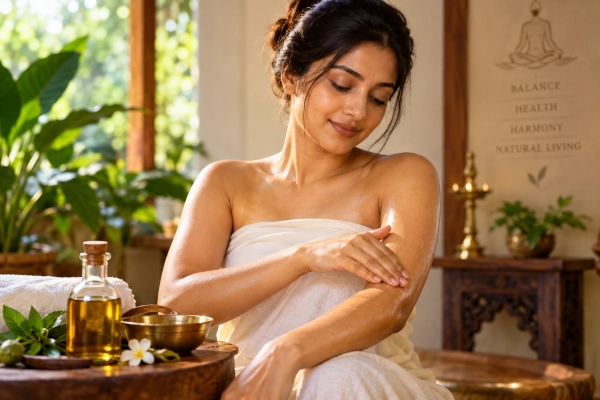
Among the daily practices described in Ayurveda, Abhyanga, or oil massage, holds a particularly important place. It is not presented merely as a treatment for pain or fatigue, but as part of Dinacharya, the daily routine intended to preserve health, maintain strength and support the body through the ordinary stresses of life.
Classical Ayurvedic texts recommend regular application of oil to the body, with particular attention to the head, ears and feet. The practice is traditionally associated with calming Vata, nourishing the body, supporting the skin, reducing fatigue and encouraging restful sleep. In modern life, where long hours of sitting, frequent travel, irregular sleep and continuous mental stimulation are common, Abhyanga remains one of Ayurveda’s simplest and most accessible lifestyle practices.
Abhyanga in the Classical Ayurvedic Routine
The Ashtanga Hridaya places Abhyanga within its discussion of the daily regimen. It advises regular oil massage and traditionally associates the practice with relief from fatigue and conditions linked with aggravated Vata. The text also connects Abhyanga with nourishment, sleep, skin quality and physical stability.
The same classical passage gives particular importance to applying oil to the head, ears and feet. This reflects the Ayurvedic understanding that these areas deserve special attention as part of daily care and that they can be included even when a complete full-body massage is not practical.
Modern Ayurveda institutions continue to place Abhyanga within Dinacharya. The Central Council for Research in Ayurvedic Sciences describes it as the application of oil to the body with mild pressure, while AYUSH literature continues to present it as a traditional daily practice intended to support general well-being.
Why Oil Is Used
Oil occupies an important place in Ayurvedic thought because of its Snigdha, or unctuous, quality. Ayurveda traditionally uses oil to counter dryness, roughness, coldness and excessive mobility, all of which are commonly associated with aggravated Vata.
This is one reason Abhyanga is often considered particularly useful during cold or dry weather, after travel, following physical exertion or during periods when the body feels stiff and depleted. Warm oil and steady touch are traditionally viewed as grounding influences.
From a practical perspective, oil also allows the hands to move smoothly across the skin without creating excessive friction. The massage adds warmth and gentle mechanical stimulation, while the oil helps soften the skin and reduce surface dryness.
Sesame Oil and the Traditional Preference
Sesame oil is among the most commonly recommended oils in classical Ayurvedic practice. Its traditional qualities make it especially associated with Vata-pacifying routines, and it is frequently used either alone or as the base for medicated oils.
This does not mean that sesame oil is ideal for every person or every season. Coconut oil is widely used in hotter climates and is generally considered more cooling. Different medicated oils may also be selected according to constitution, season and therapeutic need.
For a healthy person using Abhyanga as a simple lifestyle practice, the choice of oil can often remain straightforward. A plain, good-quality oil that feels comfortable on the skin may be more practical than automatically choosing complex medicated preparations.
Abhyanga Is Different From Vigorous Massage
Traditional Abhyanga should not be confused with deep-tissue massage, sports massage or forceful manipulation of muscles. Daily self-Abhyanga generally uses mild to moderate pressure and smooth, rhythmic movements rather than strong pressure.
Longer strokes are commonly used along the limbs, while circular movements are often used around the joints. The abdomen is traditionally massaged gently, and the scalp and soles of the feet may receive additional attention.
The practice should feel relaxing rather than painful. Greater pressure does not necessarily produce greater benefit, and a daily routine should remain comfortable enough to be repeated regularly.
A Practical Way to Perform Self-Abhyanga
A home Abhyanga routine does not need to become an elaborate procedure. A small quantity of oil can be warmed slightly until it feels comfortable to the touch and then applied gradually over the body.
The scalp may be massaged gently with the fingertips before moving to the ears, neck, shoulders, arms and hands. The chest and abdomen can then be covered with gentle movements, followed by the back as far as can be comfortably reached.
The legs may be massaged with longer strokes, while circular movements can be used around the knees and ankles. The soles of the feet may be massaged for a little longer because classical Ayurveda gives them particular importance.
After application, the oil can remain on the skin for a short period before bathing with comfortably warm water. A daily practice does not require a large quantity of oil or a lengthy massage to be meaningful.
Abhyanga and the Skin
One of the most immediate effects of oil massage is seen in the skin. Oils can reduce moisture loss from the outer layers of the skin and help improve softness and flexibility, especially in people who experience dryness.
Ayurvedic texts traditionally describe Abhyanga as supporting healthy and firm skin. From a modern perspective, the most defensible explanation is that regular application of a suitable oil can act as an emollient and help maintain the skin barrier.
People with eczema, acne-prone skin, allergies or other dermatological conditions should be more selective about the oils they use. Not every traditional preparation is suitable for every skin type.
Abhyanga and Sleep
Sleep is one of the benefits repeatedly associated with Abhyanga in classical Ayurveda. The tradition places importance on the calming effect of oil massage, particularly when applied to the head and feet.
There is also a practical explanation for this. Gentle massage can promote relaxation, and a quiet oil-massage routine performed away from screens and other stimulation can itself become part of a calming pre-sleep ritual.
Modern clinical evidence specific to Abhyanga remains limited. A small pilot study involving healthy adults reported a reduction in self-reported stress after a one-hour Abhyanga session and also recorded a reduction in heart rate. The researchers themselves noted that larger and more rigorous studies would be needed.
For this reason, the traditional claim that Abhyanga improves sleep should be understood as part of Ayurvedic practice rather than as a conclusively proven treatment for insomnia.
Abhyanga and Stress
Modern lifestyles often keep the nervous system continuously stimulated through work, travel, notifications and irregular routines. A slow and repetitive self-massage naturally creates a very different environment.
Abhyanga requires a person to stop moving, reduce external stimulation and pay attention to the body. Even apart from the traditional properties attributed to the oil itself, this change in pace may contribute to the sense of calm that many people experience after massage.
The available scientific evidence is encouraging but still preliminary. Some small studies and reviews suggest possible benefits for perceived stress and physiological relaxation, but stronger research is needed before broad therapeutic claims can be made.
Abhyanga is therefore better understood as a supportive lifestyle practice rather than a substitute for treatment of anxiety disorders, hypertension or other medical conditions.
Why Ayurveda Connects Abhyanga With Vata
The relationship between Abhyanga and Vata is central to the traditional explanation of the practice. Ayurveda describes Vata through qualities such as dryness, lightness, mobility and coldness. Oil is understood as possessing opposing qualities such as unctuousness, heaviness and warmth.
Warm oil and steady touch are therefore used to counter conditions Ayurveda associates with excessive Vata. This is why Abhyanga is frequently recommended after travel, during dry seasons, with advancing age and during periods of excessive physical or mental activity.
This framework belongs to classical Ayurvedic physiology and should not be confused with modern neurological or anatomical terminology. It nevertheless explains the internal logic behind the practice.
Special Importance of the Head
Ayurvedic texts place particular emphasis on applying oil to the head. A gentle scalp massage can be both practical and relaxing, especially for people who experience scalp dryness or tension.
The mechanical action of massage may help relieve a sensation of tightness, while oil can condition dry hair and scalp. Traditional texts attribute a wider range of benefits to head oiling, but these should not automatically be translated into modern medical claims without evidence.
For everyday use, the most reasonable role of scalp Abhyanga is as a comfortable form of grooming, relaxation and routine self-care.
Special Importance of the Feet
Foot massage is another part of Abhyanga singled out in classical literature. The feet carry the body throughout the day and can become tired after prolonged standing, walking or travel.
Gentle massage with oil can soften dry skin and provide a soothing sensation before sleep. For many people, a short foot massage is also the easiest form of Abhyanga to maintain consistently.
Someone who does not have time for a full-body massage may still incorporate foot massage into the evening routine. People with diabetes, loss of sensation, ulcers, poor circulation or active foot infections should seek appropriate medical advice before applying oils or massage to damaged skin.
How Long Should Abhyanga Take?
Ayurveda describes Abhyanga as a regular practice, but regular does not have to mean lengthy. A full traditional massage may take considerably longer, particularly when performed therapeutically, but a home lifestyle routine can be much shorter.
Even ten or fifteen minutes may be enough to apply oil gently to the limbs, joints, feet and other areas that feel dry or tense. On busy days, attention can be limited to the scalp and feet.
Regularity is more consistent with the philosophy of Dinacharya than occasional excessive effort. A simple routine that can be maintained is usually more useful than an elaborate practice that is difficult to continue.
Morning or Evening?
Abhyanga is traditionally associated with the morning routine and may be followed by bathing. Morning practice can be useful for people who experience stiffness on waking or who prefer to begin the day gradually.
Others may find a short evening practice, especially foot massage, more compatible with their schedule and more relaxing before sleep.
For general lifestyle use, consistency and comfort are usually more important than rigidly following a fixed clock.
Should the Oil Be Warm?
Slightly warmed oil is traditionally preferred in many forms of Abhyanga, especially when the aim is to calm Vata. The oil should always be comfortably warm and never hot.
A simple way to warm the oil is to place the container in warm water rather than heating it aggressively. People with reduced skin sensation should be especially cautious because they may not accurately detect excessive heat.
When Abhyanga Should Be Avoided
Classical Ayurvedic texts do not recommend Abhyanga indiscriminately. The Ashtanga Hridaya advises avoiding it in circumstances associated with aggravated Kapha, after certain purification procedures and during indigestion.
From a modern safety perspective, massage should also generally be avoided over feverish illness, acute infections, open wounds, burns, inflamed skin, fresh injuries or painful swelling unless a qualified clinician advises otherwise.
Deep massage should not be performed over suspected blood clots or areas affected by certain vascular conditions. People recovering from surgery or living with significant medical illnesses should obtain professional guidance before beginning regular therapeutic massage.
Abhyanga Is Not a Detoxification Procedure
Modern descriptions sometimes claim that oil massage pulls toxins through the skin or directly detoxifies the body. Such statements go beyond established scientific evidence.
The liver, kidneys, lungs and gastrointestinal system perform the principal physiological processes involved in eliminating metabolic waste from the body.
Ayurveda has its own concept of Ama, but translating Ama simply as modern biochemical toxins can be misleading. Abhyanga can be discussed meaningfully without relying on unsupported detoxification claims.
Daily Self-Care Rather Than Luxury
One of the most useful aspects of Abhyanga is its simplicity. It does not require specialised equipment, elaborate preparations or a spa setting.
Within Ayurveda, it belongs to ordinary daily care alongside appropriate food, adequate sleep, exercise, hygiene and a balanced routine.
This context changes the way the practice is understood. Abhyanga is not presented as an occasional indulgence, but as a small act of regular physical maintenance.
The modern tendency to treat massage primarily as a luxury service therefore differs considerably from the role it occupies in traditional Ayurvedic daily life.
Abhyanga in Modern Life
Many features of modern living are almost the opposite of the conditions encouraged by traditional Dinacharya. People sit for long periods, travel frequently, eat irregularly, sleep late and remain mentally stimulated throughout the day.
Abhyanga cannot compensate for all of these habits. It cannot replace exercise, nutritious food, adequate sleep or appropriate medical treatment.
What it can provide is a deliberate period of physical care and reduced stimulation. The combination of gentle touch, oil application and a few quiet minutes can make it easier to create a more regular daily rhythm.
That may be one of the most practical ways to understand Abhyanga in contemporary life.
An Ancient Practice With a Modest Modern Role
Ayurveda gives Abhyanga a much wider range of benefits than modern clinical research has so far demonstrated. Classical texts place it firmly within preventive daily living, particularly for calming Vata, supporting the skin, reducing fatigue and encouraging good sleep.
Modern evidence remains limited, although small studies suggest that massage may help with relaxation and perceived stress. These findings are not sufficient to justify claims that Abhyanga can treat major diseases or prevent ageing.
Its value does not depend on such claims. As a gentle form of self-care, Abhyanga offers a practical way to care for dry skin, relax the body and introduce a period of stillness into the day.
That combination helps explain why oil massage has remained part of Ayurvedic daily living for centuries.
References
Ashtanga Hridaya, Sutrasthana, Dinacharya Adhyaya, verses 8–9.
Central Council for Research in Ayurvedic Sciences — Ayurveda: The Science of Life.
Ministry of AYUSH — Dinacharya and daily lifestyle guidance.
Basler AJ — Pilot Study Investigating the Effects of Ayurvedic Abhyanga Massage on Subjective Stress Experience, Journal of Alternative and Complementary Medicine, 2011.
Research reviews on Ayurveda, massage, ageing and preventive lifestyle practices.
You may also like
-
Dr. Reddy’s Launches Made-in-India Nivolumab Biosimilar NIVORZ Across 12 Cancer Indications
-
Centre Proposes Mandatory CCTV at Medical Stores to Curb Unauthorised Sale of Prescription Drugs
-
Centre Tightens Oversight of Stem-Cell Therapy, Restricts Autism Use to Approved Clinical Trials
-
Why Fatty Liver Is Appearing Earlier — And What Lifestyle Has to Do With It
-
Before the Heart Falls Ill: The Ayurvedic Way of Protecting Hridaya Through Daily Living
