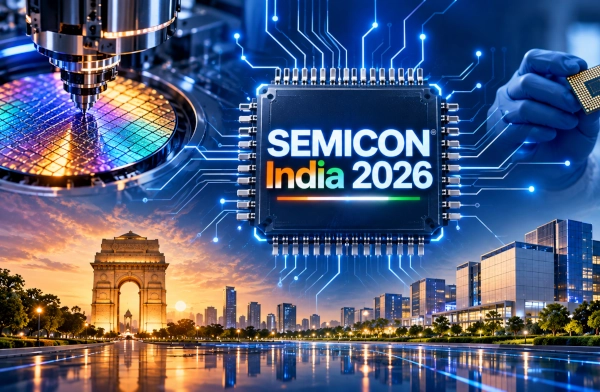
SEMICON India 2026 concluded successfully at Yashobhoomi, New Delhi, marking a significant milestone in India’s efforts to build a complete semiconductor ecosystem spanning chip design, fabrication, advanced packaging, equipment, materials, artificial intelligence, quantum technologies, research and skilled manpower.
The fifth edition of India’s flagship semiconductor conference was held from 17–19 September 2026 under the theme “Silicon to Systems: Building the Ecosystem”. The three-day event brought together global semiconductor companies, domestic manufacturers, startups, research institutions, academic organisations and government stakeholders to showcase India’s progress and future roadmap in the semiconductor sector.
The event recorded 51,656 registrations and around 40,000 cumulative footfall, with participation from more than 600 exhibitors, including nearly 300 international companies. Representatives from 52 countries, six country pavilions and twelve state pavilions participated in the conference, highlighting the growing global interest in India’s semiconductor ambitions.
The event featured over 150 speakers, along with a Startup Pavilion, Workforce Development Zone, Innovation Showcase and Student Hackathon, covering the complete semiconductor value chain from research and design to manufacturing and deployment.
From semiconductor policy to commercial production
Prime Minister Shri Narendra Modi inaugurated SEMICON India 2026 and highlighted India’s transition from semiconductor planning and policy development towards actual commercial production.
During the event, the Prime Minister interacted with young chip designers and students and virtually inaugurated commercial production lines at CDIL Semiconductor, Mohali, and Suchi Semicon, Surat. With these additions, the number of operational commercial semiconductor units among the 12 projects approved under Semicon 1.0 increased to five.
The Prime Minister also outlined the next phase of India’s semiconductor strategy through Semicon 2.0, which has an approved outlay of ₹1,27,500 crore. The programme focuses on six major pillars — semiconductor design, machines and materials, new fabrication facilities, advanced packaging, research and development, and talent development.
The transition reflects a broader objective of building not only semiconductor manufacturing capacity but also the supporting ecosystem required for a globally competitive industry, including equipment manufacturing, specialised materials, intellectual property creation, precision engineering and skilled workforce development.
56 strategic announcements strengthen semiconductor ecosystem
Across the three days of SEMICON India 2026, a total of 56 MoUs, announcements and strategic initiatives were unveiled covering semiconductor design, fabrication, advanced packaging, equipment, materials, artificial intelligence, high-performance computing, research, logistics, startups and workforce development.
The announcements involved semiconductor manufacturers, technology companies, academic institutions, research organisations and skilling partners, reflecting a shift towards deeper ecosystem integration.
The discussions throughout the conference focused on building resilient supply chains, strengthening domestic research capabilities, developing semiconductor manufacturing expertise and connecting innovation with commercial deployment.
Final day focuses on indigenous innovation and sovereign technologies
The concluding session of SEMICON India 2026 featured 15 major announcements and collaborations focused on indigenous processors, artificial intelligence platforms, quantum technologies, semiconductor manufacturing systems, startup engagement and workforce development.
The initiatives brought together government institutions, industry players, academia and training organisations with the objective of translating semiconductor capabilities into deployable technologies and skilled manpower.
A major focus area was the development of indigenous computing platforms and reducing dependence on external technology ecosystems through locally developed solutions.
Digital India RISC-V Grand Challenge promotes indigenous processor applications
The winners of the Digital India RISC-V (DIR-V) Grand Challenge, organised by Maker Village under the Chips to Startup (C2S) Programme of the Ministry of Electronics and Information Technology, were announced during the concluding session.
The challenge received participation from 1,236 teams comprising 5,045 participants from across India. The competition encouraged innovators to build practical applications using indigenous processors developed by Indian institutions.
The first prize was awarded to Meevisai Technologies Pvt. Ltd., representing Team Digital Dawgs from SASTRA University, Thanjavur, for developing an autonomous water-surface cleaning robot using the indigenous SHAKTI processor developed by IIT Madras.
The second prize went to Digiscope LLP, representing Team Binary Bandits from ER&DCI Institute of Technology, Thiruvananthapuram, for developing VEGA Chikitsa, a digital stethoscope based on the indigenous VEGA processor developed by C-DAC.
The third prize was secured by Zetawave Technologies Pvt. Ltd., representing Team NeuroBytes from the Indian Institute of Science, Bengaluru, for a forest environment monitoring system based on the VEGA processor.
New platforms launched for AI, semiconductor manufacturing and quantum research
The concluding day also witnessed the launch of several technology platforms aimed at strengthening India’s capabilities in advanced computing and semiconductor manufacturing.
The Bharat AI-SoC Challenge 2026–27 was launched under the Chips to Startup Programme to encourage students and professionals to develop artificial intelligence and system-on-chip solutions.
The Semi-Conductor Laboratory (SCL), Mohali, launched the Device Manufacturing Integrated System (DMIS), an indigenous manufacturing execution system designed to improve semiconductor fabrication management.
A collaboration between C-DAC and NLC India Limited was announced to establish a data centre within India’s energy-sector ecosystem using indigenous technologies.
Another partnership between C-DAC and Bharat Electronics Limited (BEL) will focus on developing indigenous high-performance computing, artificial intelligence and sovereign data-centre solutions.
C-DAC also launched PARAM Vidya, an AI Excellence Lab-in-a-Box platform, and inaugurated PARAM Shavak-QS, a compact quantum simulation platform designed to support research and innovation in quantum technologies.
Building India’s semiconductor workforce
A major theme of SEMICON India 2026 was workforce development, recognising that semiconductor manufacturing requires specialised skills across chip design, verification, fabrication, testing, packaging and equipment operations.
The Electronics Sector Skills Council of India announced partnerships with organisations including Maitrio Labs and Truechip Solutions to strengthen semiconductor training and certification programmes.
The National Institute of Electronics and Information Technology (NIELIT) announced initiatives focused on ATMP skilling and the creation of a Digital Twin for Semiconductor Manufacturing.
The Ramaiah Institute of Advanced Skills and Technology (RIASAT) and the Indian Institute of Science, Bengaluru, also exchanged an MoU to strengthen semiconductor capability development through institutional collaboration.
Startups and student innovation receive greater focus
SEMICON India 2026 placed significant emphasis on startups and young innovators working in semiconductor-related technologies.
The SEMICON India Hackathon Grand Finale received 3,808 team registrations from 881 colleges, with more than 1,000 ideas submitted. Ten teams reached the final stage, with teams from VIT Vellore and IIT Madras emerging as winners.
The Startup Mitra initiative provided a platform for semiconductor startups to present their technologies before investors. Eleven startups pitched their ideas to more than 20 venture capital investors.
Global partnerships expand semiconductor cooperation
International collaboration remained a central theme throughout SEMICON India 2026.
Six country roundtables were organised with participation from the United States, Japan, Singapore, Europe, South Korea and Malaysia.
The discussions focused on commercial partnerships, semiconductor manufacturing, advanced packaging, equipment and materials, resilient supply chains, research collaboration and workforce development.
India’s semiconductor roadmap moves towards ecosystem leadership
The concluding session also saw the launch of the EY and India Semiconductor and Electronics Association report titled “Semicon India 2.0: From Capacity Creation to Ecosystem Leadership.”
The report highlighted opportunities for India’s semiconductor market to expand from approximately USD 64 billion in 2026 to USD 200 billion by 2035, while emphasising the need to strengthen manufacturing, advanced packaging, research and innovation capabilities.
Together, the announcements made during SEMICON India 2026 demonstrate India’s expanding semiconductor strategy — combining manufacturing infrastructure with indigenous processors, artificial intelligence platforms, quantum technologies, startups, research institutions and skilled manpower.
The event showcased the complete “Silicon to Systems” journey, linking semiconductor design and intellectual property with fabrication, packaging, electronics manufacturing, research and end-use applications.
SEMICON India 2026 marked another step in India’s effort to establish itself as a major participant in the global semiconductor value chain while building domestic technological capabilities for the future.
References
Press Information Bureau, Government of India — SEMICON India 2026 conference updates and concluding session announcements, 19 September 2026.
You may also like
-
Aadhaar Biometric Authentication Made Mandatory for Subsidised LPG Refills From October 2026
-
SEMICON India 2026 Day Two Records 25 Semiconductor Partnerships
-
Rozgar Mela Provides Appointment Letters to 51,000 Youth as Government Highlights Employment Initiatives
-
Malihabadi Dusseheri Mango — Awadh’s Fragrant Summer Fruit and the Orchard Legacy of Malihabad
-
Kaiga Unit-1 Completes Major Life Extension Overhaul, Showcasing India’s Nuclear Engineering Capability
