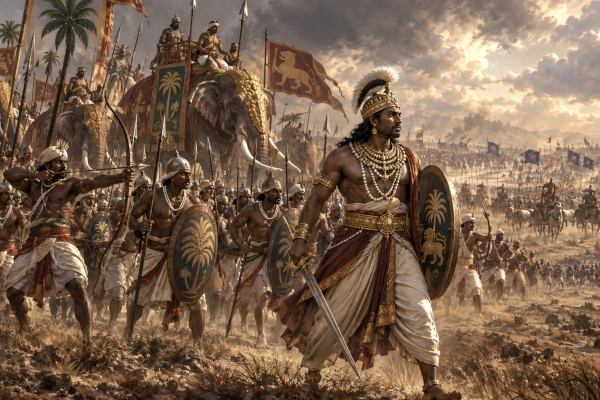
The Mahabharata’s geographical horizon extends deep into the southern seas, where island realms appear alongside the kingdoms of peninsular India. Among the most important of these is Simhala, also encountered in later Sanskrit tradition as Simhaladvipa, a name widely associated with the island of present-day Sri Lanka. The identification is considerably stronger than many of the more uncertain frontier regions mentioned in the epic, although the relationship between the names Simhala and Lanka deserves careful treatment.
Simhala appears in the Mahabharata not merely as a distant island name but as a politically recognised realm. Its ruler is associated with Yudhishthira’s Rajasuya, its people bring valuable marine products and luxury goods, and Simhala warriors later appear on the Kaurava side during the Kurukshetra War. These references present the island as part of the wider political and commercial world known to the epic tradition.
Simhala and the Island of Sri Lanka
The Sanskrit name Siṃhala became one of the most enduring historical names associated with Sri Lanka. Later Indian literary, geographical and religious traditions repeatedly use Simhala or Simhaladvipa for the island, while related forms eventually contributed to names such as Sinhala and Sinhalese.
Ancient Sanskrit geographical traditions frequently describe Simhala as an island south of the Indian mainland. The identification with Sri Lanka became firmly established in later literature and geographical writing, and modern reference works commonly equate ancient Simhala with Ceylon or Sri Lanka.
For a modern geographical reconstruction, therefore, Sri Lanka provides the clearest location for Simhala. Unlike some Mahabharata kingdoms whose borders remain difficult to reconstruct, the island setting gives Simhala a strong geographical anchor.
Simhala and Lanka: A Necessary Distinction
An important complication arises because Sanskrit literature does not always use Simhala and Lanka as interchangeable names. Some ancient and medieval texts list them separately, and scholarship on South Asian geographical traditions has noted that certain Sanskrit sources regarded Simhaladvipa and Lanka as distinct locations.
This distinction is especially relevant when reading the Mahabharata. The epic contains references both to Simhala and to Lanka, and these should not automatically be merged into one political entity in every passage. Later tradition strongly associated both names with Sri Lanka, but the textual history is more complex.
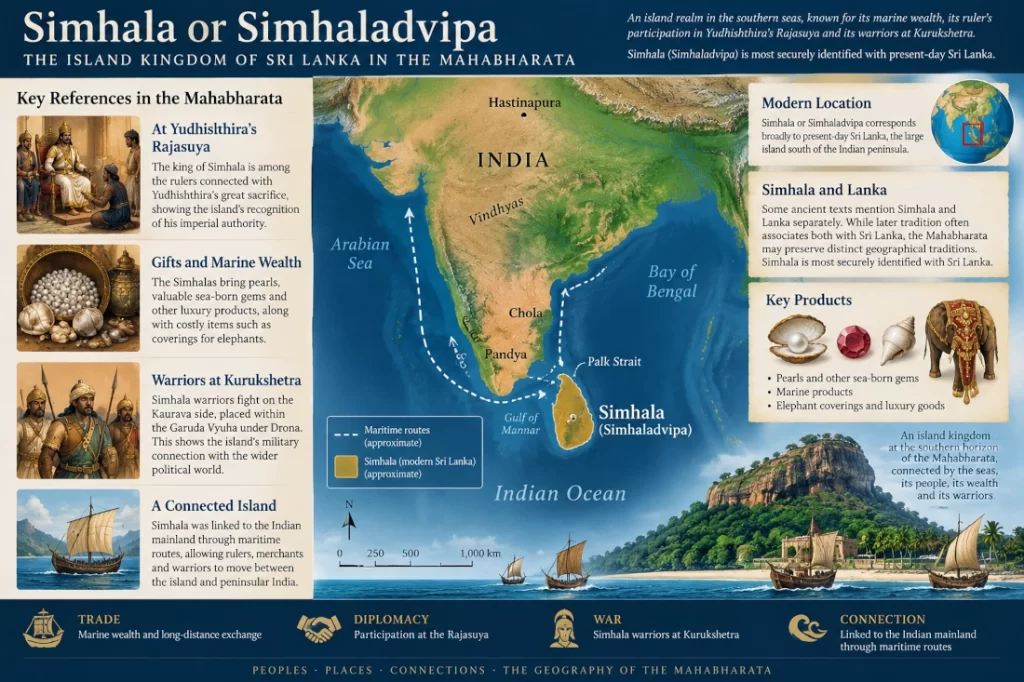
The safest geographical approach is therefore to identify Simhala with ancient Sri Lanka, while recognising that the Mahabharata may preserve traditions in which Simhala and Lanka were treated as separate geographical or political designations. This caution is particularly important when reconstructing the epic’s world on a modern map.
The King of Simhala at Yudhishthira’s Rajasuya
One of the clearest political references occurs during Yudhishthira’s Rajasuya. The great ceremony at Indraprastha brings rulers and representatives from numerous kingdoms into the Pandava court, turning the sacrifice into a demonstration of political recognition extending far beyond the Kuru heartland.
The Mahabharata includes the king of Simhala among those connected with the Rajasuya. His presence places the island realm within the network of states acknowledging Yudhishthira’s imperial ceremony. The episode is important because Simhala is not presented as an unknown or mythical island at the edge of the world, but as a kingdom sufficiently integrated into the wider political order to be represented at a major royal gathering.
The Rajasuya therefore provides one of the strongest indications that the epic tradition regarded Simhala as a recognised southern polity.
Sea-Born Wealth from Simhala
The Mahabharata provides an even more vivid glimpse of Simhala through the tribute associated with its people. During descriptions of the wealth brought to Yudhishthira, the Simhalas are associated with pearls and other valuable products of the sea, along with costly items appropriate to an island kingdom.
One translation of the Sabha Parva describes the Simhala contribution as including valuable sea-born gems, pearls and large numbers of coverings for elephants. The Sanskrit tradition behind the passage specifically associates the Simhalas with maritime wealth.
This is geographically appropriate for Sri Lanka. The waters surrounding the island, particularly those between Sri Lanka and the southeastern coast of India, became famous in historical periods for pearl fisheries and maritime commerce. The Mahabharata passage should not be treated as a precise commercial record for a particular century, but the association of Simhala with pearls and marine wealth fits the island’s long-standing maritime character.
An Island Connected to the Indian Mainland
The Simhala references reveal that the sea did not isolate the island from the political and economic world of the mainland. On the contrary, maritime routes across the narrow waters separating southern India and Sri Lanka would have allowed rulers, merchants, envoys and luxury goods to move between the two regions.
The Palk Strait and the Gulf of Mannar form a relatively narrow maritime zone compared with the open ocean farther south. Historical interaction between Sri Lanka and Tamilakam developed across this corridor for centuries, linking the island with the Pandya, Chola and Chera regions of southern India.
Within the geographical imagination of the Mahabharata, Simhala therefore belongs naturally to the same broad southern sphere as Pandya, Chola, Kerala and other peninsular regions. It is separated from the mainland by water, but not removed from its political or economic networks.
Simhala Among the Southern Kingdoms
The wider geography of the epic repeatedly looks southward beyond the Vindhyas toward the kingdoms of peninsular India. During the Rajasuya-related narratives, the Pandavas establish connections with numerous southern peoples and rulers, while descriptions of tribute emphasise exotic woods, gems, pearls and other products associated with tropical and maritime regions.
Simhala fits naturally into this southern network. Its island geography distinguishes it from the mainland kingdoms, yet the products attributed to it and its participation in royal gatherings show that it formed part of the same interconnected world.
The Mahabharata thus presents southern India and the surrounding seas not as remote margins but as active components of the political geography surrounding the great northern kingdoms.
Simhala and the Maritime World
The association of Simhala with pearls is particularly significant because it connects the epic’s geography with the maritime environment of the Indian Ocean. Pearls were among the most valuable prestige commodities of the ancient world, and the waters around southern India and Sri Lanka became renowned for their production.
Other marine products, precious stones, spices and luxury commodities would later make Sri Lanka an important node in Indian Ocean commerce. Ships moving between the western coast of India, the southern peninsula, Sri Lanka and Southeast Asia transformed the island into a strategic point along major sea routes.
The Mahabharata does not provide a detailed account of this maritime system, but its portrayal of Simhala as a source of valuable sea-born goods reflects an awareness of the island’s distinctive relationship with the ocean.
The Simhalas at the Kurukshetra War
Simhala appears again in a very different setting during the Kurukshetra War. According to the Mahabharata tradition, Simhala warriors fought on the Kaurava side, demonstrating that the island’s connection with the mainland extended beyond ceremonial tribute and trade.
During the formation of the Garuda Vyuha under Drona, the Simhalas are described among the forces positioned within the battle formation. Traditional references place them around the neck section of the formation, alongside other allied contingents.
The episode is significant because it brings warriors associated with an island far to the south directly into the central military conflict of the epic. As with other distant peoples represented at Kurukshetra, their presence reinforces the Mahabharata’s portrayal of the war as a struggle drawing participants from across an enormous geographical area.
From the Indian Ocean to Kurukshetra
The geographical distance between Sri Lanka and Kurukshetra makes the Simhala participation particularly striking. The army would have had to move through or alongside large parts of peninsular India before reaching the northern plains, unless the reference represents broader epic memory rather than a literal reconstruction of a single historical campaign.
Regardless of how the passage is interpreted historically, its narrative significance is clear. The Mahabharata imagines the conflict at Kurukshetra as capable of drawing warriors even from an island realm in the southern seas.
Simhala therefore appears in two contrasting but complementary contexts. At the Rajasuya, it participates in royal diplomacy and tribute; at Kurukshetra, its warriors participate in military mobilisation. Together, the episodes portray the island as an active member of the wider political world.
Simhala in the Epic’s Description of Peoples
The Mahabharata also preserves ethnographic descriptions of distant communities, and the Simhalas appear within this broader tradition. Later compilations based on the epic describe the Simhalas as wearing ornaments or garments decorated with jewels and associate them with a distinctive physical appearance.
Such descriptions should be approached cautiously. Epic ethnography often combines observation, literary convention and inherited stereotypes, and these passages should not be treated as scientific descriptions of historical populations.
Nevertheless, their presence demonstrates that the term Simhala referred not merely to a geographical island but also to a recognisable people within the epic tradition.
The Meaning of Simhaladvipa
The fuller form Simhaladvipa combines Simhala with dvīpa, meaning an island or island-land. In geographical usage, the term therefore means the Island of the Simhalas.
This form became especially common in later Sanskrit, Buddhist and Jain traditions. It provided a natural geographical description for Sri Lanka, whose insular character made it readily distinguishable from the kingdoms of the Indian mainland.
The name is particularly useful when reconstructing ancient geography because it makes the island character explicit. While Simhala can denote both the country and its people, Simhaladvipa unmistakably refers to an island realm.
Simhala, Sri Lanka and Historical Continuity
The identification of Simhala with Sri Lanka is reinforced by later historical traditions associated with the island itself. The term Sinhala became central to Sri Lankan political and cultural history, while Sanskrit and Pali literature repeatedly used related forms for the island and its inhabitants.
This continuity makes the geographical identification substantially stronger than many other places mentioned in the Mahabharata. The political boundaries, rulers and precise chronological context described by the epic cannot be reconstructed with certainty, but the broad location is clear.
On a modern map, Simhala or Simhaladvipa should therefore be placed on the island of Sri Lanka, directly south of the Indian peninsula.
A Strategic Position in the Southern Seas
Sri Lanka occupies an exceptionally important geographical position. Situated immediately south of the Indian subcontinent and close to major maritime routes crossing the northern Indian Ocean, the island forms a natural bridge between South Asia and the wider maritime world.
Its northern coast lies close to Tamil Nadu, while its southern position opens toward routes leading across the Indian Ocean. These geographical features help explain why the island repeatedly became involved in the political, commercial and cultural history of southern India.
The Mahabharata’s portrayal of Simhala as a source of maritime wealth and as a kingdom connected with mainland rulers therefore fits naturally within the island’s broader geographical character.
How Simhala Should Be Shown on a Modern Map
Unlike Cina, Kamboja or some other ancient regions whose precise territorial extent remains uncertain, Simhala can be located with considerable confidence. A modern geographical map should highlight Sri Lanka as the core area corresponding to ancient Simhala or Simhaladvipa.
The island should be shown south of Tamil Nadu, separated from the mainland by the Palk Strait and the Gulf of Mannar. The map may also indicate the proximity of the Pandya and Chola regions because these southern mainland kingdoms formed part of the broader geographical environment connecting India with the island.
However, a map should avoid assigning a precise Mahabharata-period capital or drawing internal political boundaries unless supported by independent evidence. The epic identifies the people and realm but does not provide enough information to reconstruct the administrative geography of Simhala during the period reflected in the narrative.
Simhala and Lanka in the Mahabharata World
The relationship between Simhala and Lanka remains one of the most interesting questions in the epic’s southern geography. Later tradition frequently associates Lanka with Sri Lanka, largely because of the enormous influence of the Ramayana. Yet some Sanskrit geographical traditions list Simhala and Lanka separately, and scholarly discussions have noted that this distinction appears in several texts.
The distinction does not invalidate the identification of Simhala with Sri Lanka. Instead, it suggests that ancient geographical terminology may have been more complex than later convention implies. Different literary traditions could use overlapping or separate names for islands, kingdoms or regions in the southern seas.
For historical reconstruction, Simhala should therefore be treated securely as Sri Lanka, while references to Lanka should be examined independently rather than automatically assumed to describe exactly the same political entity.
An Island Within the Mahabharata’s Political World
The most important feature of Simhala is not merely that the epic knew of an island south of India, but that the island was integrated into the Mahabharata’s political imagination. Its ruler participates in the world surrounding Yudhishthira’s Rajasuya, its people bring maritime riches, and its warriors later appear within the vast coalition assembled for the Kurukshetra War.
The combination of these references portrays Simhala as neither mythical nor isolated. It was an island kingdom connected to the mainland through diplomacy, tribute, commerce and war.
The sea therefore functions in the Mahabharata not as the end of political geography but as another route through which distant regions were connected.
The Island Kingdom at India’s Southern Horizon
The most defensible modern identification can be stated clearly: Simhala or Simhaladvipa corresponds broadly to present-day Sri Lanka, the large island immediately south of the Indian mainland. The Mahabharata’s references associate it with sea-borne wealth, participation in Yudhishthira’s Rajasuya and warriors who later joined the Kaurava forces at Kurukshetra.
Its significance extends beyond the identification of a single place. Simhala reveals how far the geographical imagination of the Mahabharata reached into the Indian Ocean. The epic world includes not only mountain kingdoms, desert peoples and Central Asian frontiers but also island societies connected to the mainland by maritime routes.
Simhala thus represents the southern maritime horizon of the Mahabharata: an island surrounded by the Indian Ocean, rich in sea-born products and sufficiently connected with the great kingdoms of the mainland to appear in their ceremonies, political relationships and wars.
You may also like
-
Lanka in the Mahabharata: The Island Kingdom Beyond India’s Southern Shore
-
Cina in the Mahabharata: The Trans-Himalayan World at the Edge of the Epic’s Geography
-
India and France Sign Agreement to Preserve and Digitise Ancient Indian Manuscripts
-
Huna in the Mahabharata: Nakula’s Western Campaign, the Harahunas and Central Asia’s Changing Frontiers
-
GeM’s AABHAR Collection Showcases 294 Indigenous Products, Strengthens Market Access for Indian Artisans
