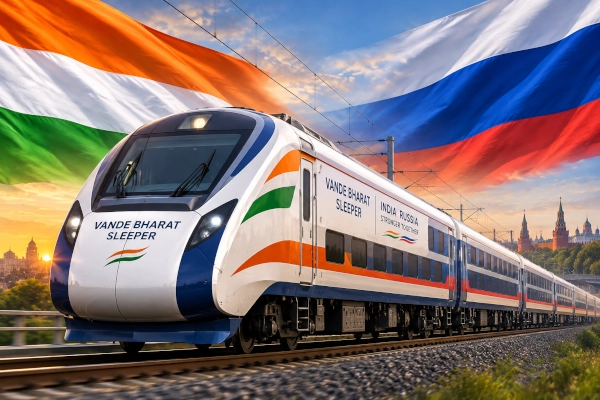
Rail Vikas Nigam Limited has placed its Indo-Russian Vande Bharat Sleeper programme at the centre of its participation in INNOPROM India 2026, highlighting one of the largest railway manufacturing collaborations currently underway between India and Russia.
Prime Minister Narendra Modi and Russian President Vladimir Putin visited the INNOPROM India exhibition in New Delhi on September 11, where RVNL showcased the Vande Bharat Sleeper programme alongside some of its major infrastructure projects. These included the Rishikesh-Karnaprayag railway project, the New Pamban Bridge and BharatNet-related infrastructure work.
INNOPROM India was held for the first time in the country from September 9 to 11 at Bharat Mandapam. The industrial exhibition formed part of a wider effort by New Delhi and Moscow to expand cooperation beyond traditional sectors such as defence and energy into manufacturing, infrastructure, engineering and technology. Modi and Putin subsequently highlighted the exhibition’s importance in strengthening India-Russia trade and industrial ties.
Vande Bharat Sleeper at the Centre of Indo-Russian Rail Cooperation
The most significant railway programme showcased by RVNL was the Vande Bharat Sleeper project being executed through KINET Railway Solutions Limited, an Indo-Russian joint venture involving RVNL and Russian rolling-stock companies associated with Transmashholding.
KINET has been contracted to manufacture 120 Vande Bharat Sleeper trainsets, each comprising 16 coaches, giving the programme a total of 1,920 coaches. Indian Railways confirmed in Parliament that the original contract remains for 120 sixteen-car trainsets.
The trains are being manufactured at the upgraded Marathwada Rail Coach Factory at Latur in Maharashtra. KINET says the facility covers approximately 351 acres and includes 11 production workshops and an 8.6-kilometre internal railway network.
The programme is important because it combines Indian manufacturing capacity with Russian rolling-stock design and engineering expertise while placing final production in India.
160-km/h Sleeper Trains for Long-Distance Routes
KINET’s Vande Bharat Sleeper trainsets are being developed for an operating speed of 160 km/h and are intended for long- and medium-distance intercity services.
Unlike the chair-car Vande Bharat trains used predominantly on daytime routes, the sleeper version is designed for overnight and longer journeys where conventional locomotive-hauled trains currently dominate.
KINET describes the project as a complete lifecycle programme covering design, engineering, manufacturing and long-term servicing. The company is responsible not only for building the trainsets but also for supporting their maintenance for 35 years.
Three maintenance locations are planned at Bijwasan in Delhi, Jodhpur in Rajasthan and Thanisandra in Bengaluru, creating a geographically distributed support network for the eventual fleet.
The scale of that commitment makes the programme substantially different from a conventional rolling-stock purchase. The supplier consortium remains involved for decades after delivery, creating incentives to address reliability, maintenance and lifecycle costs during the original design and manufacturing process.
Manufacturing Is Underway at Latur
The programme has moved substantially beyond the design stage.
KINET announced earlier in 2026 that it had completed its first fully integrated car body at Latur, while more recent updates show two prototype trainsets progressing through assembly.
RVNL Chairman and Managing Director Saleem Ahmad said at the company’s August 2026 annual general meeting that manufacturing activities were progressing at the upgraded Marathwada Rail Coach Factory and that the first prototype was expected during the current financial year.
The latest timeline places the prototype rollout by March 31, 2027.
That schedule represents a delay from earlier targets. The programme had initially envisaged an earlier prototype, but design finalisation and associated engineering work pushed the manufacturing timeline back. The current focus is therefore on completing and validating the prototype before moving into large-scale serial production.
A ₹14,400-Crore Manufacturing Programme
RVNL has described the train manufacturing component of the project as being worth approximately ₹14,400 crore, based on 120 trainsets at around ₹120 crore per set under the original Letter of Award.
The long-term maintenance component substantially increases the overall economic value of the programme. RVNL has previously estimated that maintenance over the 35-year lifecycle could amount to roughly ₹20,000 crore.
This creates one of the largest long-duration railway manufacturing and maintenance projects currently being undertaken through an Indo-Russian industrial partnership.
The project also illustrates RVNL’s expansion beyond its traditional role as an infrastructure project-execution company. While the PSU has historically concentrated on railway lines, electrification, bridges and other infrastructure, its participation in KINET gives it a direct role in advanced passenger rolling-stock manufacturing.
Russian Technology, Indian Manufacturing
The structure of KINET reflects the industrial character of the programme.
As of March 31, 2026, RVNL reported that Russian partners Locomotive Electronic Systems and Metrowagonmash held 40% and 35% respectively in KINET, while RVNL held the remaining 25%. Metrowagonmash is part of Russia’s Transmashholding group.
The Russian partners provide substantial rolling-stock design and technical expertise, while production is being developed around the Latur facility and an Indian supplier ecosystem.
Technology transfer and localisation are consequently central to the programme. The objective is not simply to import finished Russian trains, but to combine external expertise with manufacturing, workforce development, maintenance and component sourcing within India.
KINET describes the project as supporting the Make in India programme through domestic manufacturing, local supply-chain development and transfer of railway engineering capabilities.
Latur Emerging as a Rolling-Stock Manufacturing Centre
The Vande Bharat Sleeper project is also changing the industrial importance of the Marathwada Rail Coach Factory.
The Latur facility was established by Indian Railways but is now being upgraded and equipped for sophisticated semi-high-speed trainset manufacturing under the KINET programme.
Production of 1,920 coaches represents a workload extending well beyond the construction of the initial prototypes. Once serial manufacturing begins, the project will require sustained supplies of structural components, interiors, electrical systems, braking equipment, doors, HVAC systems, passenger amenities and numerous other subsystems.
This can create an industrial ecosystem around the train programme rather than limiting its economic impact to the final assembly plant.
KINET has also established an engineering centre in Hyderabad, adding an engineering and design component to the manufacturing activities centred in Maharashtra.
RVNL Showcases Wider Infrastructure Portfolio
The INNOPROM display was not limited to rolling stock.
RVNL also highlighted the Rishikesh-Karnaprayag railway project, one of India’s most technically challenging Himalayan railway programmes. RVNL has said the 125-kilometre project is being developed at a cost of approximately ₹37,000 crore, with most of the alignment running through tunnels.
The company also showcased the New Pamban Bridge, representing India’s growing domestic capability in complex railway bridge engineering, as well as its participation in BharatNet infrastructure.
RVNL’s BharatNet package involves the development of high-speed broadband infrastructure in rural and remote regions. The PSU has disclosed project work worth more than ₹13,000 crore involving thousands of kilometres of optical-fibre infrastructure.
Together, the projects presented a broader picture of RVNL’s evolution from a railway construction organisation into a diversified infrastructure and engineering company involved in rolling stock, telecommunications and major civil-engineering projects.
INNOPROM Gives Railway Partnership Political Visibility
The presence of Modi and Putin gave the exhibition considerably greater significance than an ordinary industrial trade show.
The Prime Minister’s Office confirmed that both leaders visited INNOPROM India and interacted with participants after their bilateral discussions in New Delhi. Their talks covered economic cooperation along with defence, energy, space, mobility and other areas of the India-Russia strategic partnership.
The two leaders also welcomed the staging of the Russian-origin industrial exhibition in India and emphasised its potential role in expanding bilateral trade and industrial cooperation.
For the Vande Bharat Sleeper programme, that high-level attention is particularly significant because KINET is one of the largest visible examples of Indian and Russian companies attempting to create a jointly executed manufacturing programme inside India.
Unlike traditional India-Russia commercial relations centred heavily on energy and defence, the Vande Bharat project represents cooperation in civilian high-value manufacturing.
An Important Programme, but Delivery Now Matters
The scale of the KINET programme makes it strategically and industrially important, but its success will ultimately depend on execution.
The first major test will be completion of the prototype. This must be followed by testing, certification and eventual series production before the planned 120-train fleet can enter Indian Railways service.
The revised prototype schedule means that the programme has already taken longer than originally planned. The manufacturing progress now visible at Latur is therefore important, but delivery milestones will matter more than exhibition displays as the project advances.
It would also provide an important model for India-Russia industrial cooperation: foreign railway engineering combined with Indian factories, local production, technology transfer and decades of lifecycle support.
That is what made the Vande Bharat Sleeper programme a natural centrepiece of RVNL’s presence at INNOPROM India 2026. Beyond the train itself, it represents an attempt to turn a long-standing strategic relationship into an enduring industrial manufacturing partnership.
You may also like
-
Neuland Expands Commercial Peptide Manufacturing With 6,370-Litre Facility at Bonthapally
-
PM Modi to Inaugurate SEMICON India 2026 as India Expands Semiconductor Manufacturing Ecosystem
-
DRDO Opens Testing, Funding and Software Source Codes to Indian Defence Startups and MSMEs
-
GRSE Begins Building Two Research Ships to Expand India’s Offshore Mineral Exploration
-
India’s MIGM Gives Navy an Indigenous Smart Seabed Weapon Against Ships and Submarines
