Ayurveda places unusual importance on the first few minutes after waking. Before food, work, exercise or the distractions of the day begin, the morning is treated as a useful time to observe how the body has responded to the previous day’s food, sleep and routine.
One of the simplest of these observations concerns the tongue.
In the Ayurvedic daily regimen, or Dinacharya, cleaning the mouth and tongue forms part of the morning routine. The tongue is not viewed merely as an organ of taste. Its surface, moisture, coating and general appearance were traditionally observed as possible clues about digestion, oral cleanliness and the internal state of the body.
This does not mean that every change in the tongue represents disease, nor that a person can diagnose illness simply by looking at it. The traditional value of tongue observation lies instead in noticing patterns over time and combining them with other signs such as appetite, bowel habits, thirst, sleep, energy and overall wellbeing.
Why the Tongue Changes Overnight
During sleep, the mouth becomes relatively inactive. Saliva production usually falls, swallowing becomes less frequent and microorganisms continue to act on food residues and shed cells inside the mouth.
By morning, many people therefore notice a thin coating over the tongue. Its thickness, colour and distribution can vary depending on oral hygiene, hydration, diet, smoking, medication, illness and several other factors.
Ayurveda observed this morning coating long before modern microbiology explained many of the processes occurring inside the mouth. Traditional physicians associated excessive coating with Ama, a classical concept used to describe material arising when digestion or metabolic processing is considered incomplete.
It is important not to equate Ama directly with any single modern biological substance. It is an Ayurvedic explanatory concept rather than a laboratory diagnosis. In everyday practice, however, the observation remains straightforward: a heavily coated tongue may prompt a person to pay greater attention to digestion, food habits, hydration and oral hygiene.
Jihva Nirlekhana: The Practice of Tongue Scraping
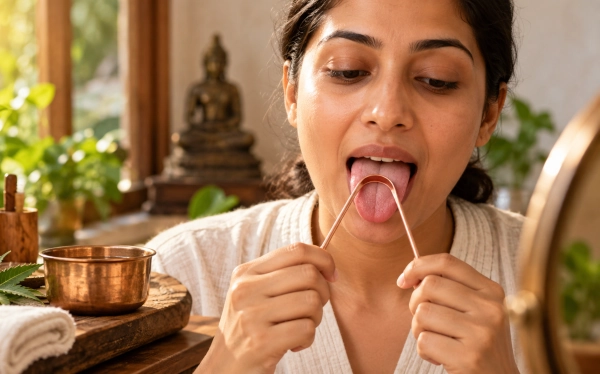
Tongue cleaning is traditionally known as Jihva Nirlekhana or Jihva Prakshalana in Ayurvedic practice. It generally involves gently drawing a smooth tongue cleaner from the back of the tongue toward the front after waking.
The purpose is simple. The scraper removes material that has accumulated on the surface of the tongue overnight and helps maintain oral cleanliness before eating or drinking.
Classical Ayurvedic texts describe tongue cleaning as part of the normal morning regimen alongside cleaning the teeth and mouth. Traditional scrapers were made from materials such as metals or appropriately prepared plant material, while modern tongue cleaners are commonly made from stainless steel, copper or other smooth materials.
The instrument should not be sharp or rough. Tongue cleaning is intended to be gentle and should not cause bleeding, pain or injury.
Why Ayurveda Does Not Ignore Tongue Coating
Ayurveda has always placed digestion at the centre of daily health.
The concept of Agni, broadly referring to digestive and metabolic capacity, is used to explain how efficiently food is processed and assimilated. When digestion is functioning well, appetite, bowel movements and energy are expected to remain relatively steady. When digestion is disturbed, Ayurveda looks for a collection of signs rather than relying on a single symptom.
Tongue coating is one of those signs.
A persistent or unusually heavy coating may traditionally be interpreted alongside reduced appetite, abdominal heaviness, sluggish digestion, altered bowel habits or a general feeling of dullness. By contrast, a relatively clean tongue together with normal hunger and comfortable digestion would generally be considered more reassuring.
The key point is that the tongue is part of an assessment, not the entire assessment.
The Tongue as a Daily Observation Tool
One reason tongue observation fits so naturally into Dinacharya is that it requires no equipment and takes only a few seconds.
A person who briefly looks at the tongue every morning may begin noticing changes associated with late meals, dehydration, disturbed sleep or particular foods. The observation can therefore function as a personal awareness practice rather than a form of self-diagnosis.
For example, someone who normally wakes with a relatively clear tongue may notice considerably more coating after several days of heavy nighttime eating. Another person may observe increased dryness during periods of poor hydration.
Ayurveda encourages awareness of such patterns because small daily observations can influence everyday decisions about food, rest and routine.
Why Tongue Scraping Is Different From Brushing
Brushing the teeth primarily cleans the teeth and gums. It does not necessarily remove the material that collects between the papillae covering the surface of the tongue.
The tongue has a textured surface containing numerous small projections. Food particles, microorganisms and shed cells can accumulate between them, particularly toward the back of the tongue.
A tongue scraper works mechanically across this surface. When used gently, it can remove part of this accumulated coating more effectively than simply rinsing the mouth.
For this reason, Ayurveda traditionally treated tongue cleaning as a distinct step rather than assuming that tooth cleaning alone was sufficient.
Tongue Cleaning and the Sense of Taste
Ayurveda also connects tongue cleanliness with taste.
A heavily coated tongue can interfere with the direct contact between food and taste receptors. Cleaning the tongue before the first meal may therefore leave the mouth feeling fresher and flavours easier to perceive.
Taste has considerable importance in Ayurvedic nutrition. The six classical tastes — sweet, sour, salty, pungent, bitter and astringent — form part of the traditional way of understanding food and its effects.
Maintaining the tongue as a clean sensory organ therefore fits naturally within the broader Ayurvedic approach to eating.
How to Scrape the Tongue Safely
Tongue scraping does not require force.
The tongue should be extended comfortably, and the scraper placed far enough back to clean the surface without provoking excessive gagging. It is then drawn forward gently. The scraper can be rinsed between strokes, and the process repeated a few times until the obvious surface coating has been removed.
Pressing hard is unnecessary and can injure the delicate surface of the tongue.
The scraper should also be kept clean and should not be shared. Anyone with mouth ulcers, active oral infections, recent oral surgery or unexplained tongue lesions should avoid aggressive scraping and seek appropriate professional advice.
Not Every Tongue Coating Means Poor Digestion
This distinction is particularly important in a modern Ayurveda article.
A coated tongue can occur for many reasons unrelated to Ayurvedic digestive concepts. Dehydration, mouth breathing, smoking, fever, medications, poor oral hygiene and changes in the normal oral microbiome can all alter the appearance of the tongue.
White patches that cannot be easily removed, persistent red or painful areas, bleeding, sores or unusual changes lasting for an extended period should not simply be interpreted as Ama.
They may require assessment by a dentist or doctor.
Ayurveda traditionally relied on the combined examination of the patient, including history, appetite, digestion, bowel habits, pulse, skin, eyes and other features. Reducing this wider system to a photograph of the tongue is therefore neither traditionally accurate nor medically sensible.
What Ayurveda Historically Observed
Traditional Ayurvedic examination sometimes considered features such as tongue colour, moisture, coating and movement.
These observations could contribute to an understanding of digestion, hydration and the balance of the doshas, but they were interpreted within the context of the entire person.
This is very different from modern online claims suggesting that every region of the tongue precisely maps to a particular internal organ or that a single colour can definitively reveal a disease.
Such simplified charts often go much further than the classical approach warrants.
Ayurvedic examination is contextual. The same visible feature can have different significance depending on age, constitution, season, diet and accompanying symptoms.
A Small Habit With a Larger Purpose
The importance Ayurveda gives to tongue cleaning reflects a wider principle running through Dinacharya: health is influenced by repeated small actions.
Scraping the tongue takes less than a minute. Yet the practice encourages oral cleanliness, greater awareness of the body and attention to what happened the previous day.
Did dinner come too late? Was the meal unusually heavy? Was sleep disturbed? Was there enough water during the day? Is appetite normal this morning?
These questions are more valuable than trying to interpret the tongue as a diagnostic chart.
The morning tongue becomes, in this sense, a simple feedback mechanism.
The Ayurvedic Morning Begins With Observation
Ayurveda does not begin the day by asking people to immediately consume a supplement or perform an elaborate ritual. Much of Dinacharya begins with basic observation and hygiene.
The tongue is one of the easiest places to start.
Looking at it briefly before cleaning can help a person notice changes. Gently scraping it can improve oral cleanliness. Paying attention to recurring changes can encourage better awareness of digestion, hydration and daily habits.
The practice is simple precisely because it was designed to be repeated.
For Ayurveda, that is where its value lies. The tongue is not an oracle and it is not a laboratory test. It is simply one small window through which the body can be observed every morning before the demands of the day begin.
You may also like
-
High Blood Pressure Through an Ayurvedic Lens: Stress, Diet and Dosha Imbalance
-
IISc Develops Engineered Nanobody Antivenom With Broad Protection Against Indian Cobra Venoms
-
Indian MedTech Startup Periwinkle Takes Rapid AI Cervical Cancer Screening to BRICS
-
WHO Chief Praises India’s Gains in Maternal, Child Health and NCD Care
-
Ayurvedic Foods for Liver Health and Digestion
