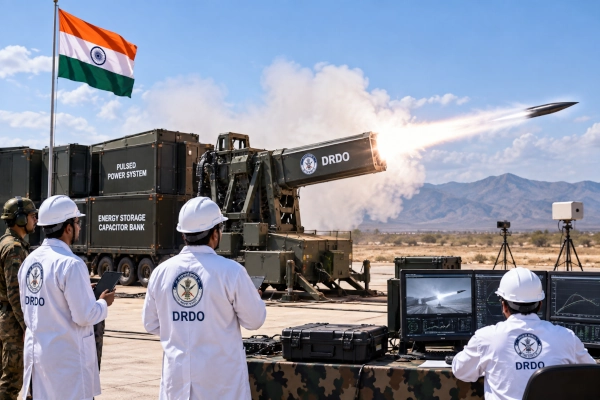
India’s Defence Research and Development Organisation is steadily building the technologies required for an electromagnetic railgun, a weapon that replaces the chemical propellant of a conventional gun with an intense pulse of electrical energy to accelerate a projectile to extreme velocity.
The programme, led primarily by the Armament Research and Development Establishment (ARDE) in Pune, has progressed beyond basic laboratory experimentation. DRDO has already developed and tested a 10-megajoule electromagnetic railgun system, established a dedicated Centre for Electromagnetic Launch Technology and begun work on the materials, pulsed-power systems, rail durability, mobility and targeting technologies required to turn the concept into a usable weapon.
The significance of the programme lies not simply in producing another artillery system. A mature electromagnetic gun could eventually occupy the space between conventional long-range artillery and expensive guided missiles, delivering high-velocity kinetic projectiles over considerable distances without depending upon the large chemical propellant charges required by traditional guns.
How an Electromagnetic Railgun Works
A conventional artillery gun obtains its energy from the rapid combustion of propellant behind a projectile. The resulting high-pressure gases expand inside the barrel and force the projectile forward. A railgun approaches the same problem differently.
Two conductive rails run parallel to one another, with the projectile or an associated armature completing an electrical circuit between them. When an extremely large electrical current is discharged through the system, the interaction between the current and the resulting magnetic field generates a Lorentz force that accelerates the projectile along the rails.
The projectile can consequently leave the launcher at velocities substantially higher than those associated with conventional artillery. DRDO has reported achieving velocities exceeding 2,000 metres per second with its experimental electromagnetic launcher. At such speeds, the projectile itself carries very high kinetic energy even before any consideration of an explosive payload.
This does not mean that railguns eliminate all the difficulties associated with artillery. They replace one difficult engineering problem—chemical propulsion—with several others, particularly the generation and storage of enormous electrical pulses, management of heat, erosion of the rails, switching very high currents and maintaining accuracy at extreme velocities.
It is these supporting technologies, rather than simply firing a projectile electrically, that determine whether an experimental railgun can become a military weapon.
India Has Already Built a 10-Megajoule Demonstrator
DRDO’s work has produced a 10-MJ electromagnetic railgun facility at ARDE using programmable pulsed-power technology. DRDO material states that the system has conducted a series of dynamic firing experiments and demonstrated projectile velocities above 2,000 metres per second.
The 10-MJ programme has effectively served as the technology base from which India can investigate larger electromagnetic launchers. Experience gathered from it is being applied to power storage, capacitor banks, switching systems, rails, launch structures and projectile acceleration.
The scale of the electrical challenge is considerable. A railgun does not draw its firing energy directly from a normal electrical generator at the instant the trigger is pressed. Energy must first be generated and stored before being released into the rails in an extremely short and powerful electrical pulse.
That requirement explains why capacitor banks are central to electromagnetic weapon development. The challenge is not merely storing several megajoules of energy, but discharging it rapidly and repeatedly without damaging the power electronics or launcher.
A Compact 10-MJ Railgun Points Towards Mobility
One of the more important steps towards a practical weapon appeared at Aero India 2025, where DRDO displayed a compact and transportable electromagnetic railgun configuration.
According to information provided by DRDO officials to Janes, the system incorporates a 10-MJ modular capacitor bank, lithium-chemistry battery bank, railgun launcher and a portable diesel generator. The capacitor arrangement reportedly consists of 25 modules storing 400 kilojoules each. A 15-kW generator is used to recharge the battery system, which in turn charges the capacitor bank used for firing.
The compact configuration is significant because mobility represents one of the fundamental barriers separating a laboratory railgun from a battlefield weapon. A fixed test installation can draw heavily on established power infrastructure and tolerate considerable weight and volume. A deployable system must carry or generate its own energy, withstand movement and vibration, survive military environments and still deliver repeatable high-energy pulses.
Janes reported that DRDO described the compact configuration as ready for field trials. The system was reported to accelerate projectiles beyond 2,000 metres per second, with rail life improved to more than 50 shots before maintenance. DRDO officials also indicated that a fully charged configuration could support multiple firings, although these figures should be regarded as development-stage characteristics rather than specifications of an inducted weapon.
The Much More Ambitious 100-MJ Programme
India’s longer-term ambition goes substantially beyond the 10-MJ demonstrator. DRDO has previously outlined plans for a 100-megajoule electromagnetic railgun capable of accelerating a much heavier projectile.
In its published technology material, DRDO described a concept for launching an 18-kg projectile at a velocity exceeding 2,000 metres per second using a 100-MJ capacitor bank. The development pathway envisages railguns of up to 155-mm class and eventual medium-range systems with potential engagement distances between approximately 100 and 400 kilometres.
Those numbers need to be understood correctly. They represent the direction and objectives of the development programme, not the performance of an operational Indian artillery system. Achieving more than 2,000 metres per second during a controlled firing test is very different from reliably launching an operational projectile hundreds of kilometres with the accuracy, rail life, rate of fire and logistical support required by the armed forces.
Nevertheless, the objectives show where DRDO wants the programme to go. A weapon capable of throwing a useful projectile mass to such velocities and ranges would begin to blur the traditional distinction between artillery and tactical missile systems.
CEMaLT Gives the Programme Dedicated Infrastructure
Another important development came with the establishment of the Centre for Electromagnetic Launch Technology, or CEMaLT, by DRDO.
The facility was inaugurated in 2025 specifically to support research into electromagnetic railguns and their associated subsystems. DRDO described CEMaLT as infrastructure intended to advance projectile launch at very high velocities without relying upon conventional propellants, with potential applications relevant to both the Indian Army and Indian Navy.
CEMaLT matters because railgun development requires specialised facilities that conventional artillery laboratories do not necessarily possess. Researchers must work with pulsed-power systems carrying enormous currents, high-energy capacitors, advanced switching equipment, electromagnetic modelling, high-speed diagnostics, launcher materials and specialised projectile designs.
Earlier DRDO documents also linked CEMaLT with development of the proposed 100-MJ railgun and specifically referred to eventual weaponisation and field adaptation for naval and land environments.
The programme should therefore no longer be viewed simply as an isolated experimental gun. DRDO is assembling an institutional and technological base around electromagnetic launch systems.
Rail Erosion Remains One of the Hardest Problems
The two conducting rails experience extraordinary electrical, mechanical and thermal stresses every time the weapon fires. Extremely high currents, friction, arcing and heating can damage the contact surfaces, gradually degrading launcher performance.
DRDO’s current technology roadmap shows how seriously the organisation is treating this problem. ARDE is pursuing graphene-based friction-reduction coatings, wear- and spark-erosion-resistant nickel-molybdenum cladding, and external electrical insulation for the barrel.
These may sound like secondary engineering details, but rail durability is one of the technologies that will determine whether a railgun becomes militarily useful. An artillery system that requires major maintenance after a small number of shots would have limited value during sustained combat.
Increasing rail life while preserving consistent projectile velocity and accuracy is therefore as important as increasing muzzle energy.
Power Generation Is the Other Major Battlefield Constraint
The second major problem is energy.
A 100-MJ weapon requires a power architecture far beyond that of an ordinary artillery piece. The energy must be generated, stored and released repeatedly while keeping the overall installation sufficiently compact for military deployment.
DRDO’s technology roadmap lists work on high-power compensator-based systems, lithium-silicon battery banks, semiconductor switches, liquid-metal current injectors, high-energy-density capacitors and supercapacitor processing. The roadmap also calls for a high-mobility mounting arrangement for an electromagnetic railgun.
This provides perhaps the clearest indication of the programme’s present direction. DRDO is no longer studying only whether electromagnetic launch works. It is tackling the technologies necessary to make the weapon smaller, more durable, mobile and capable of repeated firing.
For a land-based system, power generation and storage will directly affect vehicle numbers, deployment time and logistical burden. A future naval railgun could theoretically have access to much greater electrical-generation capacity aboard a suitably designed warship, but integrating repeated high-energy pulses into a ship’s electrical architecture would create its own demanding engineering requirements.
Why the Indian Army Could Be Interested
For the Indian Army, the attraction is principally range, velocity and the possibility of delivering kinetic effects without carrying the same quantity of artillery propellant required by conventional guns.
A future mobile electromagnetic gun could potentially attack command posts, logistics installations, air-defence positions, hardened infrastructure and other valuable targets at ranges traditionally associated with rockets or missiles.
High projectile velocity could also reduce flight time compared with conventional artillery at equivalent distances. That would compress the time available for a target to relocate after a firing solution has been generated.
Yet extreme range alone is of limited value without precision. Atmospheric effects, projectile heating and small errors in launch conditions become increasingly important as range rises. DRDO accordingly lists extreme-long-range targeting accuracy and firepower among the technology areas being pursued for the electromagnetic railgun.
The eventual military value of the weapon will therefore depend heavily on the projectile. A railgun without an effective guidance and targeting architecture would struggle to exploit its theoretical range against point targets.
The Indian Navy Could Eventually Be an Equally Important User
Naval applications are potentially attractive because warships already operate substantial electrical-generation systems and have fewer constraints on the physical footprint of energy-storage equipment than a mobile land battery.
A future railgun could potentially provide a surface combatant with a very-high-velocity weapon for long-range surface attack or land strike. Depending on how the technology develops, electromagnetic launch could also have applications against certain aerial threats.
There are, however, major integration hurdles. A shipboard railgun would have to coexist with propulsion, radar, electronic warfare, combat-management and other high-demand electrical systems. Saltwater corrosion, maintenance at sea, thermal management and the effects of repeated firing on the launcher would have to be addressed.
It is therefore premature to associate the present DRDO system with a specific Indian Navy ship class. DRDO has explicitly envisaged both land and naval adaptation, but no operational naval railgun installation has been announced.
Railguns Will Not Make Missiles Obsolete
It would also be misleading to describe electromagnetic railguns as replacements for missiles.
A missile can manoeuvre extensively, carry sophisticated seekers and guidance systems, alter its trajectory and deliver specialised warheads over very long ranges. A railgun projectile begins with enormous velocity but must operate within much tighter physical constraints, particularly because the electronics and guidance package must survive extraordinary acceleration during launch.
The two systems are therefore more likely to complement one another.
If electromagnetic artillery eventually provides an economical way of engaging some targets currently assigned to expensive missiles, commanders could reserve missile inventories for the targets that genuinely require their range, manoeuvrability, guidance or warhead effects.
That possibility explains DRDO’s description of the technology as potentially bridging part of the capability gap between conventional guns and missiles.
The Real Importance of DRDO’s Railgun Programme
India is not yet on the verge of inducting a 400-km electromagnetic cannon. Considerable engineering work remains before such a system could move through military trials and enter operational service.
What has changed is the maturity of the effort.
DRDO has demonstrated a 10-MJ electromagnetic launcher and hypervelocity firing, developed a transportable configuration, created dedicated infrastructure through CEMaLT and publicly identified the technologies required for higher-energy, mobile and longer-lived railgun systems. Its roadmap now includes advanced rail coatings, pulsed-power generation, batteries, capacitors, high-current switching, augmented rails, mobile mounting and extreme-range targeting.
The proposed 100-MJ system represents the next major leap. Moving from a laboratory demonstrator to a field weapon capable of repeatedly accelerating an 18-kg projectile beyond 2,000 metres per second would demand major progress in electrical engineering, materials, thermal management and precision fire control.
For now, DRDO’s railgun should be regarded as an advanced weapon-development programme rather than an operational capability. But the transition from proving the physics to addressing mobility, power, rail life and targeting shows that the programme has entered a considerably more serious phase of weaponisation.
You may also like
-
Inbound Aerospace Turns to Australia to Test India’s Recoverable Re-Entry Spacecraft
-
IIT Madras Develops Morphing Wing Technology to Improve Aircraft Stall Performance
-
DRDO Develops SWiFT-K High-Speed Stealth Kamikaze Drone as India Expands Indigenous Strike-UAV Programme
-
IIT Hyderabad Joins Andhra Pradesh’s Drone City Push as Kurnool Builds Full UAV Ecosystem
-
Quad Moves Indo-Pacific Logistics Network Toward Operational Stage With Tokyo Exercise
