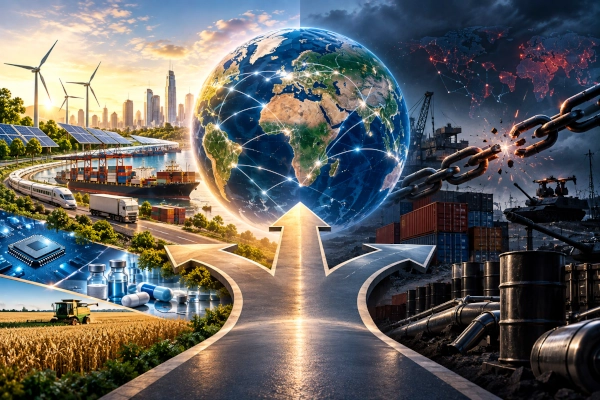
For several decades after the end of the Cold War, economic interdependence was treated largely as a source of prosperity and stability. Countries could specialise in what they produced most efficiently, purchase critical components from whichever supplier offered the best price, rely on international shipping and finance, and assume that commercial relationships would survive political disagreements. Globalisation rewarded efficiency, and governments gradually allowed supply chains for everything from energy and medicines to electronics and industrial machinery to stretch across continents.
That assumption is now being reconsidered. Wars, sanctions, export controls, pandemic-era shortages, semiconductor restrictions, energy disruptions and competition over critical minerals have demonstrated that dependence can also become a source of pressure. Governments increasingly ask not only whether a product can be imported cheaply, but whether it will remain available during a crisis. They are asking similar questions about energy, payment networks, telecommunications, artificial intelligence, defence equipment and access to strategic technologies.
The International Monetary Fund has described this transition as the rise of geoeconomics, where economic and national-security policy increasingly overlap. Tariffs, sanctions, export controls, investment restrictions and industrial policy are now routinely used to advance strategic objectives. The result is a world in which economic relationships can no longer be considered entirely separate from political power.
Strategic autonomy has returned because governments have begun to recognise the risks of possessing political independence while remaining critically dependent on another country for the systems that allow their economies and militaries to function.
Strategic Autonomy Does Not Mean Isolation
Strategic autonomy is often misunderstood as an attempt to become self-sufficient in everything. That would be neither realistic nor desirable for most countries. Modern economies depend on international trade because no nation can efficiently produce every mineral, machine, medicine, semiconductor, aircraft component or energy resource it requires.
The more useful definition of strategic autonomy is the ability of a state to make important national decisions without facing unacceptable pressure because of a critical external dependency. A country may remain deeply integrated into the world economy while ensuring that no single foreign supplier can completely disable a strategic sector.
This distinction separates strategic autonomy from autarky. Autarky seeks independence from international exchange. Strategic autonomy seeks freedom of action within an interconnected world.
The IMF has made a similar argument in examining the growing importance of economic security. International specialisation creates enormous efficiency gains, but it can also create dependencies when crucial goods or services are concentrated in a small number of countries. Targeted diversification in genuine chokepoint sectors can therefore reduce vulnerability without requiring wholesale economic separation.
The Pandemic Exposed the Risks of Extreme Efficiency
The COVID-19 pandemic provided one of the first major demonstrations of how efficiently designed supply chains could become strategically fragile. Shortages emerged in pharmaceuticals, medical equipment, semiconductors and industrial inputs as factories closed and transport networks were disrupted.
Countries discovered that apparently ordinary products could become strategic assets when supplies suddenly disappeared. Governments that had spent decades allowing production to concentrate wherever costs were lowest began examining whether certain capabilities needed to exist closer to home.
Europe was particularly affected by this debate. The European Commission increasingly adopted the concept of open strategic autonomy, arguing that Europe should remain open to international trade while reducing dangerous dependencies in critical sectors. Its industrial strategy identified vulnerabilities involving raw materials, batteries, pharmaceutical ingredients, hydrogen, semiconductors and cloud technologies.
By 2026, this had moved well beyond pandemic preparedness. European economic policy explicitly emphasised economic security, stronger defence capabilities and reducing strategic dependencies across major value chains.
Strategic autonomy was no longer an abstract foreign-policy concept. It had become industrial policy.
The Ukraine War Changed the Meaning of Economic Dependence
Russia’s invasion of Ukraine accelerated the shift dramatically. European dependence on Russian energy, Russia’s dependence on Western financial and technological systems, and the extensive use of sanctions demonstrated how economic relationships could quickly become instruments of geopolitical confrontation.
European governments that had regarded inexpensive Russian gas as economically beneficial were forced to reconsider the security consequences of excessive concentration. Russia, meanwhile, discovered the risks associated with relying heavily on Western financial networks and imported advanced technologies.
The lesson extended far beyond Europe. Countries across Asia, Africa, the Middle East and Latin America watched economic infrastructure become part of warfare without formally becoming military infrastructure.
Payment systems, insurance, shipping, energy networks, semiconductor equipment and reserve assets suddenly became part of the strategic battlefield.
The conclusion was not necessarily that globalisation had failed. It was that interdependence without alternatives could become dependence, and dependence could become leverage.
The US-China Rivalry Has Turned Technology Into Strategic Territory
The competition between the United States and China has reinforced this trend. Semiconductors, artificial intelligence, telecommunications equipment, batteries, rare-earth processing and advanced manufacturing technologies are increasingly treated as strategic capabilities rather than ordinary commercial products.
Washington has imposed extensive controls on the transfer of advanced semiconductor technologies to China, while China has sought to strengthen indigenous technological capabilities and has exercised greater control over strategic mineral supply chains.
The consequences extend beyond the two countries. Companies and governments around the world must now consider whether technology purchased from one side could later become inaccessible because of sanctions, export controls or geopolitical pressure.
This has encouraged semiconductor programmes in India, Europe, Japan and other economies. It has also accelerated efforts to diversify critical-mineral supply chains and establish domestic capacity in batteries, electronics, defence systems and advanced computing.
The IMF notes that the sectors most vulnerable to coercion tend to be those where alternatives are difficult to create quickly because of economies of scale, technological concentration or infrastructure requirements. Financial services, semiconductor technologies and certain manufacturing networks fit this pattern particularly well.
Strategic autonomy therefore increasingly depends on understanding where genuine chokepoints exist rather than attempting to manufacture everything domestically.
India Has Practised Strategic Autonomy for Decades
For India, strategic autonomy is not a new concept created by the current period of geopolitical fragmentation. It has been a recurring feature of Indian foreign policy since independence.
India’s Ministry of External Affairs describes the pursuit of strategic space and autonomy as one of the continuing objectives of Indian foreign policy. India’s earlier policy of non-alignment was built partly around preserving independent judgment rather than automatically joining one geopolitical bloc against another.
The terminology has evolved, but the underlying principle remains visible. India cooperates extensively with the United States, Japan and Australia through the Quad while maintaining longstanding relations with Russia. It participates in BRICS and the Shanghai Cooperation Organisation while building increasingly extensive economic, military and technological relationships with Europe and the United States. It has simultaneously deepened relations with Israel, Saudi Arabia, the UAE, Iran and other states whose interests do not always coincide.
This approach is sometimes described as multi-alignment, but its purpose remains closely connected to strategic autonomy: India seeks partnerships without surrendering its ability to make independent decisions when its interests differ from those of its partners.
Autonomy Now Depends on Industrial Capability
Diplomatic flexibility alone, however, cannot create strategic autonomy. A country may possess an independent foreign policy on paper while remaining dependent on foreign suppliers for weapons, energy, communications systems or critical technologies.
This explains India’s growing emphasis on domestic capability in defence, space, electronics, semiconductors, energy and advanced manufacturing.
Prime Minister Narendra Modi has explicitly linked self-reliance in strategic sectors with India’s ability to act independently, particularly in defence and technology. India’s push for indigenous weapons, domestic semiconductor production, renewable-energy manufacturing, space technology and critical-mineral partnerships reflects the view that political autonomy ultimately requires an adequate domestic industrial base.
The objective is not to eliminate imports. India will continue purchasing foreign technology and participating in international supply chains. The objective is to reach a point where foreign dependence does not become a veto over national policy.
That distinction is central to understanding modern strategic autonomy.
Europe Has Arrived at a Similar Conclusion
India is not alone. Perhaps the most striking development of recent years has been Europe’s growing use of language that resembles concepts India has discussed for decades.
The European Union’s idea of open strategic autonomy combines continued international trade with efforts to strengthen European capacity in areas where external dependence could create unacceptable risks.
Europe is investing in semiconductor manufacturing, defence production, energy diversification, critical minerals, battery supply chains and digital infrastructure. The European Commission’s 2026 economic recommendations explicitly call for reducing strategic dependencies while strengthening research, industrial competitiveness, defence investment and economic security.
This does not mean Europe intends to withdraw from its alliance with the United States. Rather, European policymakers increasingly recognise that alliances do not remove the need for independent capability.
Strategic autonomy is therefore no longer primarily associated with countries seeking distance from great-power blocs. Even close allies are attempting to build greater room for independent action.
France Has Made Strategic Autonomy Part of Technology Policy
France has long been among Europe’s strongest advocates of strategic independence, particularly in defence, nuclear energy and aerospace. That thinking is now expanding into newer technological sectors.
The India-France Innovation Roadmap 2030, announced in February 2026, explicitly connects innovation with economic resilience, technological sovereignty and strategic autonomy. India and France identified artificial intelligence, digital technology, cybersecurity, research and advanced industrial cooperation as areas in which stronger bilateral capabilities could reduce vulnerability while expanding economic opportunity.
This illustrates an important feature of modern strategic autonomy. It does not always mean producing technology alone. Countries can achieve greater autonomy through trusted partnerships that diversify supply chains and prevent excessive reliance on a single source.
A country does not necessarily need to own every link in a supply chain. It needs enough alternatives to prevent one link from becoming a strategic choke point.
Energy Security Has Become Strategic Autonomy
Energy is another area where the transformation is obvious. Countries that depend heavily on imported oil, gas or coal have always understood the relationship between energy and national security. The energy transition is creating new dependencies rather than eliminating them.
Electric vehicles require lithium, nickel, cobalt, graphite and rare-earth elements. Solar manufacturing depends heavily on concentrated industrial supply chains. Wind turbines, battery storage and electricity grids require large quantities of specialised materials.
The transition from fossil fuels therefore does not automatically create energy independence. It changes the resources on which countries depend.
This explains the global race to secure critical minerals, build domestic battery manufacturing, diversify energy suppliers and develop renewable-energy technology. Nuclear energy has also regained strategic attention in several countries because it can provide large quantities of electricity without continuous fuel imports on the scale required by fossil-fuel power generation.
Energy policy is increasingly being designed around resilience rather than cost alone.
Defence Autonomy Has Returned to the Centre
Defence provides perhaps the clearest example of why strategic autonomy matters.
A military that depends entirely on foreign suppliers remains vulnerable even when those suppliers are allies. Spare parts can be delayed, ammunition production may be insufficient, political disagreements can affect deliveries, and foreign governments may restrict the use or transfer of sensitive technology.
The wars of recent years have demonstrated that ammunition consumption can rapidly exceed peacetime manufacturing capacity. Countries across Europe are therefore rebuilding defence-industrial capabilities that had declined after the Cold War.
India has pursued the same objective through domestic missile programmes, warship construction, artillery production, combat aircraft development and the growing involvement of private defence companies.
Defence self-reliance does not require every component to be indigenous. Even the world’s largest defence industries depend on international suppliers. What matters is whether a country has sufficient control over critical systems to sustain military operations when external supply becomes uncertain.
Finance Is Another Emerging Chokepoint
Strategic autonomy increasingly extends to finance. The dominance of major reserve currencies, international payment infrastructure and Western financial institutions gives the United States and Europe powerful tools of economic statecraft.
Sanctions against Iran and Russia have demonstrated how restrictions on banking, payments, reserves and access to financial markets can significantly affect international commerce.
This has encouraged countries to explore local-currency settlement, alternative payment systems and stronger regional financial links. Such initiatives are frequently described as attempts at de-dollarisation, but the more important motivation is often redundancy.
Countries may continue using dollars because dollar markets are liquid and efficient while simultaneously creating alternative channels in case political circumstances disrupt access to established systems.
Financial strategic autonomy therefore follows the same logic as energy or technology diversification: maintaining access to the existing system while avoiding total dependence on it.
Middle Powers Want Choices, Not New Masters
The revival of strategic autonomy is particularly visible among middle powers. Saudi Arabia, the UAE, Türkiye, Brazil, Indonesia and others increasingly maintain relationships across competing geopolitical blocs.
These countries may purchase Western defence equipment, trade extensively with China, cooperate with Russia in selected sectors and pursue regional policies based primarily on their own interests.
Their objective is not necessarily neutrality. Many have formal alliances or strong security partnerships. What they increasingly resist is the expectation that cooperation with one major power must automatically prevent cooperation with another.
A more multipolar world gives such countries greater bargaining power because several major centres compete for partnerships.
This creates a foreign-policy environment where governments can negotiate issue by issue rather than aligning permanently across every geopolitical question.
Supply Chains Are Being Redesigned Around Trust
The shift towards strategic autonomy is also changing corporate decisions. For decades, multinational companies primarily optimised supply chains around cost, scale and efficiency. Governments are now encouraging firms to consider political reliability and geographic concentration alongside price.
Concepts such as friend-shoring, near-shoring and China-plus-one reflect this transition.
India has benefited from some of these trends as companies seek additional manufacturing locations for electronics, pharmaceuticals, automobiles and other products. Indian diplomatic thinking has increasingly described this shift as one from extreme optimisation towards resilient global value chains based partly on reliability and trust.
However, there is an important difference between diversification and economic fragmentation. Moving some production away from concentrated sources can increase resilience. Dividing the global economy permanently into hostile blocs could impose enormous costs.
Too Much Strategic Autonomy Can Become Strategic Isolation
There is a danger that governments may use national security as justification for protectionism in sectors that are not truly strategic. If every product becomes a national-security concern, the economic advantages of international specialisation begin to disappear.
The WTO warns that the world trading system is facing its most sustained disruption in decades as geopolitical tensions, industrial policy and changing economic power strain existing rules. Its 2026 modelling estimates that a deeply geo-fragmented world divided into geopolitical blocs could reduce global GDP by 5.1 per cent and global exports by 18.6 per cent compared with a functioning multilateral system.
The challenge is therefore to identify genuine vulnerabilities without turning resilience into indiscriminate economic nationalism.
Semiconductors may justify extraordinary attention because advanced chips are produced through highly concentrated and difficult-to-replicate supply chains. The same may be true of certain medicines, minerals, defence components or energy infrastructure. Producing ordinary consumer goods domestically at enormous cost simply because they are imported is a very different proposition.
Successful strategic autonomy requires discrimination between strategic dependence and ordinary interdependence.
Strategic Autonomy Is Ultimately About Choice
The defining feature of strategic autonomy is not self-sufficiency but choice.
A strategically autonomous country should be able to obtain energy from more than one supplier, acquire technology through multiple partnerships, maintain sufficient domestic defence capability, access several markets and conduct financial transactions through more than one viable channel.
Such a country may still depend heavily on international trade. What it avoids is dependence so concentrated that another state can dictate its decisions by threatening to close a single critical channel.
That is why strategic autonomy is returning across very different political systems. India calls for self-reliance and independent decision-making. Europe speaks of open strategic autonomy and economic security. Japan is strengthening supply-chain resilience. Gulf states are diversifying diplomatic and economic partnerships. The United States itself is subsidising semiconductor manufacturing and restricting critical technology transfers.
Different governments use different terminology, but the underlying concern is increasingly similar.
The World Is Not Deglobalising Completely
It would be a mistake to conclude that globalisation is simply ending. International trade remains immense, multinational supply chains remain deeply interconnected and countries continue to depend on one another for markets, technology, commodities and capital.
The WTO notes that low- and middle-income countries accounted for around 45 per cent of global merchandise trade by 2024, nearly double their share in 1995. The global economy has become not only more integrated but also more multipolar.
What is changing is the political assumption underlying integration.
Governments no longer assume that the cheapest supplier will always remain available, that financial networks will remain politically neutral, or that commercial relationships will automatically survive geopolitical confrontation.
Globalisation is therefore becoming more guarded.
Efficiency is being balanced against resilience. Cost is being balanced against security. Dependence is being measured alongside trade.
The Return of an Old Idea in a New Form
Strategic autonomy is not a new concept. What is new is the number of countries that now consider it necessary.
During the Cold War, it was primarily associated with states that wanted to remain outside rigid superpower blocs. In the twenty-first century, it increasingly describes something broader: the capacity to preserve national freedom of action in a world where economic networks themselves can become instruments of power.
A modern state cannot achieve that objective through diplomacy alone. It requires industrial capacity, technological competence, secure energy supplies, financial options, resilient infrastructure and credible defence capabilities.
Nor can strategic autonomy be achieved by withdrawing from the world. Countries that isolate themselves may reduce some external dependencies while simultaneously weakening the economic and technological foundations of their own power.
The more successful model will be one of deep engagement combined with carefully constructed alternatives.
Countries will trade globally but diversify critical supply chains. They will form partnerships without surrendering independent judgment. They will import technology while developing domestic capabilities. They will participate in international financial networks while building backup channels. They will cooperate militarily while preserving enough national capacity to act when partners disagree.
In a fragmented world, strategic autonomy is therefore becoming less about standing apart and more about ensuring that no relationship becomes indispensable.
The countries best positioned for the coming decades may not be those that choose one geopolitical camp most completely. They may be those capable of working with several centres of power while retaining enough economic, technological and military strength to make their own choices when those powers disagree.
You may also like
-
Quad Moves Indo-Pacific Logistics Network Toward Operational Stage With Tokyo Exercise
-
RVNL Completes 10.8-km Himalayan Escape Tunnel as Rishikesh–Karnaprayag Rail Project Nears Final Tunnelling Stage
-
India Emerges as World’s Largest Vaccine Producer as CEPI Partnership Enters Next Phase
-
Indian Railways Freight Loading Rises 5.4% in August as Passenger and Cargo Connectivity Expands
-
CAZRI’s New Moth Bean Varieties Withstand 35-Day Dry Spell in Rajasthan
