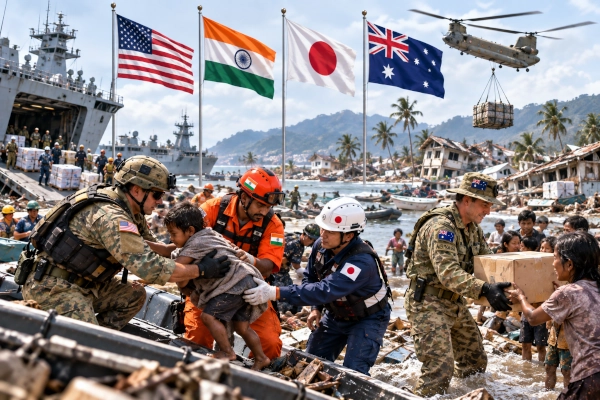
India, Australia, Japan and the United States have taken another step towards making the Quad Indo-Pacific Logistics Network operational, conducting a tabletop exercise in Tokyo aimed at improving their ability to rapidly coordinate logistics during major natural disasters across the Indo-Pacific.
The exercise was conducted on September 3 and 4 and hosted by Japan’s Ministry of Defense in coordination with its Ministry of Foreign Affairs and the diplomatic and defence authorities of India, Australia and the United States. Japan formally announced details of the exercise on September 11. The four countries subsequently issued a joint press release on the exercise.
Testing How Four Logistics Networks Can Work Together
The exercise examined how the four Quad countries could use their respective logistics capabilities to deliver assistance more rapidly and efficiently when a large natural disaster strikes somewhere in the Indo-Pacific.
Rather than concentrating on combat operations, the Indo-Pacific Logistics Network has been designed primarily around civilian disaster response. Its importance lies in bringing together four countries possessing significant military and civilian transport capabilities, including ships, aircraft, logistics facilities, communications networks and disaster-response organisations.
A major earthquake, tsunami, cyclone or other regional emergency can create an immediate requirement for food, medical supplies, engineering equipment, shelters and rescue personnel. The effectiveness of the response often depends less on the availability of aid than on the ability to move it rapidly through ports, airports and staging areas. The IPLN seeks to establish mechanisms that allow the four countries to coordinate those capabilities rather than operate independently during a crisis.
From a Pilot Initiative to an Operational Network
The Indo-Pacific Logistics Network was launched as a pilot initiative at the Quad Leaders’ Summit in 2024. Its objective was to determine whether the shared logistics capabilities of India, Australia, Japan and the United States could be used to strengthen civilian responses to major natural disasters in the region.
The initiative subsequently moved from political agreement towards practical testing. A tabletop exercise was held in April 2025, followed by a field training exercise during Operation Christmas Drop in December 2025. Quad foreign ministers subsequently agreed that the network should be progressively operationalised through a structured series of engagements.
The September 2026 Tokyo exercise represents the next stage in that process. Instead of merely establishing that cooperation is desirable, the four countries are increasingly examining the procedures required to make such cooperation function during an actual emergency.
Standard Operating Procedures Become the Next Priority
One of the most important objectives of the IPLN programme is the development of common Standard Operating Procedures. Quad foreign ministers have previously said these procedures should facilitate multimodal logistics coordination while improving staging, sustainment and operations during disaster response.
This is significant because multinational disaster response can involve several layers of coordination. Aircraft from one country may deliver supplies to an airport operated by another partner, while ships, helicopters and ground transport may subsequently move them into affected regions. Information about available transport, warehouses, fuel, medical facilities and routes must therefore be shared quickly if assistance is to reach affected populations without duplication or delay.
Developing procedures before a crisis occurs allows participating countries to identify potential bottlenecks and establish channels through which logistical decisions can be made rapidly.
Quad Disaster Response Cooperation Has Been Expanding
The logistics network forms part of the broader Quad Partnership on Humanitarian Assistance and Disaster Relief. The partnership was announced at the Quad Leaders’ Meeting in 2022, with guidelines subsequently established to improve coordination among the four countries during regional disasters.
Quad countries have already coordinated responses to major emergencies, including the 2024 landslide in Papua New Guinea’s Enga Province and the 2025 earthquake in Myanmar. These experiences have reinforced the need for mechanisms that allow information sharing, transport planning and relief operations to begin quickly after a disaster.
The four countries have consequently been developing not only logistics procedures but also post-crisis review mechanisms, strategic communications arrangements and wider humanitarian-response coordination.
India Brings a Major Indian Ocean Logistics Position
For India, participation in the IPLN carries particular importance because of its geographic position at the centre of the Indian Ocean and its growing ability to provide humanitarian assistance across the wider region.
India has repeatedly deployed naval ships, military transport aircraft, helicopters, medical teams and disaster-response personnel during emergencies in the Indian Ocean and neighbouring countries. Integration with Australian, Japanese and American logistics networks could allow those capabilities to be combined more effectively during particularly large or geographically dispersed disasters.
The arrangement could also improve familiarity between Indian personnel and the logistics systems of the three other Quad partners, something that becomes increasingly valuable when several countries have to respond simultaneously to the same crisis.
Civilian Mission, but With Wider Strategic Significance
The Quad has been careful to describe the Indo-Pacific Logistics Network as a mechanism supporting civilian responses to large-scale natural disasters. The Tokyo exercise should therefore not be portrayed as the creation of a NATO-style military logistics structure.
Nevertheless, the network has broader strategic significance. Logistics coordination requires countries to understand one another’s transport capabilities, planning systems, communication channels and operating procedures. Regular cooperation therefore improves interoperability and institutional familiarity among the four countries even when the immediate mission is humanitarian.
Japan’s Ministry of Foreign Affairs describes humanitarian assistance and disaster relief as one of several areas of practical Quad cooperation, alongside maritime security and critical and emerging technologies, within the broader objective of supporting a free and open Indo-Pacific.
Moving From Coordination to Preparedness
The importance of the Tokyo exercise therefore lies less in the tabletop event itself than in the gradual construction of a functioning multinational logistics framework.
Since its launch as a pilot programme in 2024, the Indo-Pacific Logistics Network has progressed through tabletop planning, field exercises and now further work on common operating procedures. Each stage is intended to reduce the amount of coordination that would have to be improvised after a major disaster.
For a region regularly exposed to earthquakes, tsunamis, cyclones, volcanic activity and other natural emergencies, the ability to rapidly combine the transport and logistics resources of India, Australia, Japan and the United States could become one of the Quad’s most practical contributions to regional resilience.
The Tokyo exercise indicates that the Quad is increasingly attempting to translate political cooperation into mechanisms that can function on the ground. If the IPLN continues moving towards common procedures and regular practical exercises, it could eventually provide the four countries with a standing framework through which large-scale humanitarian assistance can be mobilised across the Indo-Pacific at far greater speed.
You may also like
-
DRDO Opens Indigenous Electro-Mechanical Actuator Technologies to Indian Industry
-
Narendra Modi Completes 25 Years in Government: From Gujarat to the Mission of Viksit Bharat
-
Hical Technologies Expands Rafale and Aerospace Manufacturing with New Bengaluru Facility
-
IZI Enterprise Wins DRDO Order for VANA Surveillance Drones
-
ideaForge Enters Long-Range ISR and UCAV Segment with ZOLT Hybrid and ZOLT Combat Drone
