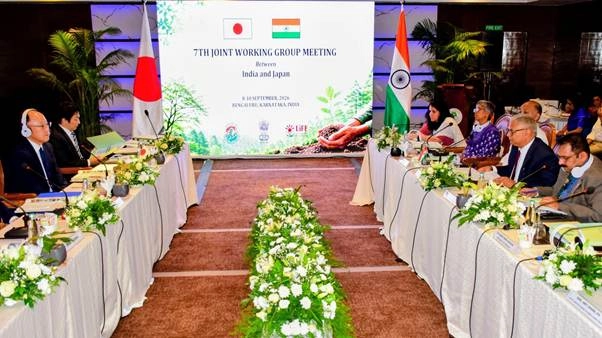
India and Japan have agreed on a new roadmap for expanding cooperation in forestry, biodiversity conservation, research and capacity building, with the two countries concluding the 7th India-Japan Joint Working Group Meeting on Forests in Bengaluru on September 8, 2026.
The Indian delegation was led by Ramesh Kumar Pandey, Additional Director General of Forests in the Ministry of Environment, Forest and Climate Change, while the Japanese side was headed by Shimizu Kotaro, Deputy Director General of Japan’s Forestry Agency under the Ministry of Agriculture, Forestry and Fisheries.
Discussions centred on three areas — Trees Outside Forests, forest genetics and the Forest Stack framework — reflecting a broader effort to combine traditional forest management with improved planting material, genetic conservation and modern monitoring technologies.
Under the Trees Outside Forests segment, the two sides exchanged experience on assessing and managing tree resources growing beyond formally classified forest areas. Discussions also covered genetic improvement, an area that can support better productivity, resilience and quality of planting material used in agroforestry and other tree-based systems.
Forest genetics formed another major part of the meeting. India and Japan discussed conservation of genetic resources, tree-breeding programmes, germplasm preservation and the development of improved planting material. Such cooperation can support long-term forest restoration and help maintain genetically diverse tree populations.
The Forest Stack discussions focused on the use of technology for forest assessment and monitoring. The two delegations exchanged approaches to forest inventories, assessment of forest stocks, geospatial applications and monitoring systems, areas that are becoming increasingly important for tracking forest health, changes in land cover and conservation outcomes.
A key outcome of the meeting was the endorsement of a Roadmap for 2027–2031 under the India-Japan Memorandum of Cooperation on forests signed in 2015. The roadmap is intended to guide the next phase of collaboration in forestry, biodiversity conservation, research and institutional capacity building.
The meeting concluded with the signing of the minutes of the 7th Joint Working Group, formally recording the areas of agreement and future cooperation.
The programme also includes field-level exchanges intended to connect policy discussions with forestry practices on the ground. The delegations visited the Institute of Wood Science and Technology in Bengaluru and interacted with officials of the Karnataka Forest Department.
On September 9, the two sides are scheduled to visit sandalwood agroforestry farms, a sandalwood depot and a processing facility in Mysuru. These visits are expected to provide an opportunity to study the cultivation of sandalwood on private farms and exchange experience on management and processing practices.
The programme will conclude with a visit to Nagarhole Tiger Reserve on September 10, where the delegations will examine wildlife and habitat conservation practices.
The Bengaluru meeting marks another step in a forestry partnership that has been in place for more than a decade, with the new five-year roadmap placing greater emphasis on scientific forestry, genetic resources, technology-enabled monitoring and practical exchanges between Indian and Japanese institutions.
You may also like
-
India and Italy Hold First Maritime Security Dialogue in Rome, Strengthen Strategic Maritime Cooperation
-
India and Azerbaijan Agree to Strengthen Security, Trade, Energy and Economic Cooperation
-
Jaishankar Meets Azerbaijan President Ilham Aliyev in Baku, Discusses Trade, Technology and Strategic Cooperation
-
Piyush Goyal Holds High-Level Talks in Berlin to Strengthen India–Germany Trade, Investment and Industrial Cooperation
-
Indian Navy to Host Indo-Pacific Regional Dialogue 2026 with Experts from 18 Countries on Maritime Science and Technology
