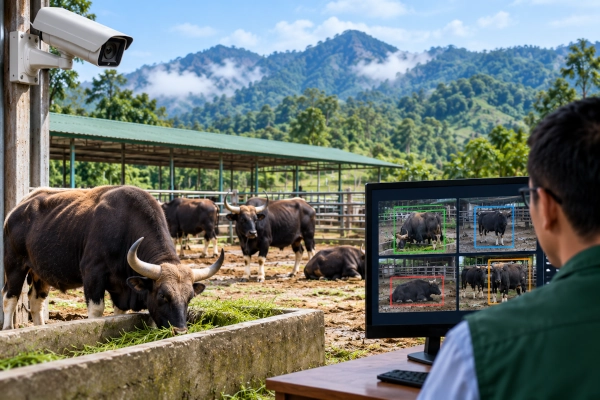
Researchers at the ICAR-National Research Centre on Mithun in Nagaland have developed an artificial intelligence-based system capable of automatically detecting and tracking the behaviour of Mithun, opening the way for continuous technology-assisted monitoring of one of Northeast India’s most important livestock species.
Mithun, scientifically known as Bos frontalis and often called the “Cattle of the Hills”, has deep economic, social and cultural importance for several tribal communities across Northeast India. Traditionally, monitoring the animals depends heavily on direct human observation. Researchers are now exploring whether cameras and artificial intelligence can provide farmers and livestock managers with continuous information on animal activity without requiring round-the-clock physical supervision.
The system developed by researchers from ICAR-NRC on Mithun, working with NIT Nagaland, Nagaland University and CHRIST (Deemed to be University), uses computer vision to recognise four important behaviours: feeding, standing, lying and mounting.
Researchers installed 12 high-definition CCTV cameras across two sheds at the ICAR-NRC on Mithun farm in Nagaland. The network provided continuous surveillance during both daytime and nighttime, with infrared imaging allowing the animals to be monitored even under low-light conditions.
From the resulting video footage, the team created a dataset containing 3,000 manually annotated images representing the four selected behaviours. These images were then used to develop and evaluate the artificial intelligence framework.
The system combines the YOLOv8n object-detection model with DeepSORT tracking technology. YOLO identifies the animal and its behaviour in individual video frames, while DeepSORT follows animals as they move through successive frames and assigns persistent identities to them.
This means the system can do more than simply recognise that a Mithun is feeding or lying down. It can also attempt to determine which individual animal is performing that behaviour as it moves through the monitored area.
The results reported by the research team were highly encouraging. The YOLOv8n model achieved a mean average precision of 99.5% at [email protected] and a recall of 99.6%. On an NVIDIA RTX 3060 graphics processor, the system processed approximately 31 video frames per second, making real-time operation possible.
Researchers also tested the system under conditions that commonly complicate automated livestock monitoring. These included animals partially blocking one another, background clutter, wet and uneven ground, shadows, motion blur and infrared footage recorded at night.
The importance of such monitoring extends well beyond simply keeping track of where an animal is located. Behavioural changes can often provide useful information about the health and physiological condition of livestock.
Alterations in feeding patterns, for example, may indicate changes in nutrition, illness or stress. Differences in the amount of time an animal spends standing or lying can provide information about comfort and health, while mounting behaviour can be particularly useful in identifying reproductive activity and supporting oestrus management.
An automated system capable of recording such behavioural patterns continuously could therefore provide livestock managers with a much richer picture of an animal’s condition than occasional manual observations.
For Mithun farmers, this could eventually translate into earlier recognition of unusual behaviour, improved breeding management and more efficient use of labour. Camera-based monitoring also has the advantage of being non-contact, meaning the animals do not need to wear sensors or other electronic devices for the system to observe their activity.
The researchers, however, have emphasised that the technology remains at the research stage. The current system has been evaluated at only one farm and will need to be tested under a much wider range of conditions before large-scale deployment can be considered.
Future validation will need to examine its performance across different geographical regions, seasons, stocking densities, farm layouts and camera configurations. Heavy occlusion, where animals block one another from the camera, can still affect detection and identity tracking.
The present system is also limited to four behaviours. Researchers envisage expanding it to recognise additional activities such as aggression, grooming and prolonged inactivity associated with illness.
Future versions could incorporate temporal AI models capable of examining behaviour across longer periods instead of relying primarily on individual video frames. Edge computing could also allow some of the artificial intelligence processing to take place directly on devices installed at farms, potentially reducing dependence on powerful central computers or continuous high-bandwidth connectivity.
Building larger datasets covering more farms, animals and seasonal conditions will be another important part of improving the system.
The project represents a wider shift towards precision livestock farming, in which cameras, sensors, artificial intelligence and data analytics are increasingly being explored as tools for managing animals more efficiently.
For livestock systems in difficult or remote terrain, such technologies could be particularly valuable. Mithun are closely associated with the hill regions of Northeast India, where continuous physical monitoring of animals can be difficult and labour-intensive.
By combining traditional livestock science with computer vision, the Nagaland research demonstrates how artificial intelligence could eventually help farmers observe herd behaviour around the clock, identify important changes earlier and make breeding and animal-management decisions using continuous behavioural data.
The research has been published in Engineering Research Express, Volume 8 (2026), Article 175213.
Source: PIB: https://www.pib.gov.in/PressReleaseDetail.aspx?PRID=2307952®=48&lang=1
You may also like
-
ICAR Scientists Develop Indigenous Protective Gloves for Cotton Farmers, Sign Commercial Manufacturing Agreement
-
India Moves Towards Five-Year Assured Orders for Defence Startups Under New Procurement Reforms
-
BHEL–Coal India Joint Venture Begins Construction of ₹25,016 Crore Indigenous Coal Gasification Project in Odisha
-
Zen Technologies Introduces Indigenous Hyper-Strike Falcon AI-Guided Counter-Drone Interceptor
-
L&T and Germany’s SCHOTTEL Expand Partnership for Controllable Pitch Propeller Systems in Indian Shipbuilding
