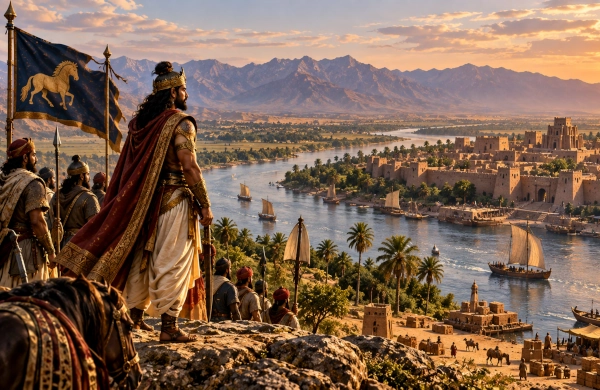
Among the great western regions described in the Mahabharata, Sindhu occupies a prominent place. Closely associated with the mighty Sindhu River, or Indus, the kingdom lay in the northwestern part of ancient Bharat and is generally identified with the lower Indus Valley and much of present-day Sindh in Pakistan, with its wider cultural and political sphere touching regions adjoining present-day western India.
Sindhu becomes particularly important in the epic because its most famous ruler was Jayadratha, husband of Duhshala, the only sister of the Kaurava brothers. Through Jayadratha, this distant Indus kingdom became directly connected with the Kuru dynasty and eventually played a decisive role in one of the most tragic episodes of the Kurukshetra War.
The Land of Sindhu
The word Sindhu has several meanings in ancient Indian literature. It is the Sanskrit name of the Indus River, but it was also used for the people and political territory associated with the river.
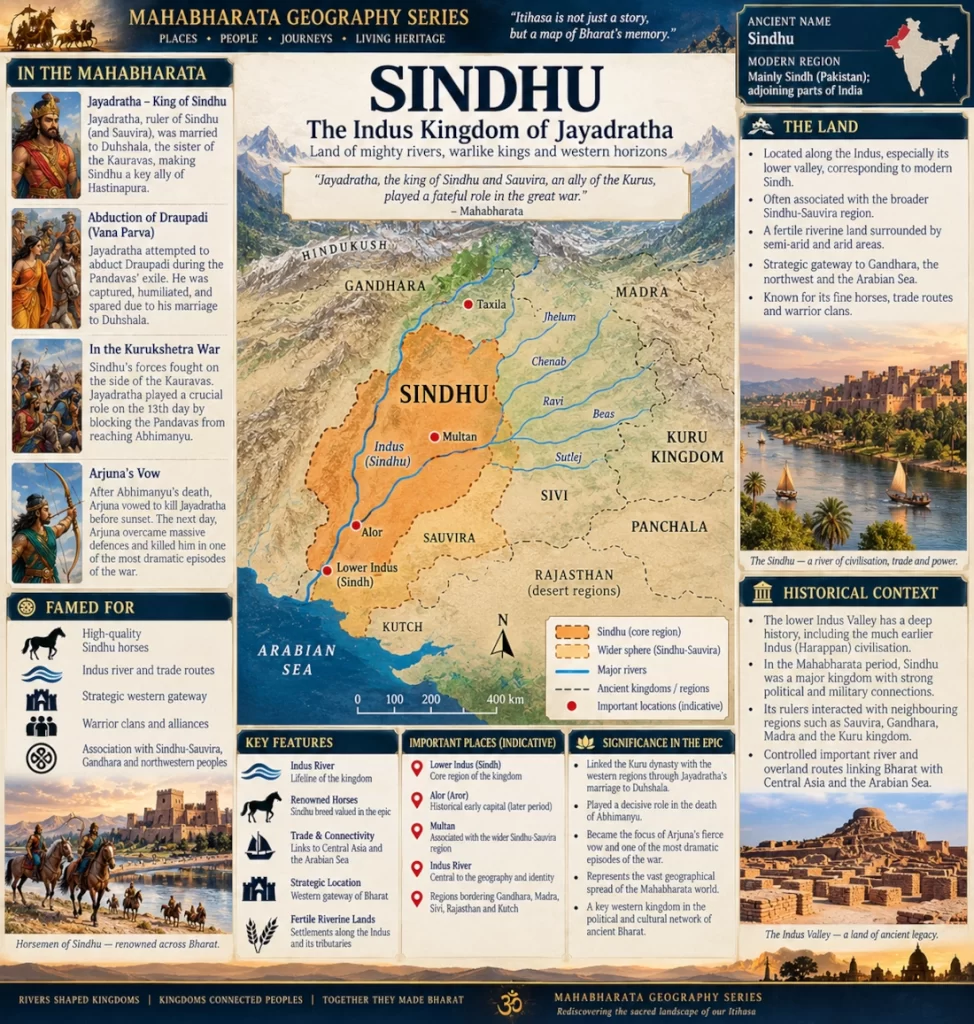
Historical geographical studies generally place the Sindhu country along the Indus, particularly its lower reaches. Ancient geographical traditions distinguish it from neighbouring regions such as Gandhara, Madra and Sauvira, although Sindhu and Sauvira are so frequently linked in the Mahabharata that their political histories clearly overlapped. One traditional geographical study describes Sindhu primarily as the country along the Indus while noting that the name later came particularly to denote the lower portion corresponding broadly to modern Sindh.
The Bhishma Parva itself lists the Sindhus among the recognised peoples and provinces of Bharat and elsewhere refers jointly to the Sindhu-Sauviras, confirming their place within the epic’s geographical conception of northwestern India.
The heartland of Sindhu was shaped overwhelmingly by the river. Unlike the heavily forested Himalayan kingdoms or the fertile monsoon plains farther east, the lower Indus region depended upon a great river flowing through an increasingly dry landscape.
The Sindhu River — Lifeline of the Kingdom
The Sindhu River was one of the great geographical features known to ancient Indians.
The Mahabharata treats the river itself separately from the political kingdom. In the Sabha Parva, Sindhu appears among the sacred and celebrated rivers of the world in the divine assembly of Varuna.
For the inhabitants of the Sindhu country, the river provided water, fertile floodplains, communications and routes of exchange. Settlements naturally clustered along its channels and tributary systems while surrounding areas gradually merged into arid and semi-arid country.
This geographical dependence on the Indus would remain one of the defining features of Sindh throughout later history.
Sindhu and Sauvira
One of the more complicated questions in Mahabharata geography concerns the relationship between Sindhu and Sauvira.
The epic sometimes treats the two as separate peoples and elsewhere combines them as Sindhu-Sauvira. Jayadratha himself is variously described as king or ruler of Sindhu, Sauvira and associated territories.
When Jayadratha encounters Draupadi during the Pandavas’ exile, the Vana Parva explicitly calls him the king of Sindhu, Sauvira and other countries.
Ancient geographical studies have therefore offered several reconstructions. Sindhu is generally connected with the Indus country, particularly lower Sindh, while Sauvira may have occupied territory farther upstream or east of the river. One scholarly reconstruction places Sauvira around the upper Sindh and southern Punjab region, while another ancient geographical tradition associates it with territory around Multan and regions below the great Punjab river confluences.
It is therefore best to understand Sindhu-Sauvira as a closely interconnected political and cultural zone of the lower and middle Indus region, rather than attempting to impose modern fixed borders upon the two ancient names.
Jayadratha — King of Sindhu
The most famous ruler associated with Sindhu in the Mahabharata is Jayadratha, son of Vriddhakshatra.
Jayadratha’s political importance extended far beyond his distant western kingdom because he married Duhshala, daughter of Dhritarashtra and Gandhari and sister of the Kaurava princes. This marriage linked the royal house of Sindhu directly with Hastinapura. The epic consistently identifies Jayadratha as ruler of the Sindhus, while other passages describe him as lord of both the Sindhus and Sauviras.
This family relationship helps explain why Jayadratha became one of Duryodhana’s important allies during the Kurukshetra War.
But long before the war, he had already become an enemy of the Pandavas.
Jayadratha’s Abduction of Draupadi
During the Pandavas’ forest exile, Jayadratha passed through the region where they were residing and encountered Draupadi while her husbands were temporarily away.
Overcome by desire, he attempted to persuade her to abandon the Pandavas and accompany him. When she rejected him, Jayadratha forcibly carried her away.
The Vana Parva describes him commanding a coalition containing warriors of Sindhu, Sauvira and Sivi, illustrating the wider network surrounding his kingdom.
The Pandavas pursued him. Bhima and Arjuna destroyed or scattered his forces, rescued Draupadi and captured Jayadratha.
Bhima wanted to punish him severely, but Yudhishthira and Arjuna remembered that Jayadratha was married to their cousin Duhshala. His life was therefore spared. He was humiliated, his hair was cut into five tufts, and he was eventually released.
This act of mercy would have profound consequences during the Kurukshetra War.
Sindhu Joins the Kauravas
When the great war began, Jayadratha and the forces associated with Sindhu joined Duryodhana and the Kaurava alliance.
The Bhishma Parva repeatedly places the Sindhus and Sauviras among the Kaurava formations. In one description, Gandharas, Sindhu-Sauviras, Sivis and Vasatis advance alongside Bhishma’s army. Another battlefield passage directly describes the ruler of the Sindhus fighting Bhima.
Sindhu was therefore not simply represented by Jayadratha personally. It contributed military forces to the enormous coalition assembled by Hastinapura.
The epic also associates the Sindhu region with highly regarded horses. During preparations to defend Jayadratha, thousands of horses are described, including three thousand steeds specifically identified as being of the Sindhu breed.
This suggests that the Indus country was remembered not only as a political region but also as a source of valuable cavalry animals.
Jayadratha and the Death of Abhimanyu
Sindhu’s most consequential role in the entire war came on the thirteenth day of Kurukshetra.
Drona arranged the Kaurava army in a difficult battle formation. Abhimanyu, the young son of Arjuna and Subhadra, knew how to penetrate the formation but did not possess complete knowledge of how to exit it.
The Pandavas intended to follow him through the opening he created.
Jayadratha prevented them.
According to the Drona Parva, Jayadratha had obtained a boon from Mahadeva, enabling him on that day to hold back the Pandava brothers other than Arjuna. He successfully blocked Yudhishthira, Bhima, Nakula, Sahadeva and their allies from following Abhimanyu into the formation.
Abhimanyu consequently became isolated deep inside the Kaurava army.
He fought with extraordinary courage but was eventually surrounded by several major warriors and killed. The epic explicitly recalls that Jayadratha’s blocking action prevented the Pandavas from reaching him.
Jayadratha had therefore become a crucial link in the chain of events that led to Abhimanyu’s death.
Arjuna’s Terrible Vow
When Arjuna returned and learned what had happened to his son, his grief turned into fury.
He vowed that Jayadratha would die before sunset on the following day. The Kaurava commanders consequently concentrated enormous resources on protecting the Sindhu king.
Jayadratha himself was terrified. The Drona Parva records him considering abandoning the battlefield and returning to his country after learning of Arjuna’s vow. Drona, Duryodhana, Karna and other leading warriors instead organised an elaborate defence around him.
What followed became one of the most dramatic battles of the epic.
Arjuna and Krishna drove through successive layers of the Kaurava army as the day advanced, while the defenders attempted to keep Jayadratha beyond Arjuna’s reach until sunset.
The Death of the King of Sindhu
As evening approached, Jayadratha remained heavily protected.
Krishna created the appearance that the sun had disappeared, causing Jayadratha and his defenders to believe that Arjuna’s vow had failed. When the opportunity emerged, Arjuna struck.
The Drona Parva describes Arjuna severing Jayadratha’s head and using his weapon to carry it to the place where Jayadratha’s father Vriddhakshatra was performing his evening observances.
With Jayadratha’s death, one of the principal western allies of the Kauravas fell.
His story also created one of the strongest geographical links between distant Sindhu and the central narrative of the Mahabharata. A kingdom lying hundreds of kilometres west of the Kuru heartland became intimately connected with the dynastic struggles of Hastinapura.
Sindhu as a Western Gateway
Geographically, Sindhu occupied an exceptionally important position.
The Indus Valley formed a natural north-south corridor. To its north and northwest lay routes towards Gandhara and the mountain passes leading into Central Asia. To the east were Punjab, Rajasthan and the territories connecting the Indus world with the Gangetic plains. To the south, the river eventually opened towards the Arabian Sea.
The Sindhu region therefore stood at the meeting point of river transport, overland trade, pastoral movement and long-distance communication.
Its location helps explain why the epic repeatedly associates Sindhu with other northwestern peoples rather than treating it as an isolated frontier.
An Ancient Landscape With an Even Deeper Past
The lower Indus Valley was already one of South Asia’s great centres of human settlement long before the historical periods reflected by the surviving form of the Mahabharata.
Cities of the much earlier Indus or Harappan Civilisation, including Mohenjo-daro, had flourished in the same broad river system millennia earlier.
That does not mean that the Sindhu kingdom of the Mahabharata can simply be identified with the Harappan civilisation. They belong to very different chronological and cultural contexts.
What the comparison does demonstrate is the extraordinary geographical continuity of the Indus corridor. For thousands of years, the river remained capable of supporting settlements, agriculture, movement and political communities across an otherwise challenging landscape.
Sindhu in Modern Geography
In modern terms, the core of the ancient Sindhu country is best associated with Sindh Province in present-day Pakistan and the lower Indus Valley.
Its broader ancient geographical sphere may also have extended north towards the upper Sindh–southern Punjab transition and eastwards towards the desert and coastal regions adjoining Rajasthan, Kutch and Gujarat in India. Ancient boundaries, however, were rarely identical to today’s international or state borders.
The safest geographical identification for the series is therefore:
Ancient Name: Sindhu
Epic Region: Indus country, especially the lower Indus Valley
Modern Identification: Mainly Sindh and neighbouring Indus regions in present-day Pakistan, with the wider ancient geographical sphere adjoining western India
Sindhu in the Geography of the Mahabharata
Sindhu demonstrates just how geographically expansive the world of the Mahabharata was.
The epic was not confined to Hastinapura, Indraprastha, Panchala or the Ganga-Yamuna heartland. Its political network stretched westwards across Punjab to the Indus Valley, linking the Kurus with Sindhu, Sauvira, Madra, Gandhara and numerous other peoples.
Through Jayadratha’s marriage to Duhshala, Sindhu became connected by blood to the Kuru dynasty. Through the attempted abduction of Draupadi, it entered the personal history of the Pandavas. Through Jayadratha’s defence of the Chakravyuha, it became inseparable from the tragedy of Abhimanyu. And through Arjuna’s celebrated vow, the ruler of Sindhu became the focus of one of the greatest single-day struggles of the Kurukshetra War.
The Sindhu of the Mahabharata can therefore be identified broadly with the ancient Indus country centred on the lower Indus Valley and modern Sindh. It was a powerful western realm situated along one of the great rivers of Bharat—a region of warriors, prized horses, long-distance routes and political connections extending from the Arabian Sea towards the northwestern frontiers of the subcontinent.
You may also like
-
Kuninda or Kulinda: The Himalayan Realm of the Mahabharata in Uttarakhand and Himachal Pradesh
-
Durga versus Mahishasura: Weapons, Battlefield Tactics and the Triumph of Shakti
-
Kuluta: The Kullu Valley Kingdom of the Mahabharata
-
Trigarta: The Kangra–Jalandhar Kingdom of the Mahabharata
-
Kasmira: The Kashmir Valley and the Northwestern Himalayan World of the Mahabharata
