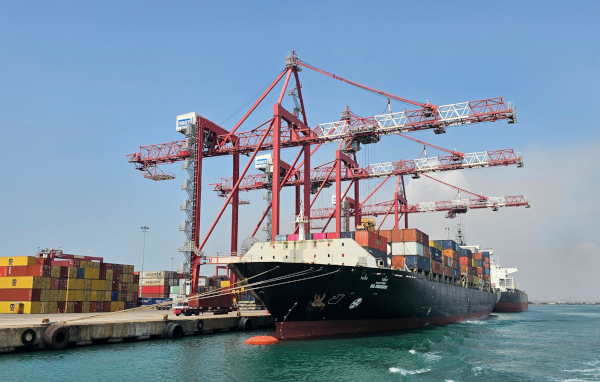
India is accelerating preparations to transform some of its largest ports into hubs for green marine fuels, shore-side electricity and low- or zero-emission shipping corridors, as the country attempts to position itself at the centre of the emerging global market for cleaner maritime trade.
Union Minister for Ports, Shipping and Waterways Sarbananda Sonowal reviewed the programme at The Energy and Resources Institute’s Gwal Pahari campus in Gurugram on September 3, where government agencies, research institutions and major ports presented progress on alternative-fuel infrastructure and maritime decarbonisation.
The review centred on two increasingly connected objectives: preparing Indian ports to handle the fuels that future ships are likely to require and developing international shipping routes on which low- and zero-emission vessels can operate with reliable access to those fuels.
Three major ports — Deendayal Port Authority at Kandla, Paradip Port Authority and V.O. Chidambaranar Port Authority — presented their progress toward becoming Green Fuel Bunkering Hubs. Kamarajar Port, meanwhile, reported that shore-power facilities have been installed at its coal terminals, allowing ships at berth to draw electricity from land rather than continuing to run their auxiliary engines.
Shore power can significantly reduce local emissions because ships normally continue operating diesel-powered generators while docked to provide electricity for lighting, pumps, refrigeration, ventilation and other systems. Connecting them to the port’s electrical grid allows those engines to be shut down during cargo operations, reducing fuel consumption, exhaust emissions and noise around port areas.
The larger transformation, however, concerns the fuel used when ships are at sea.
International shipping has traditionally depended heavily on petroleum-based bunker fuels. As shipping companies come under pressure to lower greenhouse-gas emissions, attention is shifting toward fuels such as green methanol, green ammonia and hydrogen-derived fuels, alongside battery-electric and hybrid systems for shorter routes and port craft.
India wants its ports to become suppliers rather than merely consumers of this transition.
Deendayal Port at Kandla is currently one of the most advanced examples. The port successfully conducted a shore-to-ship methanol bunkering trial in April 2026, validating fuel-transfer procedures, safety systems and regulatory processes with partners including Stolt Tankers, J M Baxi, Aegis Vopak and Indian Oil Corporation. DNV participated in verification of the trial.
Kandla is now working toward making approximately 500,000 tonnes per year of RFNBO-compliant e-methanol available by 2028-29. The fuel is intended partly for deep-sea dual-fuel ships operating on the major Asia-Europe maritime route. The next planned operational step is ship-to-ship methanol bunkering.
A separate project being developed with Assam Petro-Chemicals Limited envisages a 150-tonne-per-day e-methanol plant at Kandla, involving estimated investment of about ₹1,200 crore. The government has specifically connected the project with the possibility of supplying ships operating along the Singapore-Rotterdam trade corridor.
Deendayal Port has also commissioned a 1-MW electrolyser-based green-hydrogen plant, allotted around 3,400 acres for green-hydrogen and green-ammonia projects, and developed a 3.5-million-tonne-per-year jetty capable of handling green ammonia.
On India’s eastern coast, Paradip Port is developing even larger green-energy handling infrastructure.
The Ministry of Ports, Shipping and Waterways approved a ₹797.17-crore dedicated green-hydrogen and green-ammonia jetty at Paradip earlier this year. The facility is being planned with a capacity of 4 million tonnes per annum and will include storage facilities, pipelines and specialised cargo-handling systems. It is to be developed through a public-private partnership model.
Further south, V.O. Chidambaranar Port at Thoothukudi is also being developed as one of India’s designated Green Hydrogen Hubs. It has already commissioned a small pilot green-hydrogen plant, allocated more than 205 acres for green-hydrogen and green-ammonia projects, and is developing a green-methanol bunkering facility consisting of two 750-cubic-metre storage units.
These three ports — Deendayal, Paradip and VOC Port — have formally been recognised by the Ministry of New and Renewable Energy as Green Hydrogen Hubs under India’s wider green-hydrogen strategy.
The timing is also significant because India notified national standards for green ammonia and green methanol in February 2026, establishing emissions thresholds and eligibility requirements for fuels produced from renewable hydrogen. Those standards provide a regulatory foundation for eventually producing, certifying and trading Indian green marine fuels internationally.
The other part of India’s strategy involves creating green shipping corridors linking ports where cleaner ships can obtain compatible fuels, infrastructure and services.
India has already established Green and Digital Shipping Corridor cooperation frameworks with Singapore and Rotterdam. The Singapore initiative began with formal cooperation on maritime digitalisation and decarbonisation, including the identification of relevant shipping companies, ports, fuel suppliers and technology providers needed to build a functioning corridor.
Such corridors do not mean that every vessel travelling between the participating ports is already emission-free. They are intended to create the commercial and infrastructure conditions under which low- and zero-emission shipping can progressively become viable.
That requires far more than simply producing green fuel.
Ports need specialised storage tanks, pipelines, transfer systems, emergency procedures, certification standards and trained personnel. Shipowners must invest in vessels capable of using new fuels, while fuel producers need sufficient long-term demand to justify large production plants. Regulators, financiers, classification societies and insurers must also agree on standards governing the handling of fuels such as methanol, ammonia and hydrogen.
The National Centre of Excellence for Green Ports and Shipping, which briefed Sonowal during the September 3 review, is intended to help coordinate this transition. The centre is supporting research, policy development and technology programmes related to maritime decarbonisation, while the Rocky Mountain Institute is working on concepts for low- and zero-emission shipping corridors.
India is simultaneously attempting to reduce emissions from activities occurring inside its ports. Measures already under way include greater use of renewable electricity, electrification of cargo-handling equipment and railway systems, deployment of zero-emission trucks and the Green Tug Transition Programme, under which conventional diesel-powered harbour tugs are progressively to be replaced by electric, hybrid and other cleaner vessels.
Deendayal Port, JNPA, Visakhapatnam and VOC Port have already placed orders for electric tugs under this transition.
India has also introduced its first national shore-power standard, establishing a common technical framework through which vessels can receive electricity while berthed. This is important because compatibility between ships and ports is necessary if shore power is to expand beyond isolated pilot installations.
Together, these projects show that India’s green-shipping programme is beginning to move beyond policy declarations into physical infrastructure.
Kandla has already conducted methanol bunkering and commissioned green-hydrogen production. Paradip has received approval for a four-million-tonne green-energy jetty. VOC Port is developing hydrogen and methanol infrastructure. Kamarajar has installed shore power at coal terminals, while several other major ports are ordering electric harbour craft.
The September 3 review therefore represents more than another sustainability initiative. It signals an attempt to connect India’s rapidly expanding green-hydrogen industry with its strategic position on some of the world’s busiest maritime trade routes.
That would give the country’s green-port programme an economic dimension beyond reducing domestic emissions. Green bunkering could attract international vessels, stimulate hydrogen and renewable-energy investment, create new export markets for Indian fuels and strengthen the country’s role in global maritime logistics.
For now, many of the proposed zero-emission corridors remain under development, and the transition of international shipping away from conventional bunker fuels will take years. But the infrastructure emerging at Kandla, Paradip and Thoothukudi demonstrates that India is beginning to build the physical fuel network required for that transition.
The objective is increasingly clear: Indian ports are being prepared not simply to handle more ships and cargo, but to become energy hubs for the next generation of global shipping.
You may also like
-
Mecwin Builds Indigenous 45-HP Electric Tractor Powertrain After 500 Hours of Field Testing
-
India’s Major Port Network Set to Expand Beyond 12 With Vadhavan and Galathea Bay
-
ONGC’s Cluster-7 Offshore Field Crosses 100 Crude Shipments and ₹21,000 Crore Revenue
-
Inside PRAGYA: India’s First Private Tokamak Begins Producing Plasma
-
Russia Offers Technology Transfer as India–Russia Industrial Partnership Moves Beyond Trade
