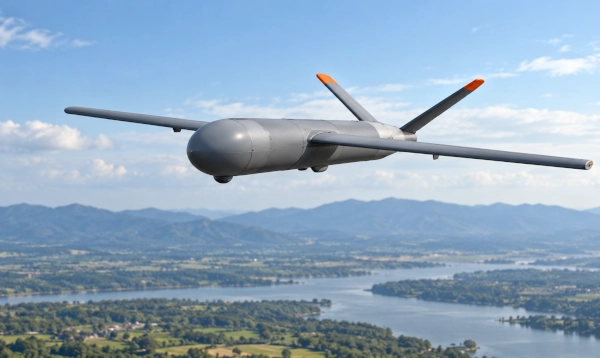
India’s private-sector unmanned-aircraft ecosystem is set to gain another ambitious platform with Raghava Aerospace & Defence Pvt Ltd announcing a joint venture with Peridot Advanced Materials to develop the MALE-300, an indigenous Medium Altitude Long Endurance unmanned aircraft intended primarily for intelligence, surveillance and reconnaissance missions.
The Hyderabad-based company has announced a demanding configuration for the new platform. The MALE-300 is being designed around a 300-kg modular payload capacity, endurance of up to 30 hours and an operating altitude of around 30,000 feet. Raghava Aerospace has also emphasised that the aircraft will have a fully Indian-owned design, making ownership of the underlying intellectual property an important element of the programme.
A Larger Class of Indian Unmanned Aircraft
The significance of the MALE-300 lies in the class of missions it is being designed to address. Medium Altitude Long Endurance UAVs are intended to remain airborne for extended periods while carrying electro-optical sensors, radar, communications equipment, electronic-intelligence systems or other mission payloads.
An endurance target of 30 hours would allow an aircraft to remain over a surveillance area far longer than most tactical UAVs. A 300-kg modular payload capacity would also give designers considerable flexibility in configuring the aircraft for different ISR missions, provided those targets are achieved during development.
Rather than building the aircraft around one fixed sensor package, the modular-payload approach could allow different combinations of cameras, synthetic-aperture radar, communications systems or electronic-support equipment to be integrated according to customer requirements.
Raghava Aerospace has so far publicly identified the MALE-300 as an ISR platform. No armed configuration or weapon-integration programme has been announced, and it would therefore be premature to classify the aircraft as an armed MALE drone.
Indian Ownership of the Design Could Be Crucial
One of the more strategically important parts of the announcement is Raghava Aerospace’s emphasis on Indian ownership of the aircraft design and intellectual property.
Indigenous control of the design can provide advantages well beyond local assembly. It potentially gives the developer greater freedom to modify the airframe, integrate Indian sensors, alter mission computers and communications systems, customise the platform for different services and develop export variants without depending on a foreign original equipment manufacturer for every engineering change.
For an ISR aircraft in particular, control over mission-system interfaces can become nearly as important as control over the airframe itself. Indian ownership could make it easier to integrate domestically produced radar, electro-optical systems, datalinks and electronic-warfare equipment as the programme matures.
The announcement therefore fits India’s broader attempt to move its defence industry from licensed manufacturing towards domestically controlled designs and system-level intellectual property.
Raghava Brings Electronics and Mission-System Capabilities
The MALE-300 programme is being announced as Raghava Aerospace expands its manufacturing and engineering presence in Hyderabad.
The company says it works across research and development, electronic-system design and manufacturing, and composite structures, with activities spanning RF and microwave equipment, electronic-warfare products, airborne electronics, embedded systems, power electronics and aerospace composite structures.
Its integrated Hyderabad infrastructure includes a Class 100,000 cleanroom for microwave assembly and RF/microwave test capabilities extending to 40 GHz, together with ESD-controlled assembly and integration laboratories. The company has also established composite-manufacturing facilities incorporating equipment including autoclaves, filament winding, industrial ovens, hydraulic presses and non-destructive testing systems.
That combination is relevant to a modern UAV programme because a MALE aircraft is not simply an airframe. It requires lightweight structures, communications systems, onboard electronics, power management, sensor interfaces and potentially sophisticated RF subsystems to operate as an effective surveillance platform.
Raghava Aerospace says its wider organisation has been built through the integration of specialised businesses working in areas including electronic warfare and wideband RF, missile-borne RF systems and telemetry, FPGA-based embedded electronics, power electronics and advanced composite structures.
The MALE-300 could therefore provide an opportunity to bring several of those capabilities together within a single airborne system.
Peridot Brings Composite-Airframe Expertise
The second half of the partnership is Peridot Advanced Materials, a Bengaluru-based advanced-composites company with a specific focus on aerospace, defence and unmanned aircraft.
Peridot describes itself as a manufacturer of carbon-fibre, glass-fibre and hybrid composite structures and says its product portfolio includes UAV airframes, radomes, aerospace structures and specialised composite components. Its integrated facility in North Bengaluru includes autoclaves, CNC systems, robotic machining, composite curing equipment and other aerospace manufacturing infrastructure.
The company specifically advertises lightweight carbon-fibre UAV airframes designed around high strength-to-weight ratios and aerodynamic efficiency. It also has capabilities in radomes, mould production, honeycomb bonding, resin infusion and autoclave processing.
These capabilities are particularly relevant to a long-endurance aircraft. Every kilogram removed from the structure can potentially be reassigned to fuel, sensors or other mission equipment. Composite construction therefore plays an important role in achieving the endurance and payload figures expected from modern MALE UAVs.
The Raghava-Peridot combination effectively brings together mission electronics and defence systems on one side and lightweight aerospace-composite engineering on the other.
The 300-Kg Payload Is an Important Part of the Design
While the 30-hour endurance figure naturally attracts attention, the proposed 300-kg payload capacity could prove equally significant.
A payload in this class can potentially support larger and more capable sensor combinations than those carried by smaller tactical drones. Depending on the final aircraft architecture, the payload could accommodate combinations of electro-optical and infrared turrets, communications equipment, radar systems or electronic-intelligence packages.
It may also allow the aircraft to be reconfigured for different missions rather than requiring separate UAV designs for every surveillance requirement.
However, payload capacity does not by itself reveal the aircraft’s overall size or capability. Raghava Aerospace has not yet publicly disclosed the MALE-300’s maximum take-off weight, wingspan, propulsion system, cruise speed, satellite-communications configuration or operational radius.
Why 30 Hours of Endurance !
Long endurance fundamentally changes how an unmanned aircraft can be employed.
A tactical UAV may be able to observe an area for several hours before returning to base. A MALE aircraft designed for around 30 hours of endurance can potentially fly a considerable distance to its operating area, remain on station for many hours and return without requiring another aircraft to take over immediately.
Such persistence is particularly useful for border surveillance, maritime monitoring, reconnaissance of remote terrain and continuous observation of strategically important areas.
For India, this is especially relevant because surveillance requirements extend across the Himalayas, deserts, coastlines and the Indian Ocean region. Long-endurance UAVs can supplement satellites and crewed reconnaissance aircraft by providing persistent observation of selected areas.
A Growing Role for Private Industry
The programme also illustrates the increasingly ambitious role being attempted by India’s private defence sector.
Indian companies initially entered the UAV market largely through small reconnaissance drones and specialised tactical systems. Industry ambitions are now moving towards larger aircraft requiring integrated flight controls, composite structures, propulsion, long-range communications and sophisticated mission systems.
A MALE-class aircraft is a considerably more difficult engineering undertaking than a small surveillance drone. Reaching the announced endurance and payload targets will require optimisation of aerodynamic efficiency, structural weight, fuel capacity, propulsion and electrical power while maintaining reliability over flights lasting more than a day.
Export Ambitions Could Shape the Programme
The MALE-300 is also emerging from a company that is openly looking beyond the Indian market. At the Hyderabad facility inauguration associated with the announcement, the emphasis was placed not only on indigenous capability but on scaling Indian defence technologies towards export opportunities. Raghava Aerospace Managing Director Likhith Reddy Ponguleti said the company intends to take capabilities in RF systems, telemetry, embedded electronics and composites into larger production programmes and overseas markets.
A domestically controlled MALE platform could potentially give an Indian manufacturer greater flexibility in pursuing such exports because it would reduce dependence on foreign design approvals.
An Ambitious New Entry in India’s UAV Ecosystem
The MALE-300 is important not because India has suddenly acquired another operational long-endurance drone, but because another Indian industrial group is attempting to move into one of the most technically challenging segments of unmanned aviation.
Raghava Aerospace is bringing capabilities in RF systems, airborne electronics, electronic warfare and embedded systems, while Peridot contributes expertise in aerospace composites and UAV structures. Their proposed aircraft is being designed around a 300-kg modular payload, 30-hour endurance and 30,000-ft operating altitude, with the partners placing particular emphasis on Indian ownership of the design.
The specifications are ambitious enough to make the MALE-300 a programme worth following closely. The decisive stage, however, will come when drawings and announced targets give way to an aircraft on the runway.
You may also like
-
HPCL Commissions India’s First Indigenous Blue Hydrogen Unit at Visakhapatnam Refinery
-
Sigma Advanced Systems Secures ₹174 Crore Export Order for 155mm Artillery Ammunition Subsystems
-
Bharat Electronics Secures ₹1,011 Crore in New Defence Orders for Radar, Communication and Sonar Systems
-
India’s 300 kW Laser Weapon Ambitions Could Strengthen Future Defence Against Cruise Missiles
-
Indian Army Seeks 360-Degree Laser Warning System with Automatic Smoke Protection for Tanks
