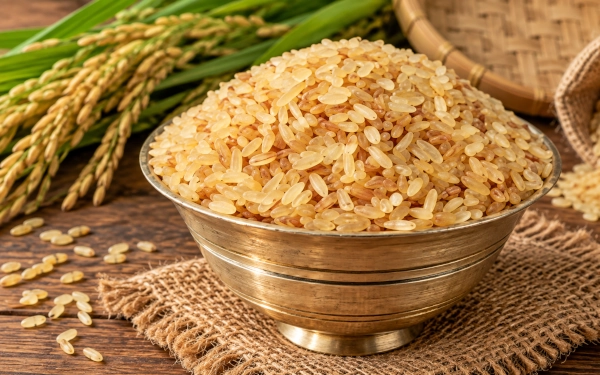
Among Assam’s extraordinary collection of indigenous rice traditions, Boka Chaul is perhaps the most unusual. Often described as Assam’s “magic rice” or “soft rice,” it can be made ready to eat simply by soaking the processed grain in water at room temperature. No boiling, pressure cooking or reheating is required at the time of consumption. Once soaked, the grains soften and are traditionally eaten with curd, milk, jaggery, sugar or other familiar Assamese accompaniments.
This unusual characteristic comes from both the traditional rice varieties from which Boka Chaul is produced and a carefully developed method of parboiling and drying the harvested grain. Strictly speaking, Boka Chaul is not merely the name of a raw paddy variety. It is the finished rice obtained from a group of traditional winter paddy varieties collectively known as Boka dhan. That distinction is central to understanding why the grain behaves so differently from ordinary rice.
Its close association with Assam’s landscape, farming traditions and indigenous processing knowledge resulted in Boka Chaul receiving Geographical Indication protection, recognising it as one of the state’s distinctive agricultural products.
Geography — A Rice of the Brahmaputra Valley
Boka Chaul has its strongest traditional association with the Lower Brahmaputra Valley of Assam, a region shaped by the river and its numerous tributaries. Seasonal floods, fertile alluvial deposits, humid monsoon conditions and extensive low-lying paddy fields have allowed farmers to develop rice varieties adapted to very different water and soil conditions.
The traditional cultivation belt includes districts such as Dhubri, Kokrajhar, Chirang, Bongaigaon, Goalpara, Barpeta, Nalbari, Baksa, Kamrup, Darrang and Udalguri. Although production is particularly associated with Lower Assam, Boka-type rice is also encountered elsewhere in the state. Recent Government of India material notes cultivation extending from the Lower Brahmaputra Valley into parts of Upper Assam, including districts such as Tinsukia and Jorhat.
The traditional Boka dhan crop is suited mainly to medium and low-lying land, with loamy to heavier soils forming an important part of its cultivation environment. These are landscapes where generations of farmers learned to select rice according to water depth, monsoon behaviour and the characteristics of individual fields.
Boka Chaul is therefore inseparable from the wider rice ecology of the Brahmaputra Valley. Its GI identity reflects not merely a particular grain but an agricultural system shaped by riverine Assam.
History — A Traditional Food Designed for Simplicity
Boka Chaul belongs to Assam’s old tradition of producing rice for purposes beyond the ordinary boiled meal. Different rice varieties were historically selected for flattened rice, puffed rice, sticky preparations, festive foods and rice that could be softened without conventional cooking.
Boka dhan belongs to the Sali or winter-rice group, Assam’s principal monsoon-season rice crop. Over generations, farming communities maintained several locally named types, including Banta Boka, Bhokhoorie Boka, Boka Jahinga, Jokhoroo Boka, Khamti Boka, Laobuka, Para Chakhua, Ranga Bokadhan, Ronga Boka and Santi Boka, among others. The existence of so many traditional names demonstrates that Boka Chaul developed from a broader group of locally maintained rice populations rather than from one recently standardised cultivar.
Its greatest practical advantage was obvious in rural life. Once processed, the rice could be prepared for eating without lighting a cooking fire. This made it convenient for agricultural workers spending long hours in the fields and for households during situations where fuel or normal cooking facilities were difficult to obtain. Government descriptions continue to note its use by labourers and its usefulness during floods, when conventional food preparation can become difficult.
What may appear today to be an innovative instant food was therefore created through traditional agricultural knowledge long before modern ready-to-eat food technology.
What Makes Boka Chaul Special
The defining characteristic of Boka Chaul is its ability to become edible after soaking in ordinary water. The GI specification describes it as a native rice of Assam whose processed kernels can be prepared simply by soaking them at room temperature.
This does not mean the grain has never been exposed to heat. The remarkable property results partly from its traditional processing. After Boka dhan is harvested, the paddy is parboiled and subsequently dried before milling. The consumer therefore receives a grain that has already undergone an important heat-processing stage. Unlike conventional parboiled rice, however, Boka Chaul can later be rehydrated and softened without another round of cooking.
The starch characteristics of the rice contribute to this behaviour. Research has found a high proportion of amylopectin, the branched starch component associated with softer and more cohesive textures. A 2025 physicochemical study reported that Boka Saul could soften in normal water in roughly 40–50 minutes, although soaking time can vary according to processing, grain type and water temperature.
The same study reported substantial carbohydrate content along with protein, fibre and minerals such as potassium, phosphorus and magnesium. These findings have renewed scientific interest in Boka Chaul not only as a traditional rice but also as a possible ingredient for convenient and minimally prepared foods.
Its uniqueness therefore lies in an uncommon combination: traditional rice genetics, starch composition and a specialised processing technique refined by farming communities over generations.
Traditional Cultivation
Boka dhan is principally grown as Sali rice, which means the crop follows Assam’s main monsoon-season agricultural calendar. The GI specification records sowing around the third and fourth weeks of June, when the southwest monsoon has established itself across the state.
Farmers traditionally select medium to low-lying fields with loamy or heavier soils. Paddy fields are prepared through repeated tillage, while the traditional cultivation system has generally relied on relatively modest external inputs. The original GI specification notes that farmers commonly use only small quantities of organic manure or well-decomposed cow dung during field preparation.
The cultivation of Boka dhan is only the first part of the production process. After harvesting, the conversion of paddy into Boka Chaul requires considerable skill. The grain is soaked and parboiled before being drained and dried thoroughly in sunlight. Proper drying is particularly important because excess moisture can damage the grain during storage.
This processing stage is one reason Boka Chaul should be understood as both an agricultural and a traditional food-processing product. The special quality does not depend on the seed alone. It depends on farmers and processors knowing how to handle the paddy so that the final rice will soften correctly when soaked.
From Paddy to “Magic Rice”
Ordinary rice must normally be cooked until water and heat break down the starch inside the grain. Boka Chaul takes a different route. During traditional parboiling, heat and moisture alter the grain before it reaches the consumer. The subsequent drying stabilises it for storage.
When the finished Boka Chaul is later placed in water, the grain absorbs moisture and returns to a soft state suitable for eating. This is why the rice can appear to “cook” in cold water even though an important part of the thermal processing has already taken place earlier.
The distinction is important because it highlights the sophistication of the traditional method. Boka Chaul is not a curiosity that somehow defies the normal behaviour of rice. It is an example of how generations of observation and experimentation created a naturally convenient food long before industrial instant-rice processing became common.
Season, Cuisine and Market
Boka Chaul has traditionally been eaten as part of jalpan, the broad Assamese tradition of light meals and rice-based preparations. Once soaked and softened, it can be mixed with curd or milk and sweetened with jaggery or sugar. Banana and other local ingredients may also accompany it, depending on household and regional preference.
Its convenience made it especially useful during the warm months and for people working away from the household kitchen. It also appears during community occasions and festivals, where traditional rice foods remain important parts of Assamese culinary identity.
Boka Chaul’s value has expanded beyond its original rural setting. Packaged versions increasingly appeal to consumers interested in regional foods, convenient meals and traditional grains. Its ability to be prepared without cooking also gives it potential for travel food, emergency supplies and ready-to-eat products, although maintaining traditional quality and proper processing remains essential as the market grows.
The Government of India has identified Boka Chaul among Assam’s GI agricultural products with potential for value-added foods and wider markets. In 2026, APEDA also showcased Boka Chaul at Gulfood alongside other Indian GI-tagged rice varieties, bringing the grain before an international food-industry audience.
Its commercial future may therefore rest on turning its oldest characteristic — the ability to provide a satisfying rice meal with little more than water — into an advantage for modern consumers without separating the product from the farmers and traditional processors who preserved it.
GI Information
- GI Name: Boka Chaul
- State: Assam
- Category: Agricultural
- Class: 30
- GI Application Number: 558
- Date of Filing: 25 July 2016
- Applicants: Lotus Progressive Centre (LPC) and Centre for Environment Education (CEE)
- Geographical Area: Assam
- GI Journal Number: 104
- Certificate Number: 322
- Certificate Date: 30 July 2018
- Current Registration Valid Until: 24 July 2036
- Country: India
Boka Chaul is a striking example of how traditional agriculture can solve a practical problem with remarkable simplicity. Farmers of Assam developed and preserved rice that could be cultivated during the monsoon, processed after harvest, stored and later transformed into a meal without requiring another cooking fire.
Modern food companies might describe such a product as instant or ready-to-eat. In Assam, the principle existed generations earlier in the form of Boka Chaul. Its GI protection now recognises not only an unusual grain but also the accumulated knowledge of the communities that learned how to cultivate, process and eat it.
The result is one of India’s most distinctive traditional rice products — a grain born in the Brahmaputra Valley that needs little more than water to become a meal.
You may also like
-
Pine Labs Expands in Singapore with Unified Merchant Payments Platform
-
VORAN Partners Italian Manufacturer to Build Light-Aviation Ecosystem in India
-
World Bank Raises India’s FY27 Growth Forecast to 7.1%
-
Adani Power and Druk Green Power to Develop 770 MW Chamkharchhu-I Hydropower Project in Bhutan
-
Cabinet Approves ₹10,000 Crore SME Growth Fund to Scale Indian Manufacturing
