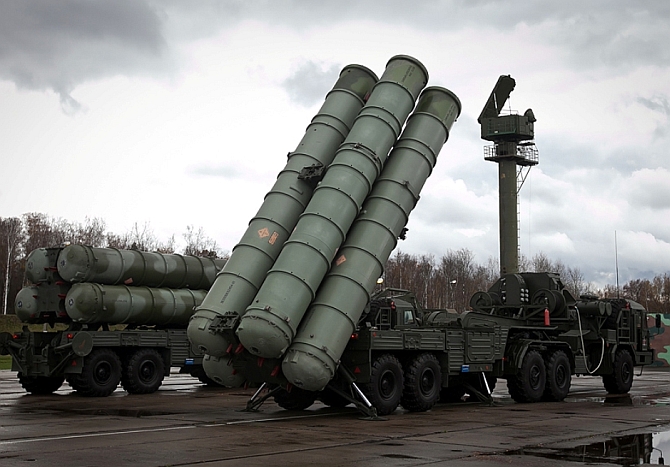
India’s plan to expand its S-400 long-range air-defence network has moved into a more concrete phase, with Russian officials confirming that Moscow and New Delhi are discussing additional supplies beyond the five systems covered by the original 2018 contract.
The latest Russian confirmation came on September 2, 2026, when Dmitry Shugayev, Director of Russia’s Federal Service for Military-Technical Cooperation, said Moscow was continuing to fulfil the existing Indian S-400 contract and that further deliveries could follow.
According to Russian defence-trade reporting citing RIA Novosti, Shugayev said there could be a continuation of the programme and noted that the issue had also been touched upon during talks between Prime Minister Narendra Modi and Russian President Vladimir Putin in Bishkek. He emphasised that any additional supply programme would require detailed negotiations and planning.
The statement reinforces an earlier confirmation from Russia’s FSMTC on May 26, 2026, when the agency told Interfax that India had expressed interest in purchasing an additional batch of S-400 systems and that negotiations were already underway. Russia said at the time that it was prepared to meet the requirement.
India Has Already Approved Further S-400 Procurement
The Russian discussions follow an important decision on the Indian side.
On March 27, 2026, India’s Defence Acquisition Council, chaired by Defence Minister Rajnath Singh, granted Acceptance of Necessity for another S-400 Long Range Surface-to-Air Missile System procurement as part of a wider ₹2.38-lakh-crore defence acquisition package.
The Ministry of Defence said the additional S-400 capability would be used to counter long-range aerial threats directed against vital areas.
The official PIB release did not publicly specify the number of systems being acquired. Indian defence reporting following the DAC meeting identified the requirement as five additional S-400 squadrons, which would effectively double India’s planned force from five to ten units.
That makes the current discussions considerably more significant than a preliminary expression of interest. India has already provided the acquisition with in-principle approval, while Russia has confirmed that negotiations are taking place.
Russia Submits Proposal for Five Additional Squadrons
The programme advanced further at the end of August when Russia reportedly submitted its proposal in response to India’s requirement.
Indian defence reporting says Moscow has offered five additional S-400 squadrons, with the proposed acquisition valued at more than ₹50,000 crore. The Russian response has reportedly reached the Ministry of Defence and is being processed.
The next stages would involve commercial negotiations, delivery schedules, equipment configuration, missile packages, maintenance arrangements and potentially the extent of Indian industrial participation.
No final contract for the additional systems has yet been announced.
Original Five-Squadron Programme Continues
India signed its original S-400 agreement with Russia in October 2018, with the contract valued at approximately $5.43 billion for five regimental sets.
Deliveries began in 2021, although later systems experienced schedule adjustments. Russian officials maintain that the remaining contractual deliveries are proceeding according to the revised timetable.
Shugayev said again in May 2026 that implementation of the existing contract was proceeding according to the schedule agreed between the two countries.
The completion of that contract and negotiation of a second batch are therefore running as related but separate processes.
S-400 Has Become a Core Layer of Indian Air Defence
The S-400 Triumf is designed to provide long-range protection against a broad spectrum of aerial threats, including combat aircraft, cruise missiles and certain ballistic targets.
Its architecture combines long-range surveillance radars, command-and-control vehicles, engagement radars and multiple classes of interceptor missiles. This allows a single S-400 formation to create a large air-defence zone while selecting different interceptors according to target type and distance.
India has integrated the system into its wider air-defence network rather than operating it as an isolated Russian platform.
This integration is strategically important because India’s air-defence environment includes threats ranging from conventional fighters and bombers to drones, stand-off weapons, cruise missiles and ballistic systems.
The additional squadrons would expand the number of regions that can receive persistent long-range coverage while providing greater redundancy across India’s western and northern sectors.
Operation Sindoor Strengthened the Case for Expansion
Indian interest in additional systems accelerated following the operational use of the S-400 during Operation Sindoor in 2025.
Russian officials have repeatedly highlighted Indian satisfaction with the system. On September 1, 2026, Shugayev said India’s operators were highly satisfied with the S-400 and argued that the platform had demonstrated its effectiveness in operational environments.
India’s own decision to grant Acceptance of Necessity for additional S-400 systems several months earlier provides stronger evidence of institutional confidence than promotional statements alone.
The operational experience also gives the Indian Air Force a clearer understanding of how additional units could be deployed, connected with indigenous sensors and supported within the country’s integrated air-command network.
Expansion Does Not Replace Project Kusha
Purchasing additional S-400 systems does not mean India is abandoning its indigenous long-range surface-to-air missile ambitions.
DRDO is simultaneously developing Project Kusha, intended to create an Indian family of extended-range air-defence interceptors and associated radar and command systems.
The two programmes address an important timing issue.
S-400 is an operational system already integrated into Indian service, while Project Kusha is intended to build an indigenous long-term capability. Additional S-400s can strengthen the existing network while Indian systems move through development, testing and production.
India’s future air defence is therefore likely to contain a mixture of indigenous and foreign-origin systems linked through common command-and-control networks rather than depending exclusively on a single platform.
More Missiles and Support Infrastructure Will Also Be Required
Doubling the S-400 force involves considerably more than acquiring additional launchers.
A larger network requires surveillance and engagement radars, command vehicles, transporter-launchers, reload vehicles, additional interceptor stocks, maintenance infrastructure, trained personnel and secure communication links.
Indian reporting has also pointed to plans for substantial additional S-400 missile procurement to increase war reserves for both existing and future units.
This is particularly important for high-intensity air defence. A sophisticated launcher has limited operational value without sufficient stocks of interceptors to sustain repeated engagements during a prolonged conflict.
The expansion programme must therefore be assessed as a complete air-defence ecosystem rather than simply as five additional sets of launch vehicles.
Industrial Cooperation Could Become More Important
Future negotiations could also revisit localisation.
Russia and India have previously discussed the possibility of producing selected S-400 components in India. Rostec chief Sergei Chemezov publicly confirmed such discussions during the earlier programme, citing India’s established experience with licensed manufacture of Russian-origin defence equipment.
The structure of the new procurement has not been officially disclosed, and no current localisation percentage has been announced.
India’s defence procurement policy has moved increasingly towards domestic maintenance, component production and lifecycle support, making industrial participation an important consideration in any second major S-400 agreement.
A larger fleet would make local maintenance and spare-parts capability particularly valuable because the systems are expected to remain operational for decades.
India-Russia Air-Defence Partnership Remains Stronger
The latest statements also show that air defence remains one of the strongest areas of India-Russia military-technical cooperation despite India’s increasingly diversified defence procurement.
India continues to develop indigenous Akash variants, MRSAM, QRSAM, VSHORADS and Project Kusha while simultaneously retaining Russian systems where they provide capabilities considered operationally valuable.
The S-400 expansion fits that pragmatic model.
The programme has now progressed through several identifiable stages: India expressed interest in additional systems, the Defence Acquisition Council granted in-principle approval in March 2026, Russia formally confirmed negotiations in May, and Moscow has subsequently submitted a proposal for the reported five-squadron requirement.
Shugayev’s September 2 statement provides the latest Russian-side indication that the programme remains active.
A final contract has not yet been signed, but the additional S-400 acquisition has moved well beyond speculative discussion. It now sits within an approved Indian procurement process backed by acknowledged negotiations with Russia, potentially paving the way for India to double the size of one of the most capable layers in its long-range air-defence network.
You may also like
-
India and Belgium Move to Establish Joint Counter-Terrorism Working Group
-
India’s AMCA to Use Indigenous Multi-Layer Stealth Materials as DRDO Builds Advanced Radar-Absorbing Technologies
-
DRDO Invites Bids to Develop Indigenous Air-to-Air Refuelling Pod for Indian Air Force
-
Armanetics Demonstrates Indigenous ARMANET Swarm Drone System to Indian Army
-
Apollyon Dynamics’ Ahuti Mk II Becomes India’s Fastest Multirotor UAV at 498 km/h
