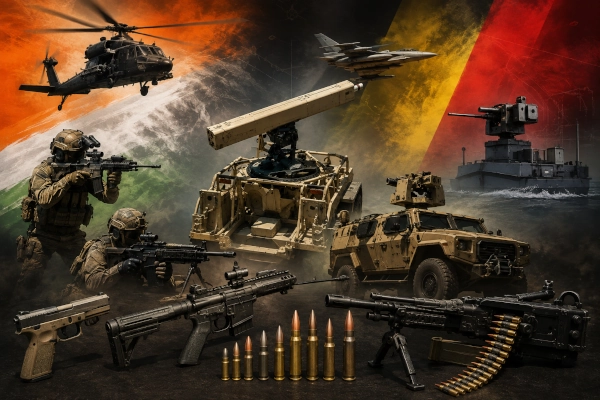
India could gain a new domestic manufacturing base for advanced small arms, integrated weapon systems and counter-drone technologies under a partnership between Kalyani Strategic Systems Limited and Belgium’s FN Herstal.
The two companies signed a Memorandum of Understanding in New Delhi on September 3, 2026, establishing a framework to evaluate a dedicated production centre in India and a possible strategic alliance or joint venture. The programme is intended primarily to address requirements of the Indian defence market through local manufacturing, technology cooperation and greater domestic participation in future procurement programmes.
Kalyani Strategic Systems Limited, or KSSL, is the wholly owned defence subsidiary of Bharat Forge and now leads the Kalyani Group’s defence business. FN Herstal is part of Belgium’s FN Browning Group and brings more than 135 years of experience in small arms and integrated weapon systems.
Three Major Areas of Cooperation
The proposed partnership covers small arms, integrated weapon systems and counter-unmanned aerial system solutions. This gives the agreement a considerably broader scope than conventional rifle manufacturing.
Small arms would provide the most established area of cooperation, drawing on FN Herstal’s extensive portfolio and KSSL’s growing Indian manufacturing capabilities. Integrated weapon systems could extend collaboration towards platform-mounted armament and associated equipment, while the counter-UAS component addresses one of the fastest-growing requirements facing modern armed forces.
The companies have not yet disclosed specific weapons or C-UAS products selected for Indian manufacture. Their agreement instead establishes the framework through which individual programmes will be evaluated according to Indian military requirements.
FN Herstal Brings a Broad Weapons Portfolio
FN Herstal has developed weapons ranging from pistols and assault rifles to machine guns, ammunition and integrated platform-mounted systems. Its integrated-weapons business includes airborne installations and remotely operated weapon solutions for land and maritime platforms.
The company’s airborne systems are based around weapons such as the FN MAG and FN M3M, while its wider portfolio includes remote weapon stations and weapon integration for helicopters and other military platforms. FN says more than 4,500 of its airborne weapon systems have been installed worldwide.
FN Herstal also manufactures ammunition across widely used NATO-standard calibres, including 9×19 mm, 5.56×45 mm, 7.62×51 mm and 12.7×99 mm, and already offers technology-transfer arrangements aimed at establishing or improving domestic production in customer countries.
The September agreement, however, should not be interpreted as confirmation that every FN weapon or ammunition calibre will be produced in India. Specific systems remain subject to subsequent negotiations and programme decisions.
Counter-UAS Capability Adds a New Dimension
The inclusion of counter-UAS technology makes the partnership particularly relevant to changing battlefield conditions. Small drones are now routinely being used for reconnaissance, precision attack, artillery correction and one-way strike missions, creating demand for comparatively economical systems capable of engaging them.
Counter-drone defence increasingly involves several layers, ranging from electronic warfare and jamming to guns, missiles and specialised interceptors. Integrating such capabilities with weapon stations and conventional armament can provide armed forces with additional options against low-flying unmanned threats.
For KSSL, cooperation with FN Herstal therefore provides access not merely to conventional infantry weapons but to a wider family of technologies relevant to emerging force-protection requirements.
Kalyani Brings India’s Manufacturing Scale
KSSL contributes a rapidly expanding domestic defence-manufacturing base. Its portfolio already spans artillery systems, armoured and protected vehicles, small arms, ammunition, marine systems and unmanned platforms, supported by Bharat Forge’s expertise in metallurgy, precision engineering and high-volume manufacturing.
Bharat Forge has progressively consolidated its defence activities under KSSL. The group has also expanded manufacturing infrastructure to support complete defence platforms rather than operating primarily as a component supplier.
This industrial base is central to the FN Herstal agreement. Rather than importing complete systems from Belgium, the proposed model would combine FN technology with Indian engineering and production capability, allowing greater value addition within the country.
Security of Supply Becomes a Strategic Objective
Both companies have emphasised local industrial capacity and security of supply as important objectives of the partnership.
For military equipment, domestic production has significance beyond manufacturing economics. Weapons, spares and consumables must remain available during periods of elevated operational demand, when international supply chains can become constrained.
Building production capability inside India can therefore improve maintenance, replenishment and lifecycle support while reducing dependence on overseas deliveries.
FN Herstal described the partnership as an effort to create long-term sovereign capability for the Indian Armed Forces, while KSSL said it intends to combine FN’s established technologies with India’s industrial scale.
Potential Strategic Alliance or Joint Venture
The next phase will involve assessing the commercial and technological feasibility of individual cooperation programmes.
The MoU specifically allows KSSL and FN Herstal to examine the creation of a Strategic Alliance or Joint Venture, alongside the dedicated Indian production centre. Such a structure could provide a longer-term industrial framework encompassing manufacturing, technology cooperation and future product development.
The official announcement makes clear, however, that these arrangements remain under evaluation. No investment figure, ownership structure, factory location or production capacity has yet been announced.
That distinction makes the September agreement an industrial roadmap rather than a final production contract.
Part of Kalyani’s Wider Defence Expansion
The FN Herstal agreement comes during a major expansion of Kalyani’s international defence partnerships.
On the same day, KSSL signed a separate strategic agreement with Thales to establish Indian production capability for 70-mm unguided and laser-guided rockets, with the first fully assembled Indian-made rocket targeted for early 2027.
Together, the agreements push KSSL into several complementary defence segments: artillery and armoured systems developed within the Kalyani Group, advanced rocket ammunition through Thales, and potentially small arms, integrated weapons and counter-UAS solutions through FN Herstal.
The strategy increasingly positions KSSL as a systems manufacturer capable of combining indigenous products with selected international technologies rather than concentrating on a single category of military equipment.
A Broader India-Belgium Defence-Industrial Partnership
The agreement was signed against the backdrop of a wider expansion in India-Belgium defence cooperation during Belgian Prime Minister Bart De Wever’s visit to India.
The two governments have encouraged their defence industries to move towards co-development, co-production and technology partnerships in areas where Belgian specialised capabilities can be combined with Indian manufacturing scale.
The KSSL-FN Herstal partnership represents one of the clearest industrial expressions of that approach. Its significance lies in the potential creation of an Indian production capability covering traditional battlefield weapons as well as newer counter-drone technologies.
The immediate task for the two companies will be converting the MoU into defined programmes, selecting systems suited to Indian requirements and establishing the industrial structure required for local production. The resulting partnership could give India another domestic source of specialised weapon systems while extending Kalyani’s position across an increasingly broad spectrum of land and counter-UAS capabilities.
You may also like
-
India to Train 600 Nigerian Army Soldiers in Specialised Jungle and Mountain Warfare
-
ICAR Scientists Develop Indigenous Protective Gloves for Cotton Farmers, Sign Commercial Manufacturing Agreement
-
India Moves Towards Five-Year Assured Orders for Defence Startups Under New Procurement Reforms
-
BHEL–Coal India Joint Venture Begins Construction of ₹25,016 Crore Indigenous Coal Gasification Project in Odisha
-
Zen Technologies Introduces Indigenous Hyper-Strike Falcon AI-Guided Counter-Drone Interceptor
