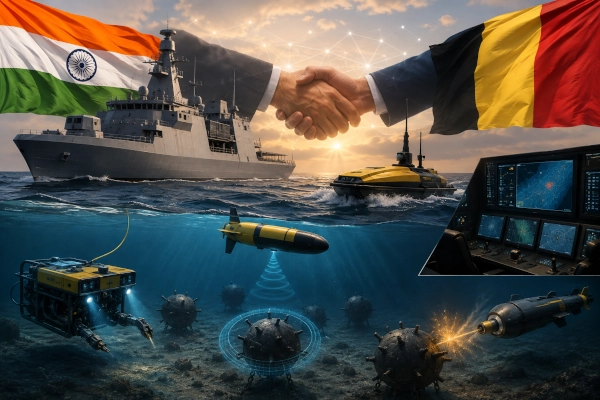
Larsen & Toubro and European maritime-robotics specialist Exail have reinforced their defence-industrial partnership as India prepares to rebuild its naval mine-countermeasure capability around autonomous and remotely operated systems.
A fresh agreement involving Larsen & Toubro, Exail Robotics SAS of France and Exail Robotics in Belgium was exchanged in New Delhi on September 3, 2026, during the India-Belgium Defence CEOs Roundtable. The development follows an earlier strategic collaboration under which L&T and Exail are preparing an advanced Unmanned Mine Countermeasures suite for the Indian Navy’s planned Mine Counter Measure Vessel programme.
The combination is significant because modern mine warfare is increasingly moving away from sending crewed vessels directly into suspected minefields. Instead, unmanned surface and underwater vehicles can search, classify and neutralise mines while the mother ship and its crew remain at a safer stand-off distance.
L&T to Lead Indian Navy MCM Offering
Under the partnership announced earlier this year, L&T will act as the prime contractor, while Exail will provide the underlying mine-countermeasure technology.
The companies plan to offer their unmanned MCM suite to shipyards competing for the Indian Navy’s upcoming programme for 12 Mine Counter Measure Vessels. This means the robotic mission package is being positioned independently of the eventual selection of the shipbuilder.
The system is designed to cover the entire mine-clearance chain — detection, classification, identification and neutralisation — through a combination of autonomous and remotely controlled platforms.
Rather than relying on a traditional minesweeper to enter a dangerous area first, the proposed architecture allows robotic assets to operate ahead of the vessel and investigate suspected mine contacts.
How Exail’s Unmanned Mine-Warfare System Works
Exail’s approach is centred on its UMIS — Unmanned Mine Countermeasures Integrated System, which connects several specialised robotic platforms through a common command-and-control environment.
The architecture can combine autonomous underwater vehicles, unmanned surface vessels, remotely operated vehicles, synthetic-aperture sonars, towed sensors and mine-disposal systems.
An autonomous underwater vehicle can survey the seabed and locate suspicious objects using high-resolution sonar. Once a potential mine has been detected, specialised vehicles can examine the contact more closely before a neutralisation system is dispatched against a confirmed threat.
The resulting process separates the crew from the most hazardous part of mine clearance while allowing different robotic systems to perform specialised tasks within the same mission network.
Inspector 125 Acts as an Unmanned Surface Mothership
A central platform within Exail’s mine-countermeasure family is the Inspector 125 unmanned surface vehicle.
The vessel can operate as a robotic gateway between a command platform and multiple underwater systems. It is designed to deploy and coordinate assets including the A18-M autonomous underwater vehicle, T18-M towed sonar, Seascan identification system and K-Ster mine-neutralisation vehicle.
This gives the system a modular character. The unmanned surface vessel does not have to conduct every task itself; instead, it transports, communicates with and supports specialised sensors and underwater robots according to the mission.
Such an architecture also allows mine hunting to be conducted over the seabed, within the water column and close to the surface rather than treating every mine threat in the same way.
Autonomous Underwater Vehicles Search the Seabed
The A18-M autonomous underwater vehicle is designed for extended underwater survey missions and can search large areas without requiring constant direct control from an operator.
Synthetic-aperture sonar provides detailed seabed imagery that can be analysed to detect and classify mine-like objects. A towed sonar such as the T18-M can complement the autonomous vehicle by conducting additional search and threat-assessment missions.
Suspected objects can subsequently be examined with specialised identification vehicles carrying sonar and optical sensors.
Once a mine has been positively identified, a dedicated neutralisation vehicle can be deployed to destroy the threat.
This progression from wide-area detection to focused identification and finally disposal reduces the need to expose expensive crewed ships to the minefield.
Technology Already Being Fielded by European Navies
Exail’s approach is not limited to a developmental concept. Its robotic mine-countermeasure technology forms a central part of the new-generation programme being introduced by the Belgian and Royal Netherlands navies.
Under that programme, dedicated MCM vessels operate as motherships for a toolbox of unmanned surface, underwater and aerial platforms.
Belgium Naval & Robotics delivered the first complete MCM robotic toolbox for the programme in March 2026. The package includes Inspector 125 surface drones, A18 autonomous underwater vehicles, towed sonar systems, Seascan and K-Ster identification and disposal systems, along with integrated mission-management software.
The operational experience generated through European programmes gives L&T access to a mature technology base while the Indian company contributes domestic system integration, manufacturing and lifecycle-support capabilities.
India Needs to Rebuild a Critical Naval Capability
Mine warfare has particular relevance for India because naval mines can threaten harbours, naval bases, commercial shipping routes and narrow maritime approaches at relatively low cost.
Even a limited mine threat can force a navy to conduct extensive clearance operations before ships can safely enter or leave an affected area.
India previously operated dedicated minesweepers, but the retirement of older vessels created a long-standing requirement for a new generation of mine-countermeasure platforms.
The proposed 12-vessel MCMV programme is intended to restore this specialised capability while incorporating technologies substantially more advanced than those available on earlier minesweepers.
Robotics fundamentally changes the operational model. The new vessel becomes less of a ship that physically sweeps mines and more of a command, deployment and support platform for distributed unmanned systems.
L&T Brings Naval Integration and Indian Manufacturing Capability
L&T is one of India’s largest private-sector defence manufacturers and has substantial experience in naval engineering, shipbuilding, underwater systems, weapon launchers, sensors and complex military integration.
That industrial capability gives the company an important role in adapting Exail’s robotic technologies to Indian Navy requirements and developing domestic manufacturing and support arrangements.
The original L&T-Exail partnership specifically highlighted local industrial collaboration and capability development, rather than relying entirely on imported equipment.
Exail has also said that the cooperation has longer-term potential for the development and production of next-generation naval drones and autonomous mission systems in India.
This could extend the significance of the programme beyond the immediate MCMV requirement by creating Indian engineering and support expertise in unmanned maritime warfare.
September Agreement Adds a Belgian Industrial Dimension
The September 3 agreement comes within a broader expansion of India-Belgium defence cooperation.
During the Defence CEOs Roundtable, Indian and Belgian companies signed a series of agreements covering weapons, electro-optics, ammunition, unmanned systems and other specialised technologies. The Indian government encouraged Belgian companies to combine their technological capabilities with India’s manufacturing scale through co-development and co-production.
The L&T agreement is notable because Exail operates an important industrial base in Belgium, including facilities connected with the Belgian-Dutch robotic mine-warfare programme.
Exail’s facility in Ostend has been involved in the production and assembly of unmanned systems for that programme, giving the Belgian part of the company direct experience in industrialising advanced maritime robotics.
The fresh pact therefore links L&T not only with Exail’s French technology organisation but also with an industrial ecosystem already producing robotic mine-countermeasure systems for European navies.
Mine Warfare Is Moving Towards Stand-Off Robotics
Naval mine countermeasures have traditionally been slow, dangerous and manpower-intensive because ships and divers often had to operate close to suspected explosive threats.
Autonomous systems change that equation by allowing sensors and expendable or remotely controlled platforms to move into the highest-risk areas while sailors remain at greater distance.
The same technologies also improve persistence. Multiple unmanned vehicles can survey different areas, exchange information through a common mission system and continue operations without requiring a large crew aboard every platform.
For the Indian Navy, adopting such a system would represent more than replacing retired minesweepers. It would introduce a new operational architecture based on distributed sensors, autonomous underwater vehicles, unmanned surface craft and remote mine neutralisation.
The strengthened L&T-Exail partnership brings together an Indian company capable of large-scale naval integration with one of Europe’s most established specialists in autonomous mine warfare. Its immediate relevance lies in India’s 12-vessel MCMV requirement, while the larger industrial opportunity is the creation of a domestic ecosystem for unmanned maritime systems that can support future Indian naval programmes.
You may also like
-
India to Train 600 Nigerian Army Soldiers in Specialised Jungle and Mountain Warfare
-
ICAR Scientists Develop Indigenous Protective Gloves for Cotton Farmers, Sign Commercial Manufacturing Agreement
-
India Moves Towards Five-Year Assured Orders for Defence Startups Under New Procurement Reforms
-
BHEL–Coal India Joint Venture Begins Construction of ₹25,016 Crore Indigenous Coal Gasification Project in Odisha
-
Zen Technologies Introduces Indigenous Hyper-Strike Falcon AI-Guided Counter-Drone Interceptor
