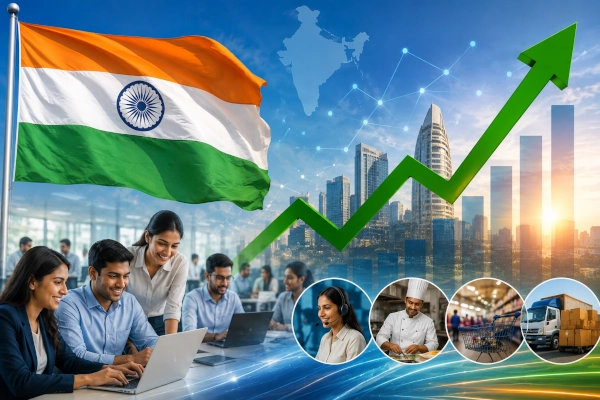
India’s services economy gathered momentum in August 2026, with business activity expanding at a faster pace and companies stepping up recruitment even as competitive pressures and relatively subdued new orders continued to temper the broader recovery.
The seasonally adjusted HSBC India Services Purchasing Managers’ Index Business Activity Index rose to 54.1 in August from 53.3 in July, remaining comfortably above the 50-point threshold that separates expansion from contraction.
The improvement is significant because services form the dominant part of India’s economy and include industries ranging from information technology, finance and communications to transport, hospitality, professional services and consumer-facing businesses.
However, the August figures also point to a recovery that remains uneven. Although the headline index strengthened, it remained slightly below its long-term average of 54.5. The pace of expansion was also the second-weakest recorded since March 2022, indicating that the sector continues to grow but has not yet returned to the stronger rates seen during much of the preceding period.
Employment Growth Reaches 15-Month High
The most encouraging development came from employment.
Hiring by Indian service-sector companies accelerated to its strongest pace in 15 months, suggesting that businesses remain confident enough about demand to expand their workforce. Around 11 per cent of companies surveyed reported an increase in staffing levels during August.
Companies said additional workers were required to support customer service, sales and digital operations, indicating that hiring was associated with actual operational requirements rather than simply expectations of future growth.
This is particularly important because employment provides a useful indication of how business expansion is translating into the wider economy. Rising service-sector hiring can support household incomes and consumption while generating demand across related industries.
HSBC Chief India Economist Pranjul Bhandari said employment increased at a marked rate during the month, with job creation reaching its highest level in 15 months.
The employment trend also stood out when compared with manufacturing. Across the combined private-sector economy, employment increased at its fastest pace in 14 months, as strong services recruitment more than compensated for a decline in manufacturing employment.
New Business Improves, But Growth Remains Relatively Soft
Indian service providers also reported another increase in new business during August.
Companies attributed the improvement to stronger customer demand and marketing efforts, indicating that firms were successfully generating additional business despite challenging market conditions.
Nevertheless, the details provide an important qualification to the headline improvement.
Although sales increased faster than in July, the pace of new-business growth remained the second-slowest in almost four-and-a-half years. Some companies reported subdued bookings, strong competition and softer customer appetite in certain service categories.
The combination suggests that India’s services economy remains firmly in expansion territory but that companies are operating in a more competitive environment than during the period of exceptionally rapid post-pandemic growth.
That makes the employment performance particularly noteworthy. Businesses continued adding workers despite only moderate growth in new orders, indicating that many firms remain confident that demand will be sufficient to support additional capacity.
International Demand Remains Resilient
External markets provided another source of support.
New export orders received by Indian service providers increased solidly during August, with growth broadly comparable to July.
Companies reported stronger demand from clients in Australia, Brazil, Canada, Japan, Malaysia, Singapore, Sri Lanka and the United Arab Emirates, demonstrating the geographical diversity of India’s services exports.
India’s services-export strength has become an increasingly important part of the country’s external economic position. While information technology and business-process services remain major contributors, Indian companies are gradually expanding internationally across professional services, engineering, consulting, finance, digital platforms and other knowledge-intensive industries.
Resilient export orders are therefore important not only for individual service companies but also for India’s broader trade balance and foreign-exchange earnings.
The geographical spread of demand is also noteworthy. Stronger business was not concentrated exclusively in North America or Europe but included customers across Asia, the Middle East and other emerging economies.
This diversification could improve resilience by reducing excessive dependence on any single overseas market.
Digital Spending Adds to Business Costs
Cost pressures remained manageable but did not disappear.
Service companies reported higher expenditure on digital platforms, electricity, labour, business inputs, marketing and regulatory requirements, contributing to a modest acceleration in input-cost inflation during August.
For modern service companies, digital expenditure has become an increasingly important operating cost. Cloud services, software subscriptions, cybersecurity, data infrastructure and online customer-acquisition platforms now form a substantial part of the cost base for businesses ranging from technology companies to retailers and financial-service providers.
Labour costs are another important component. Stronger hiring is positive for employment but can simultaneously increase operating expenses, particularly in industries competing for specialised technology, engineering and professional talent.
Even so, HSBC’s assessment indicated that overall price pressures increased only modestly.
That combination — stronger output and employment without a major acceleration in inflation — is relatively favourable for the sector.
Composite PMI Holds at 54.3
The broader picture across India’s private-sector economy was more stable.
The HSBC India Composite PMI Output Index remained unchanged at 54.3 in August, as faster growth in services compensated for weaker momentum in manufacturing.
The composite index combines activity across manufacturing and services and therefore provides a wider indication of conditions in the private-sector economy.
Its unchanged reading shows that India’s overall private-sector expansion continued during August, although the sources of growth shifted somewhat towards services.
Aggregate new orders across manufacturing and services increased at a faster pace, while overall employment growth reached a 14-month high.
At the same time, composite input-cost inflation eased to its lowest level in seven months, providing some relief for businesses even though individual service companies continued to report increases in several categories of operating expenditure.
Services Offset Manufacturing Slowdown
The contrast between services and manufacturing is one of the more important signals contained in the August PMI data.
Services accelerated from July, while manufacturing lost momentum. As a result, the services economy played a greater role in sustaining overall private-sector activity during the month.
Such divergence is not unusual because the two sectors respond differently to economic conditions.
Manufacturing is particularly sensitive to inventories, commodity prices, capital spending, international goods demand and supply-chain conditions. Services are often more closely connected to domestic consumption, digital activity, professional demand and employment.
India benefits from having relatively large contributions from both sectors. When one experiences temporary weakness, stronger performance elsewhere can provide some stability to overall economic activity.
August provides an example of this balancing effect, with service-sector expansion offsetting slower manufacturing growth and keeping the composite PMI in expansionary territory.
Hiring May Be the Most Important Signal
While the improvement in the headline services PMI is encouraging, the employment data may ultimately be the most consequential part of the survey.
Economic growth becomes more broadly beneficial when expanding output creates additional jobs and household income.
The fact that companies increased staffing at the fastest pace in 15 months indicates that service providers see enough underlying demand to justify expanding their workforce.
The types of activities cited by companies — customer service, sales and digital operations — also provide an indication of where additional employment is being generated as Indian businesses modernise and expand their operations.
Continued hiring would be particularly important for India’s young workforce because services remain among the country’s largest generators of organised-sector employment.
A Positive but Measured Signal for the Economy
The August figures should therefore be interpreted as an improvement rather than a surge.
A services PMI of 54.1 confirms continued expansion and represents a clear improvement from July’s 53.3. Export orders remain resilient, recruitment has accelerated significantly and the overall private-sector composite index remains comfortably above the contraction threshold.
At the same time, the headline services index remains below its long-term average, while growth in new business is still among the weakest observed in several years.
That combination suggests an economy continuing to expand while businesses navigate stronger competition and pockets of softer demand.
For India, however, the composition of the August data provides several encouraging signals. International demand for Indian services remains diversified, businesses are increasing employment and services are helping compensate for weaker manufacturing momentum.
15-month high in job creation stands out as the strongest signal from the August survey, indicating that even amid moderate overall growth, Indian service providers remain willing to invest in additional people and operating capacity.
You may also like
-
Koraput Kalajeera Rice of Odisha: The GI-Tagged Aromatic Heritage of India’s Ancient Rice-Growing Region
-
ICAR Scientists Develop Indigenous Protective Gloves for Cotton Farmers, Sign Commercial Manufacturing Agreement
-
BHEL–Coal India Joint Venture Begins Construction of ₹25,016 Crore Indigenous Coal Gasification Project in Odisha
-
PM Modi to Inaugurate RBI’s Tier IV Data Centre and Cybersecurity Training Institute in Bhubaneswar
-
India Creates 11 Crore Digital Farmer IDs Five Months Ahead of Target, Strengthening AgriStack Infrastructure
