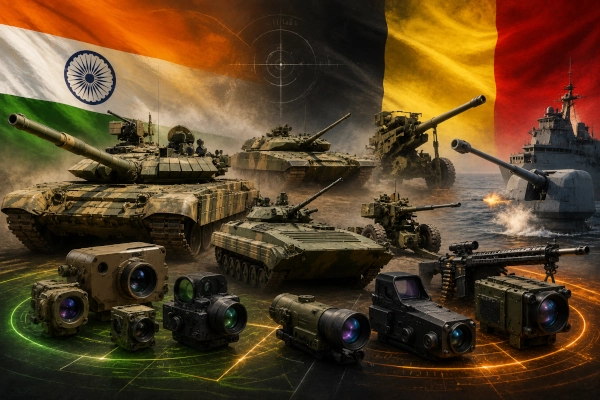
India Optel Limited and Belgium’s OIP Sensor Systems have opened a new phase of cooperation in military electro-optics, bringing together India’s state-owned defence manufacturing capability with a Belgian company that has supplied fire-control and sighting technologies for armoured vehicles for decades.
The two companies exchanged an agreement in New Delhi on September 3, 2026, during the India-Belgium Defence CEOs Roundtable and B2B meetings held alongside Belgian Prime Minister Bart De Wever’s visit to India. The Ministry of Defence listed the India Optel–OIP pact among several industrial agreements intended to combine Belgian defence technology with Indian manufacturing capacity.
The official announcement does not disclose the value, production quantities or individual systems covered by the agreement. Its significance comes from the complementary capabilities of the two companies and their existing experience with armoured-vehicle electro-optics.
Two Established Electro-Optics Specialists
India Optel Limited, or IOL, is a Defence Public Sector Undertaking under the Department of Defence Production. Headquartered in Dehradun, it was created from former Ordnance Factory Board units specialising in optical and opto-electronic equipment.
Its manufacturing portfolio includes sighting and vision equipment for T-72 and T-90 main battle tanks, BMP-II infantry combat vehicles, artillery systems, naval guns and small- and medium-calibre weapons. The company’s role places it at the centre of India’s effort to localise critical battlefield optics and fire-control technologies.
Belgium’s OIP Sensor Systems specialises in the design and manufacture of electro-optical equipment for defence and aerospace applications. Its portfolio covers thermal imagers, night-vision devices, laser rangefinders, day/night sights, fire-control systems, surveillance equipment and platform-mounted sensor packages.
The Belgian company has been developing military electro-optics for more than a century and produced its first fire-control system for the Leopard 1 main battle tank in the 1960s.
OIP Has Worked on India’s Arjun Programme Since 2000
The India-OIP relationship is not starting from scratch.
OIP’s official corporate history records its first production order for fire-control systems for India’s Arjun Main Battle Tank in 2000. This gives the company more than two decades of experience with Indian armoured-vehicle requirements.
Recent reporting on the September agreement says OIP has supplied more than 130 sights for Arjun tanks and that the latest partnership with India Optel could extend cooperation into further electro-optical and fire-control equipment for Indian armoured platforms. The Ministry of Defence has not independently published those quantities or confirmed a specific new Arjun configuration under the September pact.
That distinction is important. The newly exchanged agreement establishes deeper industrial cooperation, while specific production programmes will require separate technical and procurement decisions.
Why Electro-Optics Are Critical to Modern Armoured Vehicles
Modern armoured vehicles depend on electro-optical systems almost as heavily as they depend on armour and firepower.
A tank’s gunner and commander need to detect, identify and track targets at long distances in daylight, darkness, smoke, dust and difficult weather. That requires an integrated package of thermal cameras, visible-light sensors, laser rangefinders, stabilised sights and ballistic-computation equipment.
These systems feed information into the fire-control architecture, allowing the crew to calculate firing solutions and engage targets accurately while the vehicle or target is moving.
More capable electro-optics also improve hunter-killer operations, in which the commander searches for the next target while the gunner engages the current one. This reduces reaction time and greatly increases battlefield effectiveness.
OIP Brings Modular Fire-Control Technology
OIP’s current product range illustrates the type of expertise it can contribute to future Indian programmes.
Its EOPTRIS family combines thermal imaging, visible-light cameras and laser rangefinding in a modular electro-optical package. OIP says the architecture can be configured for surveillance, remote weapon stations, armoured fighting vehicles or complete fire-control applications.
The company’s VECTOR family consists of stabilised commander and gunner sights capable of day-and-night surveillance, target acquisition and designation. Configurations can incorporate ballistic computers, automatic tracking and different sensor packages according to platform requirements.
OIP also produces panoramic situational-awareness systems for tanks and armoured fighting vehicles. Its SENTINEL architecture uses multiple day and thermal cameras around the vehicle to provide crews with an external battlefield view while operating under armour.
These technologies correspond closely with the requirements of increasingly digitised armoured formations.
India Optel Provides the Domestic Manufacturing Base
India Optel brings an established manufacturing infrastructure that already supports some of the Indian Army’s largest armoured fleets.
Its Chandigarh unit manufactures military optical devices and periscopes for platforms including the T-72, T-90 and BMP-II, with equipment designed to withstand shock, extreme environmental conditions and battlefield use.
A deeper partnership with OIP could therefore combine specialised Belgian sensor and fire-control technology with IOL’s production, integration and lifecycle-support capabilities in India.
That model also fits the Ministry of Defence’s wider objective of moving foreign partnerships beyond direct imports toward technology transfer, domestic production, co-development and long-term support.
Part of a Larger India-Belgium Defence Manufacturing Push
The India Optel–OIP pact was one of several defence agreements announced during the September 3 industry roundtable.
Other partnerships involved Larsen & Toubro and Exail Robotics, Kalyani Strategic Systems and FN Herstal, Tembo Classic Engineering and Lachaussée, DGVK Enterprises and Sol1, and Kalyani Strategic Systems with Thales Belgium and Thales India.
India has identified areas such as unmanned systems, cyber security, underwater technologies and complex weapon systems as priorities for cooperation with Belgian industry. The bilateral relationship is consequently developing an industrial component alongside military exchanges and Indo-Pacific maritime-security cooperation.
For India Optel, the OIP agreement adds to a wider programme of international technology partnerships. In December 2025, the company signed a separate agreement with Safran Electronics & Defense for transfer of production of the SIGMA 30N inertial navigation system and CM3-MR direct-firing sight in India.
The OIP partnership broadens that effort into another established European electro-optics technology base.
Strengthening India’s Armoured-Vehicle Sensor Ecosystem
The agreement comes as India modernises both existing armoured fleets and the technologies intended for future combat vehicles. Improvements in fire-control systems, thermal sights, panoramic observation and target tracking can substantially enhance a platform’s combat effectiveness without requiring fundamental changes to the vehicle itself.
India Optel already provides the domestic industrial foundation for military optics across several Indian Army platforms, while OIP brings longstanding experience in tank fire-control and advanced multi-sensor systems.
The September 3 agreement therefore represents a potentially important step in building a stronger Indian ecosystem for advanced sights, battlefield surveillance and fire-control technologies. Its next significant milestone will be the identification of specific systems for localisation or joint development, converting the newly established industrial framework into defined production programmes.
You may also like
-
Indian Army Special Forces Depart for Indonesia for Exercise Garuda Shakti 2026
-
India to Train 600 Nigerian Army Soldiers in Specialised Jungle and Mountain Warfare
-
ICAR Scientists Develop Indigenous Protective Gloves for Cotton Farmers, Sign Commercial Manufacturing Agreement
-
India Moves Towards Five-Year Assured Orders for Defence Startups Under New Procurement Reforms
-
BHEL–Coal India Joint Venture Begins Construction of ₹25,016 Crore Indigenous Coal Gasification Project in Odisha
