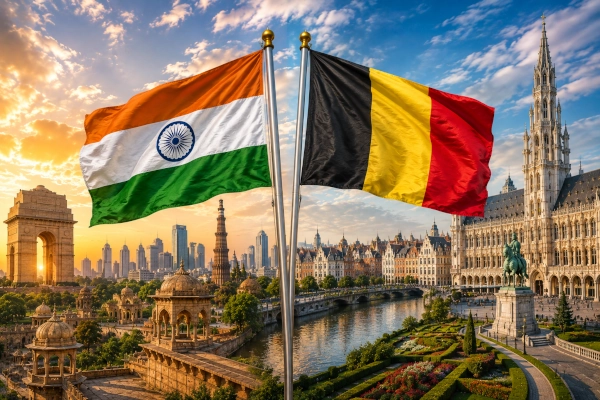
India and Belgium are preparing to give defence and security cooperation a more prominent place in their bilateral relationship as Belgian Prime Minister Bart De Wever undertakes a three-day visit to India from September 2 to 4, 2026. The visit is particularly significant because De Wever is accompanied by Belgium’s Defence Minister Theo Francken and a delegation representing the country’s defence industry, creating an opportunity to move the relationship beyond traditional trade and diplomatic engagement towards closer industrial and technology cooperation.
Prime Minister Narendra Modi and De Wever are scheduled to hold bilateral talks in New Delhi on September 3 covering the broader India-Belgium relationship as well as regional and global developments. The Ministry of External Affairs has identified defence and security, trade and investment, technology, renewable energy, connectivity and people-to-people ties among the principal areas where cooperation could be expanded.
The participation of Theo Francken gives the visit an unusual defence-industrial dimension. Francken serves not only as Belgium’s Minister of Defence but is also responsible for Foreign Trade, placing him at the intersection of military capability development and industrial engagement. Akashvani has reported that the accompanying Belgian defence-industry delegation is expected to explore opportunities for closer interaction with India’s defence ecosystem.
This comes as defence cooperation is emerging as a relatively new component of India-Belgium ties. Belgium has appointed a Defence Attaché in New Delhi, signalling its intention to establish more sustained military-to-military and institutional engagement with India. The current visit could therefore help identify practical areas for future collaboration rather than limiting defence contacts to periodic diplomatic consultations.
There is considerable industrial logic behind such engagement. Belgium maintains a specialised defence and security technology base covering weapons and land systems, ammunition, aerospace, digital and cyber technologies, electronics and sensors, unmanned systems and advanced materials. Belgium’s Defence, Industry and Research Strategy is also seeking to strengthen cooperation among government, industry and research institutions while expanding the country’s role in European defence technology development.
India, meanwhile, has increasingly encouraged foreign defence companies to move beyond the traditional supplier relationship towards local manufacturing, technology partnerships, joint ventures, co-development and integration with Indian supply chains. Against this background, engagement between Indian companies and the visiting Belgian industry delegation could eventually open opportunities in specialised technologies where the two defence ecosystems are complementary.
The defence discussions also form part of a much larger economic relationship. India-Belgium bilateral trade exceeded US$13 billion in FY2025-26, while cumulative Belgian foreign direct investment into India was around US$4.2 billion between April 2000 and December 2025. De Wever will also address a Confederation of Indian Industry event linked to the proposed India-EU Free Trade Agreement and later travel to Mumbai for engagements involving diamonds, ports and logistics.
Belgium’s position is strategically relevant beyond its bilateral economic weight. Brussels hosts the principal institutions of both the European Union and NATO, while India is simultaneously expanding its security, technology and defence-industrial relationships across Europe. A stronger India-Belgium defence relationship could therefore complement New Delhi’s broader effort to build diversified European technology and industrial partnerships.
The immediate significance of De Wever’s visit lies less in any single defence contract than in the composition and level of the delegation. With Belgium’s Prime Minister, Defence Minister and defence-industry representatives engaging India at the same time, the two countries now have an opportunity to identify concrete projects that could transform defence and security from a relatively new component of the relationship into a more substantial industrial partnership.
You may also like
-
Japan’s F-2A Fighters Head to India for Historic First Deployment at Veer Guardian 26
-
Indian Air Force Instructors to Train British Fighter Pilots at RAF Valley
-
India and Germany Deepen Cooperation on Energy Security, Low-Carbon Development and Carbon Markets
-
India to Help Rebuild Nepal School After Principal’s Timely Evacuation Saves Over 1,600 Children
-
India-SACU Trade Pact Could Reshape New Delhi’s Emerging-Market Strategy
