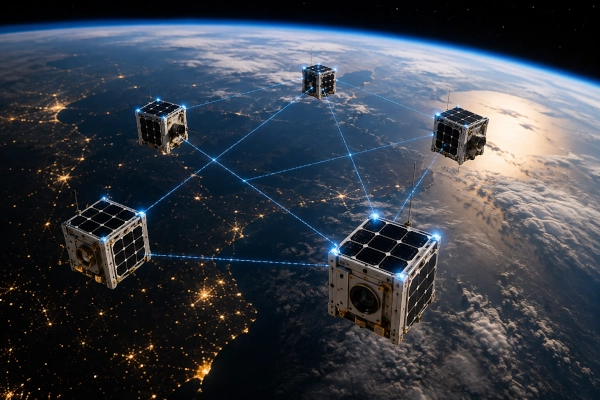
India’s effort to develop an indigenous constellation of satellites capable of autonomously cooperating in orbit is moving closer to deployment, with Bengaluru-based Kepler Aerospace raising fresh capital to accelerate its swarming Intelligence, Surveillance and Reconnaissance programme for the country’s defence-space ecosystem.
The programme has its origins in an official Defence Space Agency challenge under the Innovations for Defence Excellence, or iDEX, initiative. The challenge, titled “Autonomous CubeSat Swarms in Low Earth Orbit (LEO)”, sought the development of a group of small satellites capable of operating together as an autonomous swarm for remote-sensing missions. Kepler Aerospace was officially selected as one of the winners of the challenge by the Defence Innovation Organisation under the Ministry of Defence.
Kepler is now preparing to translate that technology-development programme into an operational space-based ISR capability. The company raised $8 million in seed funding on September 1, 2026, in a round led by Blue Ashva Capital and co-led by Finvolve India Accelerator along with other investors. The investment has been reported at around ₹66.4 crore and represents Kepler’s first external fundraising round since the company was established in 2018.
A substantial part of the capital will be directed towards building and launching the company’s first six autonomous swarming ISR satellites. Rather than functioning as six isolated spacecraft that must individually wait for instructions from controllers on Earth, the satellites are being designed to communicate, coordinate and assign tasks among themselves while in orbit.
This capability could fundamentally shorten the military intelligence cycle. In a conventional satellite-surveillance architecture, a satellite collects information, transmits it to a ground station and waits for further instructions before another spacecraft or sensor is tasked to investigate the same area. Autonomous coordination allows much of that process to take place within the constellation itself.
If one spacecraft detects an object or activity of interest, another member of the swarm could potentially be tasked to obtain additional observations using a different sensor or from a different position. Kepler says its architecture is intended to enable satellites to communicate and task one another without having to wait for a ground station for every decision.
Born From a Defence Space Agency Challenge
The origins of the programme are particularly important because Kepler’s constellation is not simply a commercially conceived Earth-observation project later adapted for military applications. Autonomous satellite swarming was specifically identified as a requirement within India’s emerging defence-space architecture.
The official iDEX awardee list issued by the Defence Innovation Organisation on February 15, 2023 identified Kepler Aerospace and Upgraha Space Technologies as winners of Defence Space Agency Challenge 35, titled “Autonomous CubeSat Swarm in Low Earth Orbit.” Kepler was therefore one of two companies selected for the main swarm challenge rather than the sole winner.
The original Defence Space Agency challenge envisaged an autonomous swarm of 20 CubeSats in Low Earth Orbit for remote-sensing missions. The iDEX description highlighted some of the fundamental advantages of CubeSat-class spacecraft, including comparatively low manufacturing costs, scalability and the ability to deploy multiple satellites as part of a distributed constellation.
Kepler also emerged as a winner of the associated Challenge 35.1 for an Attitude Determination and Control System, or ADCS, for CubeSats, alongside Bellatrix Aerospace. ADCS is a crucial part of any sophisticated satellite because it determines the spacecraft’s orientation and enables it to accurately point sensors, communications equipment or other payloads towards their intended targets.
For autonomous swarm operations, precise attitude determination and control become even more important. Satellites operating cooperatively need to orient sensors accurately, maintain appropriate positioning, coordinate observations and potentially manoeuvre in response to changing mission requirements.
Kepler recently said it had formally documented an iDEX Prime contract for swarming ADCS modules intended for its next-generation ISR constellation. According to the company, those systems will contribute to coordinated swarm operations, autonomous manoeuvring and precision attitude control.
Six Satellites Will Form the First Operational Cluster
While the original Defence Space Agency challenge described a 20-satellite CubeSat swarm, Kepler’s immediate deployment plan involves an initial cluster of six ISR satellites. The two numbers should not be confused: the 20-satellite figure comes from the original government challenge architecture, while six spacecraft represent Kepler’s first planned deployment phase.
The company has already completed its preliminary design review and mission design review, according to recent reporting citing Kepler founder and CEO Navneet Singh. A critical design review is expected to follow, while the first launch is currently being targeted for December 2027. A launch provider has not yet been finalised, with Kepler reportedly evaluating both Indian and international options.
The planned constellation is expected to incorporate several complementary sensor types. Recent company and media disclosures refer to electro-optical, thermal and radio-frequency or electronic-warfare sensing capabilities, allowing the system to observe a target through different parts of the electromagnetic spectrum rather than relying on conventional optical imagery alone.
That multi-sensor architecture could prove particularly valuable for military ISR. An electro-optical satellite might provide detailed imagery under suitable lighting and weather conditions, while thermal sensors can detect heat signatures. Radio-frequency sensing can potentially locate or characterise electromagnetic emissions associated with radars, communications systems and other emitting equipment.
The more important innovation, however, is not simply placing several different sensors in orbit. It is allowing those sensors to operate as part of a coordinated intelligence network.
For example, detection of an unusual radio-frequency emission by one satellite could potentially trigger another spacecraft equipped with an imaging sensor to examine the same region. Similarly, detection of a moving object by an electro-optical system could lead other satellites in the cluster to continue tracking it as orbital geometry changes.
Kepler describes this approach as a form of automated “tip-and-cue” intelligence, in which detection by one sensor generates a requirement for observation by another. Its broader intelligence architecture is being designed around electro-optical, RF, synthetic aperture radar and infrared information, with autonomous tasking intended to reduce the amount of manual intervention required between detection and follow-up collection.
Tracking Mobile Military Targets From Space
This approach could be especially important against targets that do not remain in one location for long periods. According to Kepler’s CEO, the constellation is being designed so that satellites could autonomously identify targets such as ships or mobile air-defence systems and cue other spacecraft to continue observing them.
Tracking mobile military assets from orbit is considerably more demanding than photographing fixed infrastructure. A traditional intelligence system can lose valuable time between detection, analysis, the generation of a new collection request and the arrival of another satellite over the relevant area.
A constellation capable of making some of those decisions autonomously could reduce that latency considerably.
This is where the military value of satellite swarming differs from simply operating a large number of individual satellites. A constellation provides coverage through numbers; a genuine autonomous swarm adds coordination and distributed decision-making.
Each satellite effectively becomes part of a larger network capable of sharing information and modifying its behaviour according to what other members detect.
Moving From Ground-Controlled Satellites Towards Autonomous Space ISR
Satellite operations have traditionally depended heavily on ground infrastructure. Commands are uploaded when a spacecraft passes within communication range, while collected information must be downlinked, processed and analysed before additional decisions are made.
Kepler is attempting to reduce some of these dependencies by combining autonomous satellite operations with its existing ground infrastructure and mission-management capabilities.
The company operates a substantial international network of satellite ground stations supporting tracking, telemetry, command and communications. Kepler’s own current material describes more than 50 operational ground stations across six continents, while some recent funding reports put the network above 70 stations depending on how the infrastructure is counted.
The new $8-million investment will consequently finance more than satellite manufacturing. Kepler also plans to expand its mission-operations and avionics businesses, creating an integrated architecture extending from satellite hardware and ground communications to mission management and final intelligence delivery.
Kepler has already secured two iDEX Prime contracts associated with its swarming ISR programmes, supported by approximately $4 million in iDEX grants, according to the company information reported alongside the latest fundraising. The new private investment is separate from those government-supported iDEX grants and provides additional capital to take the programme towards deployment.
Why Autonomous Satellite Swarms Are Important for India
Space-based surveillance has become increasingly important to modern military operations. Satellites provide intelligence across borders and oceans without depending on access to another country’s territory, but conventional large satellites can be expensive and limited by the frequency with which they revisit a particular location.
Distributed constellations of smaller satellites provide a different architecture. Losing or temporarily disabling one satellite does not necessarily eliminate the entire capability because observations can be distributed across numerous spacecraft. Additional satellites can also potentially be added over time as requirements expand.
Autonomy adds another layer of resilience. A network that can perform at least some detection, prioritisation and tasking without constant ground intervention may remain more responsive when communications links are congested or when military operations are unfolding rapidly.
The development is therefore closely aligned with India’s broader effort to create sovereign space-based intelligence capabilities rather than relying entirely on foreign commercial imagery or external satellite infrastructure for strategically sensitive information.
India already possesses substantial government-operated satellite capabilities. The emergence of private companies capable of manufacturing specialised satellites, developing advanced payloads, operating ground networks and providing intelligence services could significantly expand the capacity available to the armed forces.
Private Industry Becomes Part of India’s Defence-Space Architecture
Kepler’s progress also illustrates the changing structure of India’s defence and space sectors. Technologies that were once developed almost exclusively within government organisations are increasingly being opened to private companies through mechanisms such as Mission DefSpace and iDEX.
Under this approach, the armed forces and organisations such as the Defence Space Agency identify operational problems, while startups and established companies compete to develop technological solutions.
Kepler Aerospace is a particularly interesting example because its work extends across several layers of the space ecosystem. The company develops satellite electronics and avionics, supports spacecraft operations, operates ground infrastructure and is now moving towards providing space-derived intelligence.
Its autonomous CubeSat swarm programme brings those capabilities together around a requirement originating directly from India’s Defence Space Agency.
The fresh funding therefore represents much more than another Indian space-startup investment round. It provides Kepler with capital to move a Defence Space Agency-backed concept from technology development towards an actual group of spacecraft in Low Earth Orbit.
If the planned deployment proceeds as intended, the first six satellites could demonstrate whether an Indian-built constellation can autonomously detect events, share information, coordinate observations and rapidly deliver intelligence to defence users.
The longer-term significance lies in what could follow. A successful six-satellite cluster could become the foundation for a much larger distributed ISR architecture, combining different sensors and increasingly sophisticated autonomous decision-making across many spacecraft.
India’s “Autonomous CubeSat Swarm in Low Earth Orbit” challenge was originally conceived as an attempt to move beyond the conventional model of individually controlled satellites. Kepler Aerospace’s progress now suggests that the concept is advancing from an iDEX challenge on paper towards a deployable defence-space capability.
With the Defence Space Agency requirement behind it, two iDEX Prime programmes supporting the technology and fresh private capital available for deployment, the project represents one of the more ambitious examples yet of India’s private space sector being integrated directly into the country’s emerging military-space architecture.
You may also like
-
IAF Successfully Tests Indigenous Khagantak-243 Long-Range Glide Bomb Developed by BEL and JSR Dynamics
-
India Launches Indigenous iNDiC Underwater Systems for Military and Professional Diving
-
How India Built Its Own Rubidium Atomic Clock to Fix NavIC’s Most Critical Weakness
-
Astrek Innovations Develops AI-Assisted Robotic Exoskeleton for Lower-Limb Rehabilitation
-
VEDA Aeronautics Develops Indigenous APAS Underwater Target and Decoy Vehicle
