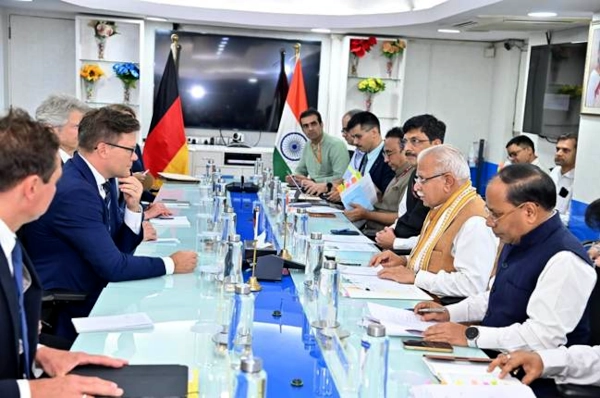
India and Germany have agreed to further strengthen their cooperation in sustainable development, with a renewed focus on energy security, low-carbon growth, carbon markets and resilient supply chains. The discussions were held during a bilateral meeting in New Delhi between Union Minister for Power and Housing & Urban Affairs Manohar Lal and Germany’s Federal Minister for the Environment, Nature Conservation, Climate Protection and Nuclear Safety Carsten Schneider.
The meeting reviewed the expanding energy partnership between the two countries and explored new areas where cooperation could be deepened. Energy security, electrification, low-carbon development, carbon-market mechanisms and diversification of critical supply chains featured prominently in the discussions.
Both sides examined ongoing initiatives and considered how India and Germany could build on their existing partnership to support the transition towards more secure, affordable and sustainable energy systems. The talks come at a time when both countries are seeking to balance rising energy demand with climate objectives, industrial competitiveness and the need to reduce vulnerabilities in global supply chains.
Energy security emerged as one of the central themes of the meeting. India’s rapidly growing economy is driving a sharp increase in electricity demand, making reliable generation, transmission and distribution infrastructure increasingly important. Germany, meanwhile, has accumulated extensive experience in renewable-energy integration, energy efficiency and low-carbon technologies. Greater cooperation could therefore support India’s expanding clean-energy infrastructure while also opening opportunities for German technology and investment.
The two ministers also discussed low-carbon development, an area that is becoming increasingly important as India expands renewable-energy capacity, modernises its electricity grid and develops new technologies for industrial decarbonisation. Cooperation in this field could include clean-energy technologies, energy efficiency, grid modernisation, green industrial processes and other solutions capable of reducing emissions without compromising economic growth.
Carbon markets were identified as another important area of cooperation. India is developing its own domestic carbon-market architecture as part of a broader effort to improve energy efficiency and encourage industries to reduce emissions. Germany has considerable experience with European carbon-pricing mechanisms and emissions-trading systems, creating scope for technical cooperation, knowledge-sharing and the development of credible carbon-accounting frameworks.
Both sides acknowledged that energy security, low-carbon development and carbon markets cannot be treated as separate policy areas. Measures that improve energy efficiency and reduce dependence on carbon-intensive fuels can strengthen energy security, while well-designed carbon markets can encourage investment in cleaner technologies and accelerate industrial transformation.
Supply-chain diversification was also discussed, reflecting growing international concern over the concentration of manufacturing and raw-material processing in a limited number of countries. The transition to renewable energy requires large quantities of solar equipment, batteries, power electronics, critical minerals and grid technologies. India and Germany are therefore exploring ways to develop more resilient and diversified supply chains capable of supporting long-term energy-transition goals.
The latest engagement builds on a much broader strategic relationship between the two countries. India and Germany recently marked 75 years of diplomatic relations and 25 years of their Strategic Partnership, providing a strong institutional foundation for deeper cooperation in energy, technology, climate action, manufacturing and sustainable urban development.
Over the years, Germany has emerged as one of India’s important European partners in renewable energy and sustainable development. Bilateral cooperation has increasingly expanded beyond traditional development assistance towards technology partnerships, investment, industrial collaboration and joint efforts to address climate and energy challenges.
For India, cooperation with Germany could support several major national priorities, including the expansion of renewable-energy generation, modernisation of electricity infrastructure, industrial decarbonisation and development of more efficient urban systems. Germany, in turn, stands to benefit from stronger access to one of the world’s fastest-growing energy markets and from opportunities created by India’s expanding manufacturing and clean-technology ecosystem.
Both ministers reaffirmed their commitment to working towards a secure, affordable and sustainable energy future and agreed to maintain close engagement in the coming months. Their discussions underlined the view that deeper cooperation across energy security, low-carbon technologies and carbon markets can produce mutually reinforcing benefits for both countries.
The New Delhi meeting therefore represents another step in the evolution of the India-Germany partnership from conventional bilateral cooperation towards a wider strategic relationship centred on energy transition, industrial transformation and sustainable economic development. As India’s energy requirements continue to rise and Germany looks to strengthen international clean-energy partnerships, the two countries are likely to find increasing opportunities for cooperation across technology, investment, policy and resilient supply chains.
You may also like
-
Japan’s F-2A Fighters Head to India for Historic First Deployment at Veer Guardian 26
-
Indian Air Force Instructors to Train British Fighter Pilots at RAF Valley
-
India-Belgium Defence Ties Move Into Focus as Belgian PM Arrives With Defence Industry Delegation
-
India to Help Rebuild Nepal School After Principal’s Timely Evacuation Saves Over 1,600 Children
-
India-SACU Trade Pact Could Reshape New Delhi’s Emerging-Market Strategy
