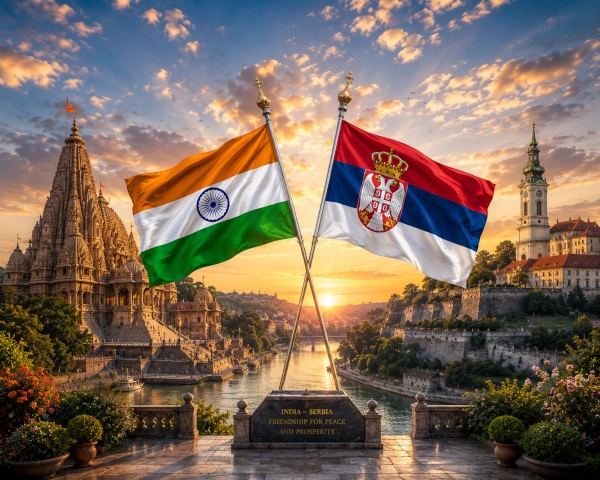
India and Serbia are looking to expand their longstanding diplomatic relationship into newer areas of economic, technological and strategic cooperation, building on a partnership whose roots stretch back to the formative years of the Non-Aligned Movement.
Union Minister for Parliamentary Affairs and Minority Affairs Kiren Rijiju held separate meetings with Serbian Prime Minister Đuro Macut and Foreign Minister Marko Đurić in Belgrade on August 31, 2026, during which both sides discussed strengthening the relationship between the two countries.
The meetings took place as Rijiju led the Indian delegation to a high-level gathering commemorating the 65th anniversary of the first Conference of Heads of State or Government of the Non-Aligned Movement. The event was held in Belgrade from August 31 to September 1 under the theme “The Legacy of Non-Alignment: Lessons for Today’s World.”
India and Serbia Look Beyond Their Historic Friendship
During his meeting with Prime Minister Macut, Rijiju discussed ways of further strengthening what India describes as a close and enduring relationship based on mutual respect, friendship and shared interests.
He subsequently met Serbian Foreign Minister Marko Đurić, with the two sides reviewing the longstanding friendship between India and Serbia and examining opportunities to deepen cooperation in areas of mutual interest.
The discussions form part of a wider effort by New Delhi and Belgrade to give greater economic and technological substance to a relationship that has traditionally been characterised by political goodwill and strong cooperation in international forums.
India and the former Yugoslavia were among the founding countries of the Non-Aligned Movement, and the relationship established during that period has continued between India and modern Serbia.
Fintech, Technology and Pharmaceuticals Emerging as New Areas
Although the latest meetings were framed broadly around strengthening bilateral cooperation, India has identified several sectors where it sees considerable potential for expanding the partnership.
Ahead of the Belgrade engagements, Rijiju said India wants not only to intensify cooperation in established sectors but also to move into areas such as science and technology, fintech, start-ups, agriculture and pharmaceuticals.
These sectors complement an already wider bilateral agenda covering trade and investment, defence, education, culture and people-to-people exchanges.
Technology could become a particularly promising area. India’s rapidly expanding digital economy, fintech sector and Digital Public Infrastructure ecosystem create possibilities for partnerships with Serbia’s growing technology and software industry.
Cooperation involving start-ups, artificial intelligence, digital payments, cybersecurity and innovation could gradually add a new dimension to a relationship historically dominated by political and diplomatic engagement.
Defence Remains Part of Broader Bilateral Agenda
Defence cooperation is also part of the broader India-Serbia relationship.
During the ninth round of India-Serbia Foreign Office Consultations held in Belgrade on March 25, 2026, the two countries reviewed cooperation across trade and economic relations, defence, science and technology, fintech, agriculture, culture and people-to-people ties.
Serbia has a substantial domestic defence-industrial base with experience in artillery, ammunition, armoured vehicles, small arms and other military systems. India, meanwhile, is rapidly expanding indigenous defence manufacturing and seeking greater international partnerships and export opportunities.
This creates potential space for industrial engagement, technology cooperation and defence trade, although no new defence agreement was announced during Rijiju’s latest meetings.
Bilateral Trade Has Been Gradually Expanding
Economic ties between India and Serbia have grown steadily, although the scale of trade remains modest compared with the political relationship.
According to Serbian Statistical Office figures cited by the Indian Embassy in Belgrade, bilateral trade reached approximately US$405.5 million in 2024, compared with US$383.6 million in 2023 and US$326.9 million in 2022.
During the first nine months of 2025, bilateral trade had already reached approximately US$365.7 million.
Indian exports account for a significant portion of commerce between the two countries. Serbia represents a potentially useful gateway for Indian companies seeking access to markets in the Balkans and wider European region.
An Indian-Serbian Chamber of Business and Commerce was established in Belgrade in January 2024 to encourage stronger commercial engagement.
Indian Companies Build Presence in Serbia
A number of Indian companies have already established business links with Serbia.
TAFE, one of India’s major tractor manufacturers, acquired strategic assets associated with Serbian tractor manufacturer IMT after exporting agricultural machinery to the country for decades.
Indian companies and Indian-linked investors are also involved in information technology, food manufacturing, agricultural machinery, pharmaceuticals and industrial production.
Mahindra and Sonalika have worked with local partners on agricultural machinery, while Indian pharmaceutical and healthcare companies have developed commercial representation in the Serbian market.
India’s Embassy has also highlighted opportunities for deeper cooperation in manufacturing, information technology, MSMEs, tourism, agriculture and food processing.
These existing commercial links provide a foundation from which bilateral economic ties could expand considerably if investment and technology partnerships accelerate.
Agriculture Offers Natural Areas for Cooperation
Agriculture is another sector where the economic structures of India and Serbia create complementary opportunities.
Serbia possesses significant expertise in seeds, agricultural research, food processing, fruit cultivation and agricultural machinery. India has an enormous agricultural market and is increasingly investing in mechanisation, food processing, cold-chain infrastructure and agricultural technology.
Closer collaboration could therefore involve agricultural machinery, seed technology, processed foods, farm research and agritech.
Indian tractor manufacturers already operating in Serbia demonstrate how agricultural cooperation can develop into long-term industrial relationships.
India Encourages Serbia to Join Global Green Initiatives
New Delhi is also seeking greater Serbian participation in India-backed international initiatives dealing with clean energy.
Rijiju has said India hopes Serbia will join the International Solar Alliance and the Global Biofuels Alliance.
Serbian participation could broaden cooperation in renewable energy, energy transition and sustainable technologies while connecting the bilateral relationship with India’s increasingly active climate and energy diplomacy.
The International Solar Alliance promotes deployment of solar energy and investment in solar infrastructure, while the Global Biofuels Alliance seeks greater international cooperation on sustainable biofuels.
Mutual Support in International Institutions
India and Serbia also maintain significant political convergence in multilateral institutions.
Serbia has supported Indian candidatures in the United Nations and other international organisations, including India’s candidature for a non-permanent seat on the UN Security Council for the 2028-29 term.
India, in turn, has consistently supported the sovereignty and territorial integrity of Serbia and does not recognise Kosovo’s unilateral declaration of independence.
This mutual diplomatic support has been one of the foundations of the relationship and helps distinguish India-Serbia ties from purely transactional economic partnerships.
Both governments have also emphasised their support for a more representative multilateral system and greater influence for developing countries in global governance.
The Non-Aligned Movement Provides Historic Context
Rijiju’s latest visit carried particular symbolic significance because it coincided with the 65th anniversary of the first summit of the Non-Aligned Movement.
The inaugural conference was held in Belgrade in September 1961, bringing together leaders including India’s Jawaharlal Nehru, Yugoslavia’s Josip Broz Tito, Egypt’s Gamal Abdel Nasser, Indonesia’s Sukarno and Ghana’s Kwame Nkrumah.
The movement emerged during the Cold War as countries across Asia, Africa and other parts of the developing world sought greater strategic autonomy rather than formal alignment with either of the dominant military blocs.
India remains a founding member of NAM, which today brings together 121 developing countries.
Serbia, as a successor state of Yugoslavia, retains an important historical connection with the movement and currently participates as an observer.
Rijiju Pays Tribute to Gandhi and Tito-Era History
During his visit, Rijiju also paid floral tribute at the bust of Mahatma Gandhi in Belgrade and interacted with members of the Indian community living in Serbia.
He met members of the diaspora whose links with the former Yugoslavia dated back several decades, including an Indian who had travelled there under an India-Yugoslavia exchange programme in 1966-67.
Rijiju also visited the Museum of Yugoslavia and the House of Flowers, the mausoleum of former Yugoslav President Josip Broz Tito.
The visit underscored the historical dimension of relations between the two countries, particularly the close association between India and Yugoslavia during the formative decades of the Non-Aligned Movement.
A Relationship Moving From History to New-Economy Cooperation
India-Serbia relations retain an unusually strong historical foundation, but both governments are increasingly attempting to transform that political goodwill into practical economic and technological cooperation.
The latest meetings in Belgrade indicate that the relationship is moving towards a broader agenda involving trade, investment, science and technology, fintech, start-ups, agriculture, pharmaceuticals and potentially greater defence-industrial interaction.
Bilateral trade remains relatively small, suggesting considerable room for expansion. At the same time, Indian companies already operating in Serbia provide a commercial foundation upon which a larger economic partnership could be constructed.
The historical connection created through the Non-Aligned Movement continues to give the relationship political depth. The emerging task for New Delhi and Belgrade is to translate that legacy into cooperation suited to a very different international environment—one increasingly shaped by technology, supply chains, energy security, investment and strategic autonomy.
In that sense, Rijiju’s Belgrade meetings represented more than a commemoration of a diplomatic relationship established decades ago. They reflected an attempt to connect the India-Serbia partnership of the Non-Aligned era with a new phase centred on technology, commerce and practical strategic cooperation.
You may also like
-
From Mahabharata to Santoor: PM Modi’s Gifts Showcase India’s Civilisational Ties with Central Asia
-
India and Armenia Move to Deepen Defence, Technology and Economic Cooperation
-
IAF’s Sarang Team Arrives in Egypt for El Alamein International Airshow 2026
-
India and Denmark Deepen MSME Cooperation in Innovation, Technology and Intellectual Property
-
India’s Roads Beyond Its Borders: The Highways Connecting South Asia, Southeast Asia and Africa
