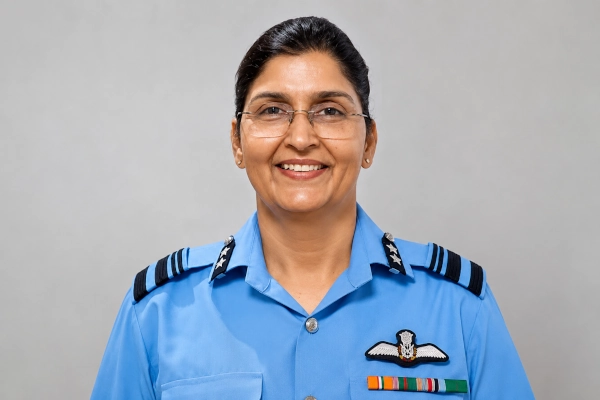
Air Vice Marshal Shakti Sharma has created history by becoming the first woman officer from a non-medical branch of the Indian Armed Forces to attain two-star rank, marking an important milestone in the expanding role of women in senior military leadership.
Sharma assumed charge as Assistant Chief of the Air Staff (Education) at Air Headquarters on September 1, 2026. The Ministry of Defence described her elevation as a historic achievement for the Indian Air Force, confirming that she is the first non-medical woman officer in the Indian Defence Services to reach the rank of Air Vice Marshal or an equivalent rank in the other services.
More Than Three Decades in the Indian Air Force
Air Vice Marshal Shakti Sharma was commissioned into the Education Branch of the Indian Air Force on June 18, 1994. During a career spanning more than three decades, she has served in a wide range of appointments covering training establishments, operational field stations, Command Headquarters and Air Headquarters.
Her career has largely been associated with military education, institutional development and strengthening the relationship between professional military training and India’s academic ecosystem. Her elevation places an officer from the IAF’s Education Branch among the senior two-star leadership of the service.
The rank of Air Vice Marshal is a two-star rank in the Indian Air Force, equivalent to Major General in the Indian Army and Rear Admiral in the Indian Navy. It sits above Air Commodore and below Air Marshal in the IAF’s commissioned officer hierarchy.
Sharma’s promotion is particularly significant because women officers from medical services had attained senior flag ranks earlier. Her achievement therefore lies specifically in becoming the first woman from outside the medical branches of India’s Armed Forces to reach two-star rank.
Strengthening Links Between the IAF and Indian Universities
One of Sharma’s notable contributions has been her involvement in establishing Indian Air Force Chairs of Excellence at IIT Kanpur and Pune University.
These initiatives were intended to strengthen interaction between the Air Force and leading academic institutions, allowing greater engagement in areas related to military studies, aerospace, technology, strategic affairs and professional education.
Such collaboration is becoming increasingly important as modern air warfare grows more technology-intensive. Contemporary air forces require expertise not only in flying and engineering but also in artificial intelligence, space systems, cyber operations, electronic warfare, data analysis, autonomous technologies and strategic studies.
Sharma’s experience in building links between the Air Force and academia therefore reflects a broader transformation taking place within military education, where technological knowledge and academic research are becoming progressively more closely integrated with operational requirements.
First Woman Officer to Head a Sainik School
Shakti Sharma had already achieved another important first earlier in her career.
She became the first woman officer from the three Armed Services to command a Sainik School, serving as Principal of Sainik School Kapurthala in Punjab.
Sainik Schools occupy an important position in India’s military education system. Established to provide structured academic and leadership-oriented education, they have traditionally prepared students for entry into institutions such as the National Defence Academy while promoting discipline, physical fitness and leadership qualities.
Sharma’s appointment as Principal of Sainik School Kapurthala therefore represented an important leadership responsibility extending beyond the IAF itself and into India’s wider defence-education ecosystem.
Why the ‘Non-Medical’ Distinction Matters
The description of Sharma as India’s first woman two-star officer requires an important qualification.
Women have previously attained two-star and even three-star ranks in the Armed Forces Medical Services. One of the best-known examples is Air Marshal Padma Bandopadhyay, who rose through the medical branch of the Indian Air Force and eventually attained the three-star rank of Air Marshal.
Other senior women officers from the medical services have similarly attained Major General, Lieutenant General, Air Vice Marshal, Air Marshal and equivalent ranks.
Sharma’s elevation is different because she belongs to a non-medical branch of the regular Indian Air Force establishment. Her promotion therefore represents the first time a woman officer outside the military medical structure has reached the two-star level anywhere across the Army, Navy or Air Force.
This distinction is significant because the career pathways available to women outside the medical services have historically expanded more gradually.
Women Move Into Wider Military Leadership Roles
The milestone comes as the Indian Armed Forces continue to expand the range of appointments available to women.
Women officers now serve in an increasingly broad spectrum of roles across the Army, Navy and Air Force, including aviation, air traffic control, engineering, signals, intelligence, logistics, education, air defence and several operational branches.
The opening of the National Defence Academy to women cadets, the expansion of permanent commissions and the gradual availability of command appointments have further widened the professional pathways through which women can build full military careers.
As larger numbers of women progress through these career structures, more officers are expected to become eligible for senior command, staff and flag-rank appointments over the coming years.
Sharma’s promotion is therefore important not merely as an individual achievement but because it demonstrates that a woman officer commissioned into a non-medical service branch can now progress through the hierarchy to the two-star level.
Assistant Chief of the Air Staff (Education)
In her new role as Assistant Chief of the Air Staff (Education), Air Vice Marshal Sharma will hold a senior appointment dealing with the educational and professional-development dimensions of the Indian Air Force.
Military education has assumed growing importance as the character of warfare changes rapidly. Modern officers increasingly require familiarity with emerging technologies, joint operations, space and cyber warfare, geopolitics, strategic planning and complex networked combat environments.
The IAF itself is undergoing a major technological transition as it introduces new indigenous aircraft, air-defence systems, sensors, weapons, communication networks and unmanned platforms.
Building personnel capable of operating, managing and strategically employing these technologies requires a corresponding evolution in professional military education.
Sharma’s long experience in education and institutional interaction therefore places her in a position closely connected with one of the less visible but increasingly important elements of the Air Force’s modernisation.
A Landmark in India’s Military Leadership
Air Vice Marshal Shakti Sharma’s elevation represents another milestone in the gradual transformation of women’s careers within India’s Armed Forces.
When she entered the IAF Education Branch in 1994, opportunities available to women officers were substantially narrower than they are today. More than three decades later, she has progressed through successive ranks to become the first non-medical woman officer across the three Services to reach two-star rank.
Her career has included appointments at field stations, training institutions, Command Headquarters and Air Headquarters, as well as responsibility for strengthening links between the Air Force and India’s academic institutions.
Her earlier distinction as the first woman officer from the three Services to lead a Sainik School and her latest appointment as Assistant Chief of the Air Staff illustrate a career centred on military education and institutional leadership.
Most importantly, her promotion establishes a new precedent. Women officers outside the Armed Forces Medical Services have now crossed the two-star threshold within India’s military hierarchy.
As more women progress through command and staff appointments across the Army, Navy and Air Force, the significance of this milestone may ultimately lie in the fact that what is historic in 2026 could become increasingly normal in the decades ahead.
References
- Press Information Bureau, Ministry of Defence, Government of India. “Air Vice Marshal Shakti Sharma becomes first woman officer (Non-Medical) in Indian Defence Forces to attain the rank of Air Vice Marshal.” 1 September 2026.
https://www.pib.gov.in/PressReleasePage.aspx?PRID=2305671&lang=2®=48 - Ministry of Defence / Indian Air Force, Government of India. Official announcement on Air Vice Marshal Shakti Sharma assuming charge as Assistant Chief of the Air Staff (Education), Air Headquarters, and becoming the first non-medical woman officer in the Indian Defence Services to attain two-star rank. 1 September 2026.
You may also like
-
Indian Navy Vice Chief Inspects Japan’s Mogami-Class Stealth Frigate as India-Japan Shipbuilding Cooperation Expands
-
Philippine Marine Wargames Reportedly Show BrahMos Can Penetrate Chinese Destroyer Air Defences
-
Safran Signs 18 Agreements with Indian Aerospace Suppliers, Expanding Make in India Manufacturing Partnerships
-
Indian Army’s Vajra Corps Certifies First Batch of Drone Operators, Strengthens Battlefield Surveillance
-
India to Seek 35% Increase in Defence Modernisation Budget for FY 2027–28
