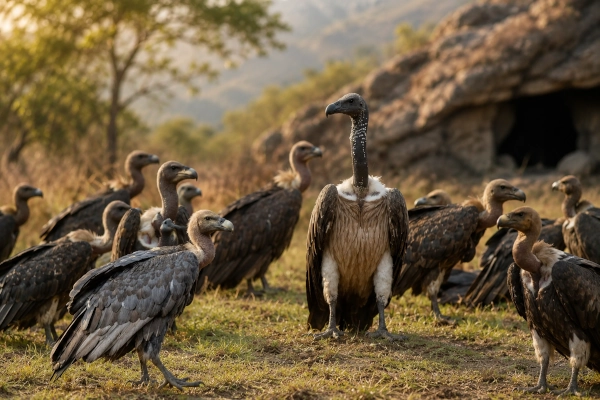
India has achieved a major wildlife-conservation milestone with the world’s first release of captive-bred Slender-billed Vultures into the wild, as Assam’s Forest Department and the Bombay Natural History Society released ten critically endangered vultures in the Biswanath landscape of Kaziranga National Park and Tiger Reserve.
The release, carried out on 7 August 2026, included five Slender-billed Vultures (Gyps tenuirostris) and five White-rumped Vultures (Gyps bengalensis). The birds were released from the Jatayu Soft Release Centre at Tewaripal in Biswanath district under a long-running conservation programme aimed at rebuilding wild populations of South Asia’s severely depleted Gyps vultures.
The significance of the programme lies particularly in the Slender-billed Vultures. While captive breeding has been used for several threatened vulture species, conservation authorities described this as the first time captive-bred Slender-billed Vultures had been released into the wild anywhere in the world.
From Captive Breeding to the Wild
The ten birds were bred at the Vulture Conservation Breeding Centre at Rani near Guwahati, which has been operated through cooperation between the Assam Forest Department and BNHS.
Before release, the vultures were transferred to the Biswanath release aviary, where they spent approximately three months acclimatising to the surrounding environment. This stage is crucial because birds raised under managed conditions need time to become familiar with the climate, local landscape, food availability and presence of wild vultures before being given complete freedom.
Rather than simply opening transport crates immediately after arrival, conservationists used a soft-release method. Under this approach, the birds are first housed in a large aviary at the eventual release site and gradually exposed to conditions similar to those they will encounter after entering the wild.
The technique is intended to improve survival by reducing the abrupt transition between captivity and an uncontrolled natural environment.
GPS Tracking Will Follow Their Survival
The released vultures have been equipped with GSM-GPS tracking devices and identification markings, allowing conservation teams to follow their movements after release.
Tracking data can reveal where the birds travel, which areas they use for feeding and roosting, whether they associate with existing wild vulture populations and whether they encounter dangerous landscapes.
Such information is particularly important for reintroduction programmes because the release itself represents only the beginning of the conservation process. Long-term success depends on whether the birds survive, establish normal ranging behaviour and eventually contribute to the breeding population.
Monitoring can also help conservationists quickly identify unusual behaviour or mortality events and investigate possible causes.
Slender-Billed Vulture Among South Asia’s Most Threatened Birds
The Slender-billed Vulture was once considerably more widespread across northern and northeastern parts of the Indian subcontinent and adjoining regions of Southeast Asia. Like several other members of the Gyps genus, however, its population collapsed dramatically beginning in the 1990s.
The White-rumped Vulture, which formed the other half of the Assam release, suffered an equally severe decline.
The principal cause of this collapse was traced to the veterinary use of diclofenac, a non-steroidal anti-inflammatory drug given to cattle and other livestock. Vultures feeding on carcasses of animals that had recently been treated with the drug could ingest toxic residues, leading to fatal kidney failure.
India responded by withdrawing veterinary diclofenac licences in 2006 and promoting safer alternatives. The Government of India has since incorporated control of vulture-toxic veterinary drugs, captive breeding, Vulture Safe Zones and rehabilitation into its national vulture-conservation strategy.
Rani Breeding Centre Becomes Central to Recovery
The Vulture Conservation Breeding Centre at Rani in Assam has become one of the important facilities supporting the recovery of threatened vultures in India.
According to Assam government information, the centre has successfully bred dozens of vultures and currently maintains significant captive populations of both Slender-billed and White-rumped Vultures. Its long-term objective is not merely to maintain birds in captivity but to produce healthy individuals that can eventually be returned to landscapes from which wild populations declined.
That objective makes the Biswanath release especially important. It represents the transition from maintaining an insurance population under human care to actively rebuilding wild numbers.
BNHS had already moved the five Slender-billed Vultures into the Biswanath soft-release aviary in March 2026, describing that step as the beginning of a landmark effort to return the species to the wild.
Wild Vultures Can Help Released Birds Adapt
Soft-release programmes can also make use of existing wild vultures as natural guides.
Conservation programmes sometimes place livestock carcasses near release aviaries so that wild vultures visit the area. Captive-bred birds can observe their behaviour before release and later follow them towards feeding and roosting locations.
This interaction can be particularly useful for highly social scavengers such as vultures, whose survival depends partly on finding unpredictable food resources scattered across large landscapes.
The Biswanath region and the wider Kaziranga landscape provide a combination of forests, grasslands, settlements, livestock populations and open areas capable of supporting scavenging birds, making it a strategically important site for such a programme.
Poisoning Remains a Serious Threat
Removing diclofenac from veterinary use addressed one of the major causes of the historic vulture crash, but it has not eliminated all risks.
Assam authorities and conservation organisations have warned that poisoned animal carcasses remain a serious threat. In some areas, livestock owners or others may deliberately lace carcasses with pesticides to kill predators or other animals, unintentionally killing vultures that gather to feed.
Because multiple vultures can feed on a single carcass, one poisoned animal can kill several birds at once.
Other risks include electrocution, collision with power infrastructure, habitat degradation, reduced availability of safe food and exposure to veterinary drugs that may also be toxic to vultures.
Reintroducing birds therefore has to be accompanied by efforts to make the surrounding landscape safe enough for them to survive.
Vultures Perform an Essential Ecological Service
The recovery of vultures is important far beyond saving individual species.
Vultures are among nature’s most efficient scavengers. Large groups can consume animal carcasses rapidly, removing decomposing tissue that might otherwise persist in the environment.
Their highly acidic digestive systems can destroy many pathogens present in carrion, helping to limit the spread of disease and reducing opportunities for populations of feral dogs and other scavengers to expand around carcass dumps.
The collapse of Indian vulture populations consequently represented not only a biodiversity loss but also the disappearance of an important ecological sanitation service.
Restoring these scavengers can therefore benefit entire ecosystems as well as communities living around livestock-producing landscapes.
India’s Long Vulture Recovery Programme Begins Showing Results
India’s vulture-conservation effort has taken decades because large vultures reproduce slowly. A breeding pair generally raises only a small number of chicks, meaning populations cannot recover rapidly even when the principal threat is removed.
Captive-breeding programmes were established to ensure that surviving genetic populations were protected while conservationists worked to reduce toxic drugs and create safer landscapes.
The release in Assam demonstrates that some of those breeding programmes have now matured sufficiently to begin returning birds to the wild.
The five Slender-billed Vultures are particularly important because their survival will provide valuable evidence about whether captive-bred individuals of the species can successfully adapt to natural conditions.
A Global First From Assam
The Biswanath release represents one of the strongest recent examples of Indian conservation moving from emergency species protection towards active population restoration.
Five captive-bred Slender-billed Vultures and five White-rumped Vultures have now moved from the controlled environment of the Rani breeding centre, through months of acclimatisation at Tewaripal, and finally into the open landscape of Assam.
Their movements will continue to be followed through GPS-based monitoring, and the coming months will provide important information about survival, feeding behaviour, movement and interaction with wild vultures.
For the Slender-billed Vulture in particular, the programme marks a historic threshold. A species brought close to disappearance by a human-made veterinary threat is now being deliberately returned to the wild through decades of breeding, research, drug regulation and habitat protection.
You may also like
-
Rare Migratory Smew Recorded for First Time in Assam’s Laokhowa Wildlife Sanctuary
-
Rare Siberian Sharp-Tailed Sandpiper Recorded at Najafgarh
-
Monsoon Survey Reveals Rich Western Ghats Bird Diversity at Kerala’s Peppara Sanctuary
-
Assam’s Dehing Patkai Rainforest Emerges as Butterfly Diversity Stronghold With 165 Species Recorded
-
New Freshwater Crab Ghatiana karnataka Reveals Hidden Biodiversity of the Western Ghats
