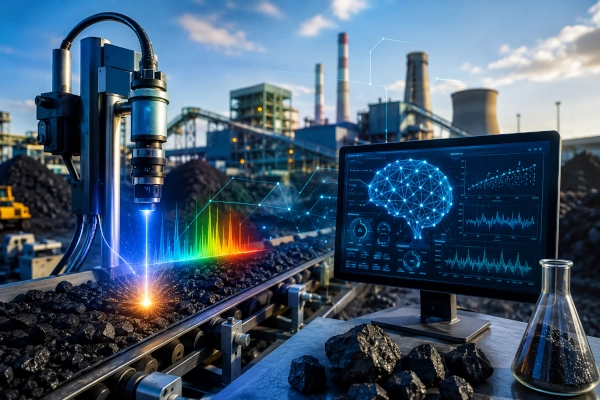
Manipal Academy of Higher Education and GHCL Limited have joined forces to develop an AI-enabled system capable of assessing the quality of carbon-based fuels in near real time, potentially allowing industrial plants to make operational decisions much faster than is possible with conventional laboratory testing.
The project will combine Laser-Induced Breakdown Spectroscopy, or LIBS, with artificial intelligence and machine-learning algorithms to estimate the Gross Calorific Value of fuels at the point where they are received or used. The collaboration brings together researchers from MAHE’s Manipal Institute of Applied Physics and engineers from GHCL, one of India’s major chemical manufacturers.
If successfully developed and deployed at industrial scale, the technology could help energy-intensive industries improve fuel utilisation, reduce uncertainty in incoming fuel quality and make combustion and process-heating operations more responsive to changes in fuel composition.
Why Fuel Quality Matters to Industry
Carbon-based fuels can vary considerably in composition and energy content, even when different consignments are classified as the same broad grade of fuel. Variations in moisture, ash, carbon content and other characteristics directly influence how much useful energy can be extracted from a given quantity.
One of the most important measurements is Gross Calorific Value, or GCV, which indicates the total amount of heat released when a fuel is completely burned under specified conditions. It is therefore a key measure of the commercial and operational value of coal and other solid fuels.
For industries that consume large quantities of fuel, even relatively small variations in calorific value can affect fuel consumption, production costs, furnace conditions and overall process efficiency.
GHCL uses carbon-based fuels extensively for process heating and energy generation, making rapid information about incoming fuel quality particularly valuable. The company and MAHE say the proposed system is intended to provide immediate information at the point of receipt rather than waiting for conventional laboratory results.
The Limitation of Conventional Testing
Traditional fuel-quality assessment generally involves collecting representative samples, preparing them and carrying out laboratory measurements.
Calorific value is commonly measured through controlled combustion techniques such as bomb calorimetry. Although such laboratory methods provide established reference measurements, obtaining results can take considerably longer than the timescale on which an industrial plant may need to modify operating conditions.
Research into industrial coal analysis has highlighted the same problem. Sampling, preparation and laboratory analysis can take hours, meaning the resulting information may arrive after combustion conditions or incoming fuel characteristics have already changed.
That delay can make it difficult for plant operators to immediately adjust fuel blending, combustion parameters or purchasing decisions.
The MAHE-GHCL project seeks to shorten this information cycle dramatically.
How Laser-Induced Breakdown Spectroscopy Works
LIBS is an optical analytical technique that can determine the elemental composition of a material extremely quickly.
A short, high-energy laser pulse is directed at the surface of the sample. The intense energy removes a microscopic quantity of material and converts it into a very small, extremely hot plasma.
As that plasma cools, atoms and ions emit light at characteristic wavelengths. Because different chemical elements produce distinctive spectral signatures, analysing this emitted light makes it possible to determine which elements are present and obtain information about their relative concentrations.
Unlike many conventional analytical procedures, LIBS can perform measurements rapidly and requires comparatively little sample preparation. These characteristics have made it an increasingly attractive technique for industrial coal and fuel analysis. Scientific reviews describe LIBS as particularly promising for fast and potentially online measurements of parameters relevant to coal quality and combustion.
Where Artificial Intelligence Enters the System
A LIBS instrument does not directly read out a figure saying how many megajoules of energy a kilogram of fuel contains. Instead, it produces a complex spectrum containing numerous emission lines associated with different chemical constituents.
This is where artificial intelligence and machine learning become important.
Researchers can train computational models using LIBS spectra from fuel samples whose properties have already been accurately determined through conventional laboratory testing. The algorithm learns relationships between combinations of spectral features and parameters such as calorific value.
When an unknown fuel sample is subsequently analysed, the system can compare its spectral signature with the patterns learned during training and generate a rapid estimate of its properties.
This combination of spectroscopy and machine learning has already shown considerable promise internationally. Research has demonstrated that machine-learning-enhanced LIBS can be used to estimate coal properties including calorific value, sulphur and volatile matter, while newer reviews identify real-time industrial fuel monitoring as one of the field’s most promising applications.
From Laboratory Spectroscopy to an Industrial Instrument
The MAHE-GHCL initiative is especially significant because its objective goes beyond laboratory research.
The partners intend to develop a system suitable for use in an actual industrial environment, where fuel samples can vary widely and measurements must remain reliable despite dust, temperature variations and other operational conditions.
The project is being led at MAHE by Dr Unnikrishnan V. K. of the Manipal Institute of Applied Physics, who is serving as Principal Investigator. MAHE’s wider project team includes the institute’s technology and applied-physics leadership, while GHCL is contributing the industrial environment in which the technology could ultimately be validated and deployed.
This transition from a controlled research laboratory to a production plant is one of the most challenging stages in developing spectroscopy-based industrial monitoring systems.
Immediate Assessment at the Point of Receipt
One of the most useful applications envisioned for the technology is analysing fuel when it reaches an industrial facility.
At present, a plant may receive a fuel consignment, collect samples and send them for laboratory testing. By the time detailed quality results become available, substantial quantities of that fuel may already have entered storage or production.
A rapid LIBS-based system could provide operators with preliminary quality information much earlier.
This could allow industries to separate consignments according to quality, modify blending ratios or adjust process parameters before substantial quantities of material are consumed.
For companies buying enormous volumes of fuel every year, faster information could also strengthen quality assurance by helping identify whether delivered fuel corresponds with contracted specifications.
Potential for Better Combustion Control
Knowing calorific value quickly can also help industrial operators maintain more consistent energy input.
If a lower-calorific-value batch enters the system unexpectedly, a plant may have to consume more material to produce the same amount of useful heat. Conversely, higher-energy fuel may require changes in feed rates or combustion settings.
With faster information, operators could potentially adjust these parameters much closer to real time.
Academic and industrial research into LIBS has already demonstrated the potential of such systems for combustion optimisation. One industrial study operated an automated LIBS coal-analysis system at a power plant for ten weeks and reported measurements of calorific value, sulphur and volatile matter that met applicable industrial-analysis requirements.
The MAHE-GHCL project will still need its own testing and validation, but this existing research demonstrates that the underlying concept is technically credible.
AI Could Compensate for Complex Fuel Variations
Solid fuels are particularly difficult to analyse because they are heterogeneous.
Two samples taken from the same shipment can contain different proportions of mineral matter, moisture and combustible material. These variations can alter the LIBS spectrum and complicate straightforward interpretation.
Machine learning provides one possible way of managing this complexity because models can consider large numbers of spectral variables simultaneously rather than relying on a single emission line.
Recent research in coal analysis has found that machine-learning techniques can significantly improve the accuracy and repeatability of spectroscopic prediction models. At the same time, researchers caution that matrix effects, variations in samples and signal stability remain important challenges that must be addressed before widespread industrial deployment.
Consequently, careful calibration using large and representative fuel datasets will be crucial to the Manipal project.
More Than Just Calorific Value
The immediate project is centred on predicting Gross Calorific Value, but LIBS potentially provides information about several elemental constituents simultaneously.
Research elsewhere has demonstrated LIBS-based analysis of characteristics including carbon, sulphur, ash-related elements and volatile matter.
That raises the possibility that a successful industrial platform could eventually evolve beyond a single-parameter instrument into a broader fuel-characterisation system.
Such an expansion would require further calibration, validation and certification, but the underlying spectroscopy provides a foundation for multi-parameter analysis.
Potential Applications Beyond GHCL
Although GHCL provides an immediate industrial use case, the technology could eventually be relevant to numerous sectors that consume carbon-based fuels.
Thermal power stations, cement manufacturers, steel plants, chemical factories and other process industries routinely handle large quantities of fuels whose quality affects operating efficiency.
A portable or permanently installed rapid-analysis system could potentially be deployed at unloading points, storage yards or process lines.
MAHE says the project is intended to generate intellectual property and scalable technology with commercial potential, and that a successful system could provide a model for deployment across other energy-intensive industries.
Industry-Academia Research with Commercial Intent
The collaboration also represents a broader movement towards translating university research into technologies that solve specific industrial problems.
Rather than developing spectroscopy or AI models independently, MAHE researchers will work with an industrial partner that has an immediate operational requirement for the technology.
For GHCL, the objective is improved fuel-quality assurance and operational efficiency. For MAHE, the project offers a platform on which advanced spectroscopy, data analytics and machine learning can be transformed into deployable industrial technology.
The agreement was formally exchanged between Sanjay Gupta, Vice President (Commercial) at GHCL, and Dr P. Giridhar Kini, Registrar of MAHE. GHCL’s Sutrapada operations are also closely involved in the initiative.
An Indian Push Towards Intelligent Industrial Monitoring
The significance of the project lies not merely in applying artificial intelligence to another industrial process, but in integrating physical sensing, spectroscopy and data-driven prediction into a single decision-support system.
Much of industrial digitalisation depends upon being able to measure physical processes quickly enough for software to respond to them. AI can optimise an operation only when it receives reliable and timely information about the material entering that operation.
By attempting to turn microscopic flashes of laser-generated plasma into an immediate estimate of a fuel’s energy content, the MAHE-GHCL project is addressing exactly that interface between physical science and artificial intelligence.
The technology remains under development and should therefore not yet be regarded as a replacement for certified laboratory testing. Its immediate promise is as a rapid monitoring and decision-support tool, with the potential for wider commercial deployment once accuracy, repeatability and industrial robustness have been established.
If those objectives are achieved, the project could give Indian industries a domestically developed platform for understanding fuel quality within seconds rather than waiting hours for laboratory feedback—bringing spectroscopy, artificial intelligence and industrial process control together in a practical application.
You may also like
-
Indian Scientists Discover How Rapidly Spinning Black Holes Produce High-Frequency X-Ray Oscillations
-
ISRO Completes Historic SPADEX Mission as Both Satellites Re-enter Earth’s Atmosphere After Successful Space Docking Experiments
-
Indian Scientists Discover Rare Accretion Disk Around Neutron Star 24,000 Light-Years Away
-
BARC Scientists Develop Indigenous Technology to Recover 90% of Lithium from Seawater
-
How Indigenous Indian Technologies Are Helping Aircraft and Trains Navigate Safely Through Dense Fog
