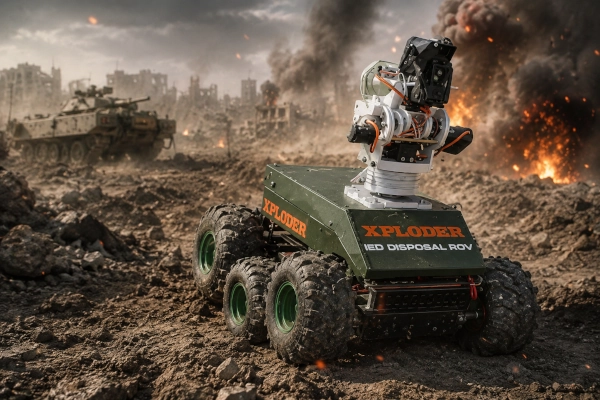
Xploder, an indigenous Unmanned Ground Vehicle developed by Indian Army officer Major Rajprasad R.S., is an example of battlefield innovation emerging directly from soldiers who understand operational problems from first-hand experience. Designed as a compact, all-terrain robotic vehicle, Xploder was conceived primarily to reduce the need for soldiers to physically approach Improvised Explosive Devices and other potentially lethal threats during counter-insurgency and counter-terrorism operations.
Major Rajprasad, an officer of the Corps of Engineers and 7 Engineer Regiment, began developing the system after examining the risks faced by troops while dealing with IEDs and clearing terrorist hideouts. Government records from the earlier stages of the project identify him as Captain Rajprasad R.S. and recognise Xploder under the iDEX4Fauji initiative as an unmanned IED-disposal remotely operated vehicle. The project subsequently matured as he continued his service and development work.
Xploder is deliberately designed to be small and portable enough to accompany troops operating in difficult terrain. Early Government of India material described it as a backpack-sized, lightweight remotely operated vehicle, allowing soldiers to carry the robot close to an operational area before deploying it from a safe position. Later versions have been described as roughly 10 kg in weight, making the platform considerably easier for infantry and combat-engineer teams to transport than conventional heavy bomb-disposal robots.
From IED Disposal to Reconnaissance
Although neutralising IEDs was the original requirement, Xploder evolved into a multi-role battlefield robotic platform. The system can conduct unmanned reconnaissance and surveillance, approach suspected explosive devices, carry explosive payloads and assist troops during room intervention and hideout-clearance operations.
Its ability to move ahead of soldiers is particularly useful during counter-terrorism operations. Instead of requiring troops to enter a suspicious room, structure or confined position first, the remotely operated vehicle can be sent forward to obtain information about the environment and identify potential threats.
The Ministry of Defence describes Xploder specifically as an IED disposal and room-intervention UGV intended for both conventional and sub-conventional operations. Defence reporting associated with the Army’s innovation programme has additionally identified reconnaissance, explosive-payload delivery and disaster-relief operations among the platform’s potential roles.
A Kamikaze Role Against Hostile Positions
One of Xploder’s most unusual capabilities is its ability to be employed as an expendable attack system when circumstances demand it.
The vehicle can carry an explosive payload towards a hostile position and be sacrificed during the attack, effectively giving it a kamikaze UGV role. This could be particularly useful during the clearance of fortified rooms, terrorist hideouts or other positions where sending soldiers forward would expose them to exceptionally high risk.
Major Rajprasad has explained that the platform was designed so that personnel could deliver explosive payloads or deal with suspected IEDs from a stand-off distance rather than requiring direct human intervention. Reporting from Aero India 2025 also described a self-destruct or kamikaze capability for hideout clearance.
This capability does not mean that Xploder is simply a ground-based suicide weapon. Its significance lies in its modularity: the same compact robotic platform can perform reconnaissance, IED-related tasks and intervention missions, with an expendable attack role available when required.
Designed Around a Problem Soldiers Actually Face
The origin of Xploder is particularly important to the story of Indian military innovation. The system did not begin as a conventional defence-industry project developed in isolation from troops. It emerged from an Army officer trying to address a recurring battlefield danger faced by soldiers.
IED disposal is inherently hazardous. Terrorists and insurgent groups can conceal explosives inside buildings, vehicles, roadsides and objects specifically intended to draw security personnel into lethal proximity. Even specialised bomb-disposal teams remain vulnerable when approaching such devices.
A small remotely controlled robot provides an additional layer of separation between the explosive threat and the soldier. If the robot is damaged or destroyed during the task, equipment is lost rather than a human life.
That practical philosophy—sending a machine into the most dangerous space before sending a soldier—lies at the heart of Xploder.
Technology Transferred to Indian Industry
Xploder has progressed substantially beyond the prototype stage.
The Ministry of Defence confirmed that the Transfer of Technology for Xploder to private industry has been undertaken, together with another soldier-developed innovation known as Agniastra. The ministry’s Annual Report 2024–25 describes Xploder as an IED-disposal and room-intervention UGV and says the two innovations have extensive applications in conventional and sub-conventional operations.
This step is important because a successful military invention has limited operational impact if it remains a one-off prototype built by its inventor. Transferring the design to industry makes serial manufacturing, standardised quality control, maintenance support and wider distribution across Army formations possible.
By early 2025, the Army was progressing Xploder towards mass procurement and induction. The system was displayed at Aero India 2025 as one of the Indian Army’s in-house innovations, and Army-related reporting indicated that larger numbers were envisaged for combat-engineer, infantry and Special Forces formations involved in counter-insurgency and counter-terrorism missions.
The precise final procurement quantity publicly contracted by the Army should, however, be distinguished from plans for wider induction. Official Ministry of Defence material confirms the technology transfer and operational utility of Xploder, while reports of hundreds of systems being inducted represent the subsequent procurement pathway rather than a publicly detailed final production contract.
Part of a Remarkable Series of Soldier-Led Innovations
Xploder is also significant because it is not Major Rajprasad’s only military innovation.
He has been associated with several systems developed to solve practical battlefield and engineering problems. These include Agniastra, a portable multi-target detonation system; Vidyut Rakshak, an IoT-enabled integrated generator monitoring, protection and control system; and earlier work on remote detonation and reconnaissance technologies.
Vidyut Rakshak has already been inducted in the Army’s Northern Command, while the Ministry of Defence has confirmed technology transfer for both Xploder and Agniastra. A portable multi-target detonation device developed by Major Rajprasad has also entered production and is being inducted into the Army.
His work illustrates an increasingly important strand of India’s defence innovation ecosystem: soldiers becoming inventors.
Personnel operating equipment in mountains, deserts, forests and counter-terror environments often understand shortcomings that may not be immediately apparent to an external designer. When mechanisms such as the Army Design Bureau and iDEX4Fauji allow those personnel to develop prototypes, test them with troops and eventually transfer successful designs to industry, battlefield experience can be converted directly into deployable technology.
Xploder represents precisely that process. What began as an Army officer’s attempt to keep soldiers farther away from IEDs has developed into an indigenous multi-role unmanned ground vehicle with applications ranging from reconnaissance and explosive disposal to room intervention and high-risk assault missions.
Its journey from a soldier’s idea to technology transfer and planned wider induction makes Xploder one of the strongest examples of innovation from within the ranks of the Indian Armed Forces.
You may also like
-
India Moves to Build Port Cranes at Home, Reducing Dependence on Chinese Equipment
-
Indian Navy Commissions INS Nipun, Strengthening Deep-Sea Diving and Submarine Rescue Capability
-
From Chandrayaan-3 to Aditya-L1: The Made-in-India Chips Powering India’s Space Missions
-
Martlet vs India’s VSHORADS: Two Very-Short-Range Air Defence Missiles, Two Different Ways to Defeat the Same Threat
-
Indian Army Aviation Executes Extraordinary One-Skid Casualty Evacuation at 18,600 Feet Near Nun-Kun
