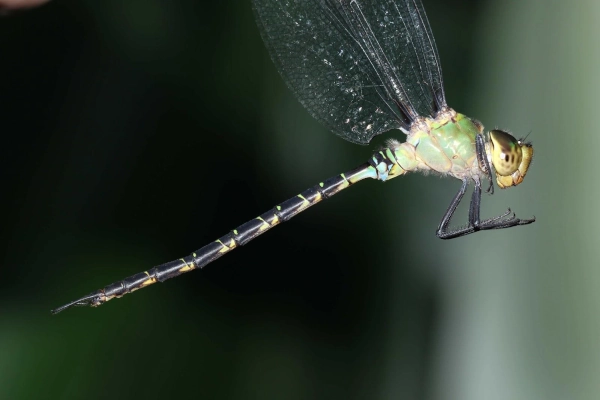
A rare forest dragonfly previously known principally from Southeast Asia has been conclusively documented in Arunachal Pradesh’s Namdapha National Park and Tiger Reserve, adding an important record to India’s extraordinary Odonata diversity.
The species, the Spoon-tailed Duskhawker (Gynacantha basiguttata), has now been identified from photographs taken along the Miao–Vijaynagar Road inside Namdapha. The finding represents the first verifiable photographic record of the species from Arunachal Pradesh and provides evidence strong enough for researchers to recommend its inclusion in India’s contemporary Odonata checklist.
Although the discovery attracted wider attention in late August 2026, the dragonfly was actually photographed almost two years earlier, in October 2024. Its identity was established only after further taxonomic examination corrected an initial identification, demonstrating how photographic records can continue to yield important biodiversity discoveries long after the original field observation.
A Rare Dragonfly Hidden in Namdapha’s Forest
The record emerged from fieldwork by a five-member team studying dragonflies in Namdapha National Park and Tiger Reserve, one of India’s richest tropical forest landscapes.
During the October 2024 survey, researchers encountered a single male dragonfly hanging vertically from vegetation in a heavily shaded location along the Miao–Vijaynagar Road. The weather was cloudy, creating precisely the dim forest conditions in which members of the genus Gynacantha are often encountered resting during daylight hours.
The dragonfly was photographed rather than collected. The images preserved enough morphological detail for specialists to examine the insect later and eventually reassess its identity.
The photograph now available from the observation is dated 16 October 2024, with the location recorded within the Namdapha landscape.
Initially Thought to Be Another Rare Duskhawker
The importance of the record was not immediately recognised.
The individual was initially identified as Gynacantha khasiaca, the Long-tailed Duskhawker, another unusual species that has also attracted considerable scientific interest in Arunachal Pradesh.
Subsequent taxonomic examination, however, revealed that the photographed male displayed a different combination of diagnostic features. Researchers concluded that it was actually Gynacantha basiguttata — the Spoon-tailed Duskhawker.
This correction is particularly interesting because Gynacantha dragonflies can be difficult to identify in the field. Species may share similar green, brown and dark colour patterns, and reliable separation often depends upon small structural details around the head, thorax, wings and terminal abdominal appendages.
The Namdapha photographs fortunately captured several of those distinguishing characteristics.
The Spoon-Shaped Tail Gives the Species Its Name
The most distinctive feature of the male Spoon-tailed Duskhawker is found at the end of its long abdomen.
Male dragonflies possess paired terminal appendages known as cerci, which play a role during mating. In Gynacantha basiguttata, these structures are relatively narrow before expanding towards their ends, producing the characteristic spoon-like appearance that gives the species its English common name.
Researchers also identified the Namdapha individual through a combination of other morphological characteristics. These included a conspicuous black T-shaped marking on the frons, or frontal part of the head, together with an olive-green thorax lacking prominent stripes and a characteristic pattern of pigmentation on the wings.
The combination of these traits allowed the researchers to distinguish the animal from closely related duskhawkers despite having only photographic evidence available.
A Dragonfly Adapted to the Twilight
The name “Duskhawker” reflects the unusual daily rhythm of these dragonflies.
Unlike many familiar dragonflies that are conspicuous around ponds and streams during bright daylight, Gynacantha species are often crepuscular, becoming particularly active around dawn and dusk.
The Spoon-tailed Duskhawker is associated with shaded tropical forests, where adults may spend daylight hours hanging vertically from vegetation, roots, branches or tree trunks. In low light they become active aerial hunters, pursuing other flying insects.
Such behaviour helps explain why the species can remain overlooked even in places where it occurs.
An insect that flies mainly during the brief transition between daylight and darkness, spends much of the day motionless beneath dense forest cover and inhabits remote tropical landscapes is considerably harder to document than brightly coloured dragonflies patrolling open wetlands during daylight.
An Aerial Predator of Small Insects
Like other dragonflies, the Spoon-tailed Duskhawker is a predator.
Adults capture insects while flying, feeding on small aerial prey such as mosquitoes, gnats and flies. Their powerful wings and large compound eyes make dragonflies highly effective hunters in flight.
Dragonflies therefore form an important part of both terrestrial and freshwater food webs. Adults remove large numbers of smaller flying insects, while their aquatic juvenile stages prey upon organisms living in ponds, marshes, streams and other freshwater habitats.
They are themselves consumed by birds, amphibians, fish and numerous other predators.
The ecological significance of Odonata consequently extends far beyond their visual appeal. Their lives connect forest vegetation, freshwater systems and aerial insect communities.
Previously Known Mainly From Southeast Asia
Gynacantha basiguttata was originally described from the Philippines in the nineteenth century and has subsequently been recorded across portions of Southeast Asia.
Records are known from tropical forest landscapes elsewhere in the region, including areas of Malaysia and neighbouring countries. Observations from Southeast Asian forests indicate that the species can be associated with low-light, humid environments and may forage during late afternoon or other subdued conditions.
Its presence in Arunachal Pradesh is therefore biogeographically plausible.
Northeastern India lies at an important meeting point between the Indian subcontinent, the eastern Himalaya and the great tropical biodiversity systems of Southeast Asia. Numerous plants and animals occurring in Arunachal Pradesh show affinities with species communities extending eastwards through Myanmar and beyond.
The Namdapha record provides another example of that biological connection.
Why Earlier Indian Records Were Considered Uncertain
The new finding is more significant than a routine extension of a known Indian distribution.
Researchers noted that older scientific literature had mentioned Gynacantha basiguttata from India, but those reports were considered doubtful because they relied upon female specimens whose identification could not be established with sufficient confidence.
As a result, the species was subsequently left out of recent Indian and South Asian Odonata checklists.
The male photographed at Namdapha changed this situation because males possess important diagnostic terminal structures that can help separate closely related Gynacantha species.
The visible spoon-shaped cerci, together with the head, thoracic and wing characteristics captured in the photographs, provided a much stronger basis for identification.
Researchers have consequently recommended that the Spoon-tailed Duskhawker now be included in India’s Odonata checklist.
No Dragonfly Was Collected
Another notable feature of the discovery is that the researchers did not preserve the animal as a physical museum specimen.
The identification was made entirely from photographs.
The team said no specimen was collected in accordance with forest regulations and provisions associated with the Wild Life (Protection) Amendment Act, 2022.
Historically, taxonomic verification often depended upon collecting specimens that could later be compared under laboratory conditions. High-resolution digital photography is increasingly allowing researchers to document certain distinctive species without removing animals from protected habitats, provided that the required diagnostic structures are clearly visible.
Photography cannot replace physical specimens in every taxonomic situation. Minute structures, genetic material and internal anatomy may still be required when species are especially difficult to separate.
In the Namdapha case, however, researchers considered the visible morphological evidence sufficient to establish the identification.
The Finding Was Published Through Scientific Research
The record is not simply an informal wildlife sighting.
The taxonomic findings were reported through the Journal of Threatened Taxa, giving the observation a scientific basis and allowing the identification to be examined within the wider context of Indian Odonata records.
The researchers associated with the study are R. Mahesh, Rajesh Gopinath, Dattaprasad Sawant, Gaurav Joshi and Roshan Upadhaya, representing researchers based in Karnataka, Maharashtra, Uttarakhand and Arunachal Pradesh.
The publication is particularly valuable because the new identification also resolves an earlier taxonomic problem created when the individual had been assigned to Gynacantha khasiaca.
Taxonomic corrections of this kind are a normal part of biodiversity research. As better photographs, comparative material and specialist knowledge become available, earlier identifications can be revised.
Namdapha Continues to Produce Remarkable Odonata Records
The Spoon-tailed Duskhawker is not the only unusual member of the genus documented recently in Namdapha.
In May 2026, researchers reported the rediscovery in Arunachal Pradesh of the Long-tailed Duskhawker (Gynacantha khasiaca) after approximately 110 years. That species was documented at Deban within Namdapha National Park and Tiger Reserve, also from photographic evidence obtained during October 2024.
Together, the two records underline how incompletely surveyed the dragonfly fauna of northeastern India’s dense forests remains.
Even within a protected area already famous for tigers, elephants, hornbills and other large wildlife, relatively small organisms continue to produce findings of considerable scientific importance.
Namdapha Is One of India’s Great Biodiversity Landscapes
Located in Changlang district of Arunachal Pradesh, Namdapha National Park and Tiger Reserve encompasses approximately 1,985 square kilometres and occupies a remarkable geographical position close to India’s international frontier with Myanmar.
Its enormous elevational and climatic range supports habitats ranging from tropical and subtropical forests to temperate and higher-elevation ecosystems.
This ecological diversity makes Namdapha one of the most biologically complex protected areas in India.
The landscape lies close to the Indo-Burma biodiversity region, where the fauna of the eastern Himalaya overlaps with tropical species extending through Myanmar and Southeast Asia.
For organisms such as dragonflies, butterflies and other insects, this transitional geography can produce exceptionally rich species assemblages.
The Spoon-tailed Duskhawker’s presence is therefore not merely an isolated curiosity. It contributes to understanding how Southeast Asian tropical fauna extends into India’s northeastern frontier.
The Miao–Vijaynagar Road Is Also a Biological Transect
The location of the discovery adds another dimension to the record.
The Miao–Vijaynagar Road crosses some of the most remote forest landscapes of eastern Arunachal Pradesh. For biological researchers, such routes can function as valuable transects through otherwise extremely difficult terrain.
Roadside surveys are sometimes misunderstood as biologically less valuable than expeditions deep into untouched forest. In reality, a road passing through an extensive protected forest can allow researchers to sample many habitats, elevations and microclimates that would otherwise require enormous logistical effort to reach.
The Spoon-tailed Duskhawker was encountered in precisely this setting, resting in densely shaded vegetation beside the route.
At the same time, roads through exceptionally biodiverse landscapes require careful management because increased traffic, habitat disturbance, lighting and development can alter the very forest conditions upon which sensitive species depend.
Dragonflies Are Valuable Indicators of Freshwater Landscapes
Dragonflies and damselflies together form the insect order Odonata.
Their biology makes them especially useful to ecologists because they depend upon both aquatic and terrestrial environments.
Dragonflies begin life underwater. Their predatory larvae develop in freshwater habitats before eventually emerging, shedding their final larval skin and transforming into winged adults.
The quality of streams, pools, marshes and forest wetlands can therefore strongly influence which Odonata species survive in a landscape.
Because many species have specific requirements relating to water quality, vegetation, shade, temperature and hydrology, changes in dragonfly communities can provide useful information about the ecological condition of freshwater ecosystems.
Forest-dependent species such as the Spoon-tailed Duskhawker make this relationship even broader because maintaining their populations requires protection not merely of water bodies but also of surrounding forest microhabitats.
Small Species Can Reveal Large Conservation Stories
Wildlife conservation frequently focuses on large mammals and birds because they are visible, charismatic and relatively easy for the public to recognise.
Yet insects represent an enormous proportion of terrestrial biodiversity.
A rare dragonfly may occupy only a fraction of the physical space required by an elephant or tiger, but its survival can depend upon a surprisingly complex combination of clean freshwater, intact vegetation, appropriate humidity, stable seasonal rainfall and undisturbed forest.
Finding a specialised forest dragonfly can therefore reveal ecological information that would be missed by monitoring large animals alone.
The Spoon-tailed Duskhawker is particularly useful in this respect because its inconspicuous daytime behaviour and preference for shaded environments make its discovery closely linked to patient field observation and the preservation of intact forest habitat.
Arunachal Pradesh Remains Underexplored
The discovery also highlights one of the defining characteristics of Arunachal Pradesh’s biodiversity: much of it remains incompletely documented.
Mountainous terrain, dense forests, intense monsoons and limited accessibility have historically made comprehensive biological surveys difficult across large areas of the state.
Consequently, researchers continue to report new distribution records, rediscover species absent from scientific documentation for decades and occasionally encounter organisms new to science.
For taxonomic groups such as insects, the potential for additional discoveries is especially high.
Many species are seasonal, active only during particular hours or restricted to very specific forest habitats. A conventional daytime survey conducted during the wrong month can therefore miss them completely.
The dusk-active behaviour of Gynacantha basiguttata provides an excellent example of this challenge.
The Record Strengthens the Case for Continued Field Surveys
The Namdapha discovery demonstrates why repeated biological surveys remain important even within protected areas that have been studied for decades.
The dragonfly was not found through a dramatic expedition into an entirely unknown ecosystem. It was encountered along an established route inside an already recognised national park and tiger reserve.
Yet determining what researchers had actually photographed required specialist knowledge and later taxonomic reassessment.
This combination of field observation, high-quality photography, taxonomic expertise and scientific publication transformed a single resting dragonfly into a significant national biodiversity record.
Further targeted surveys during dawn and dusk could now help establish whether the Spoon-tailed Duskhawker is widespread within Namdapha or represented by a small population near particular forest streams and pools.
Researchers may also eventually determine whether the species occurs elsewhere in Arunachal Pradesh or neighbouring northeastern states.
A Tiny Discovery With Wider Biogeographical Importance
The Spoon-tailed Duskhawker will never attract the attention given to Namdapha’s tigers, clouded leopards or hornbills.
Scientifically, however, its documentation carries considerable value.
The record helps clarify India’s dragonfly fauna, resolves uncertainty surrounding earlier historical reports and strengthens evidence of the deep biological connections linking northeastern India with the tropical forests of Southeast Asia.
It also illustrates the extraordinary diversity that can remain concealed within apparently familiar forest.
A single male hanging quietly from vegetation on a cloudy day in October 2024 went initially unnoticed as anything particularly unusual. Careful examination eventually revealed that it belonged to a species whose secure place in India’s modern dragonfly records had remained unresolved.
With its distinctive spoon-shaped tail, twilight habits and affinity for shaded tropical forest, Gynacantha basiguttata has now become another remarkable addition to the growing catalogue of biodiversity documented from Namdapha National Park and Tiger Reserve.
More importantly, the discovery is a reminder that some of India’s most important wildlife findings do not necessarily involve new large mammals or spectacular birds. They may be waiting quietly beneath the forest canopy, visible only for a few moments to researchers who know where — and when — to look.
You may also like
-
190-Year-Old Museum DNA Confirms Himalayan Pangolin as Distinct Species Found in Northern India and Nepal
-
Rare Bonelli’s Eagle Pair Recorded for First Time at Madhya Pradesh’s Sardarpur Sanctuary
-
Gujarat’s Khijadiya Sanctuary Emerges as Important Black-Necked Stork Breeding Stronghold
-
Tiger Returns to Karnataka’s Kishkindha Landscape After More Than Five Decades
-
Nagal Pig Becomes Nagaland’s Third Indigenous Breed to Enter India’s National Livestock Register
