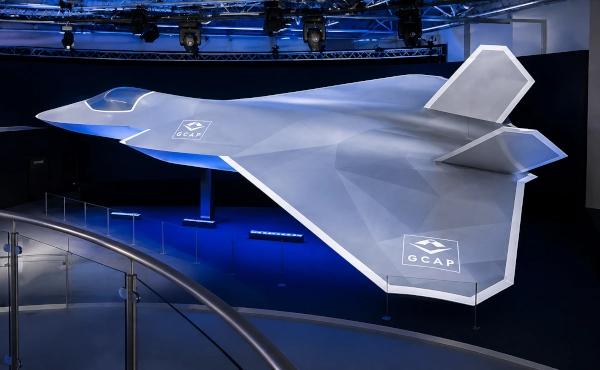
India has reportedly been granted “dialogue partner” status in the Global Combat Air Programme (GCAP), the sixth-generation fighter initiative being jointly developed by the United Kingdom, Japan and Italy. The development gives New Delhi a structured channel to discuss the programme’s progress, technologies and future capabilities without making India a formal development partner, buyer or financial contributor at this stage.
According to reports India and the United Kingdom held detailed discussions on the programme before New Delhi was nominated for dialogue-partner status. The designation allows Indian officials to engage with the GCAP partners and gain a broader understanding of the project’s technological direction and operational concept. It does not, however, give India the same status as the three founding nations or Canada, which formally became GCAP’s first Observer Nation in July 2026.
GCAP Moves Into Full-Scale Development
GCAP is one of the world’s most ambitious future combat-air programmes. Britain, Japan and Italy are jointly developing a next-generation stealth fighter and associated combat-air technologies intended to enter service in the mid-2030s.
In July 2026, the three governments awarded a £4.6-billion development contract to the Edgewing industrial joint venture to advance the aircraft into its next major design phase. The British government continues to officially describe GCAP as a trilateral programme involving the UK, Japan and Italy, with the aircraft targeted for service from 2035.
The programme is expected to combine advanced stealth, powerful sensors, next-generation propulsion, artificial intelligence, networked warfare and close integration with unmanned combat aircraft. Rather than functioning simply as an individual fighter, GCAP is intended to form part of a wider connected combat-air system.
India Keeps Multiple Sixth-Generation Options Open
India’s reported dialogue status comes as New Delhi examines different pathways into sixth-generation combat aviation while simultaneously developing its indigenous Advanced Medium Combat Aircraft (AMCA).
Indian defence authorities have also been studying potential cooperation with Europe’s Future Combat Air System, particularly the programme associated with France. The parallel engagement indicates that India has not committed itself exclusively to GCAP and is instead evaluating how international collaboration could complement its own long-term aerospace ambitions.
For India, access to discussions surrounding GCAP could provide valuable insight into technologies that will shape combat aviation beyond the 2030s. These include next-generation sensors, advanced electronic warfare, digital engineering, artificial intelligence, propulsion, manned-unmanned teaming and highly networked battlefield operations.
Dialogue Partner Does Not Mean Programme Membership
The distinction between dialogue status and formal participation remains important. India has not been announced as a fourth GCAP development nation, has not committed funding to the programme and has not been declared a customer for the future fighter.
Canada provides the clearest comparison. On July 21, 2026, the governments of Britain, Japan and Italy formally announced Canada as GCAP’s first Observer Nation, giving Ottawa enhanced insight into the programme’s governance, capabilities, industrial framework and future partnering opportunities. No equivalent government-level announcement has yet elevated India to observer or development-partner status.
India’s reported dialogue-partner status should therefore be viewed as an exploratory but strategically significant step. It gives New Delhi greater visibility into one of the world’s leading sixth-generation fighter programmes while preserving freedom to pursue other international partnerships and continue developing its own indigenous combat-air technologies.
You may also like
-
India Opens Astra Mk1 & Mk2 Production to Private Industry as Domestic Orders and Export Opportunities Surge
-
India Shot Down Five Pakistani Fighters in Operation Sindoor, Additional F-16s Destroyed on Ground
-
Tata Advanced Systems Reveals Development of 400-km-Range Indigenous Strike Systems
-
DRDO Pushes Indigenous Multi-Drone Formation Technology Through Technology Development Fund
-
BEML Seeks Technology Partnership for Vehicle-Based Mine Scattering System
