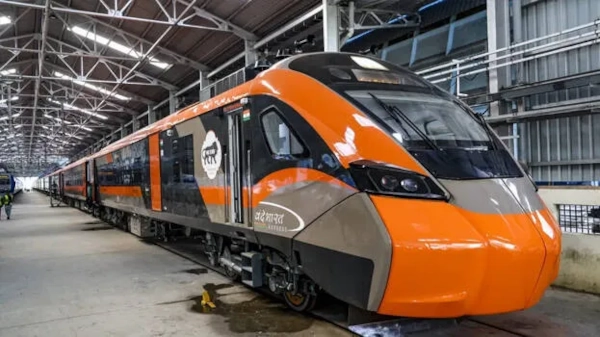
Rail connectivity between Jammu and the Kashmir Valley is set for another expansion, with a third Vande Bharat service between Jammu and Srinagar expected to be introduced soon, less than four months after direct Vande Bharat operations were extended to Jammu Tawi.
Union Minister Dr Jitendra Singh announced the development on 28 August 2026, describing the additional service as another important step in strengthening railway connectivity across Jammu and Kashmir.
A particularly significant feature of the proposed service will be a halt at Udhampur, which has now received approval from the Ministry of Railways following sustained public demand.
No date has yet been announced for the launch of the third Vande Bharat, and detailed information regarding its timetable, train number, frequency and intermediate stops is still awaited.
Udhampur Halt Approved
The inclusion of Udhampur is one of the most important elements of the latest announcement.
Dr Jitendra Singh said the Ministry of Railways had approved the stop after representations were made on behalf of local residents.
The decision is significant because Udhampur is an important population centre, military hub and gateway to several parts of the Jammu region.
It is also closely associated with the historic railway expansion towards the Kashmir Valley. For many years, Udhampur represented one of the northernmost points of India’s mainline railway network before construction advanced deeper into the Himalayas.
Adding a Vande Bharat halt would provide residents with direct access to the premium Jammu–Srinagar service and improve connections with both Jammu and the Kashmir Valley.
Third Service Follows Strong Passenger Demand
The proposed third Vande Bharat comes against a background of exceptionally strong demand for rail travel on the Jammu–Srinagar corridor.
Prime Minister Narendra Modi originally flagged off the Vande Bharat trains between Shri Mata Vaishno Devi Katra and Srinagar on 6 June 2025, when the historic Udhampur–Srinagar–Baramulla Rail Link became fully operational.
The original Vande Bharat operated with eight coaches.
Passenger response was sufficiently strong for Indian Railways to substantially expand capacity. In April 2026, the train formation was increased from eight coaches to 20 coaches, more than doubling the number of seats available.
At the same time, the service was extended southward from Katra to Jammu Tawi, creating a seamless premium train connection between Jammu and Srinagar.
Regular operations on the extended route began on 2 May 2026.
Nearly 45,000 Passengers in First Ten Days
The response to the extended Jammu–Srinagar operation was immediate.
Indian Railways reported that the four Vande Bharat train services operating in both directions carried 44,727 passengers during their first ten days of regular operation, up to 11 May 2026.
During the first week alone, the trains carried 28,762 passengers.
The numbers demonstrated substantial demand from residents, tourists, pilgrims and business travellers and provided a strong case for increasing rail capacity on the route.
Railway Minister Ashwini Vaishnaw had earlier said that the Vande Bharat service had consistently registered extremely high occupancy since its introduction.
The proposed third service therefore represents a capacity expansion on a corridor where passenger demand has already exceeded initial expectations.
Two Vande Bharat Pairs Currently Serve Srinagar
Indian Railways currently lists two Vande Bharat service pairs linking Jammu Tawi and Srinagar.
These operate as 26401/26402 and 26403/26404 Jammu Tawi–Srinagar Vande Bharat Express services.
The announcement of a third Vande Bharat would therefore add another premium service to an already heavily used railway corridor.
The exact operating pattern of the proposed train has not yet been disclosed.
Whether it will operate daily, on selected days or on a different schedule designed to complement the existing services will become clear once the Ministry of Railways releases the formal timetable.
Direct Jammu–Srinagar Rail Travel Became Possible Only in 2026
The speed at which services are now expanding is particularly notable because seamless passenger rail travel between Jammu and Srinagar is itself extremely recent.
Although railway construction in Jammu and Kashmir began decades ago, the Himalayan terrain between the Jammu region and Kashmir Valley presented one of the most difficult railway engineering challenges attempted anywhere in India.
The completion of the Udhampur–Srinagar–Baramulla Rail Link, or USBRL, finally connected the Kashmir Valley with the national railway network.
Prime Minister Narendra Modi formally inaugurated the completed 272-kilometre USBRL on 6 June 2025.
Initially, however, the Vande Bharat service operated between Katra and Srinagar.
The extension to Jammu Tawi in April 2026 completed the direct passenger link between Jammu’s principal railway hub and the Kashmir Valley.
For the first time, passengers could board a single train in Jammu and travel through the Himalayan railway corridor directly to Srinagar without changing transport modes.
Chenab Bridge Made the Connection Possible
At the heart of the route is the Chenab Rail Bridge in Reasi district, one of the most remarkable structures constructed as part of the USBRL project.
The bridge rises approximately 359 metres above the Chenab River, making it the world’s highest railway arch bridge.
Its construction was necessary to carry the railway across the deep Chenab gorge, where conventional bridge designs would have been extremely difficult to implement.
The steel arch spans a landscape characterised by steep mountains, high wind speeds and challenging geological conditions.
The bridge has consequently become both a vital piece of railway infrastructure and an engineering landmark.
Every Jammu–Srinagar Vande Bharat travelling through the USBRL corridor crosses this structure.
India’s First Cable-Stayed Rail Bridge Also Forms Part of Route
The railway also crosses the Anji Khad Bridge, India’s first cable-stayed railway bridge.
Located between Katra and Reasi, the bridge carries the railway across another difficult Himalayan gorge.
Together, the Chenab and Anji bridges solved two of the most complex infrastructure problems along the USBRL.
Their completion enabled continuous railway operations through terrain where road travel has historically been vulnerable to weather, landslides and congestion.
The engineering structures have also become attractions in their own right, with passengers increasingly choosing the railway journey partly for the experience of travelling through the spectacular Himalayan landscape.
Vande Bharat Designed Specifically for Kashmir Conditions
The Vande Bharat trains operating on the route are not identical to standard trainsets deployed elsewhere in India.
They incorporate modifications designed for extreme winter conditions and sub-zero temperatures experienced along the Jammu–Kashmir corridor.
Specialised heating systems protect critical equipment from freezing, while onboard systems have been adapted to ensure reliable operation in severe cold.
The trains also incorporate heated windshields for the driver’s cab to prevent frost formation and maintain visibility.
Water tanks and plumbing systems similarly require protection against freezing during periods of intense winter cold.
These adaptations make the Kashmir Vande Bharat a specialised version of India’s indigenous semi-high-speed train platform.
Journey Between Jammu and Srinagar Takes About Five Hours
The extension of the Vande Bharat to Jammu substantially changed travel options between the two principal cities of Jammu and Kashmir.
The train covers the approximately 266-kilometre Jammu Tawi–Srinagar corridor in around four hours and 50 minutes under the present schedule.
The existing service stops at important intermediate stations including Shri Mata Vaishno Devi Katra, Reasi and Banihal.
Rail travel provides an important alternative to road journeys through the mountainous Jammu–Srinagar corridor, where traffic congestion, weather conditions and landslides can affect journey times.
The approval of Udhampur as a halt for the forthcoming service will give another major Jammu-region centre direct access to the corridor.
Major Benefit for Tourism
Tourism is expected to remain one of the biggest beneficiaries of additional train capacity.
The Kashmir Valley receives large numbers of visitors travelling to Srinagar, Gulmarg, Pahalgam and other destinations.
Previously, tourists arriving by long-distance trains from elsewhere in India generally had to continue their journey towards Kashmir by road after reaching Jammu or Katra.
The completed railway corridor fundamentally changes that journey.
Passengers can now arrive at Jammu Tawi from cities throughout India and transfer directly to a train travelling into the Kashmir Valley.
Increasing the number of Vande Bharat services will provide additional seats during periods of peak tourist demand.
The railway journey itself is also increasingly becoming part of the tourism experience because it crosses mountains, tunnels, deep valleys and landmark bridges.
Pilgrimage Connectivity Also Strengthened
The route has equally important implications for pilgrimage.
Shri Mata Vaishno Devi Katra is already one of India’s busiest pilgrimage railway destinations.
The Jammu–Srinagar rail corridor connects Katra with Srinagar and provides easier onward access for travellers heading towards Kashmir.
Railway authorities have also highlighted the potential of the connection to improve travel for pilgrims visiting the Amarnath shrine.
The ability to combine long-distance railway services reaching Jammu with high-capacity rail transportation into the Valley could reduce dependence on road transport during major pilgrimage seasons.
Additional Vande Bharat capacity would therefore benefit both tourists and religious travellers.
Better Connectivity for Residents and Businesses
The significance of the railway extends beyond tourism.
For residents of Jammu and Kashmir, faster and more predictable travel between Jammu and Srinagar improves access to education, healthcare, government services and employment.
Business travellers and traders can move between the two regions more efficiently.
Rail connectivity can also support the wider movement of goods through the USBRL system, although the Vande Bharat itself is a passenger service.
Railway Minister Ashwini Vaishnaw has highlighted the broader potential of the completed rail corridor to improve freight movement and reduce transportation costs for essential goods entering the Valley.
Improved logistics could become increasingly important as freight operations expand over the route.
Strategic Importance of All-Weather Rail Connectivity
The USBRL also has considerable strategic significance.
Road connectivity between Jammu and the Kashmir Valley has historically been vulnerable to disruption from landslides, heavy snowfall and extreme weather.
A railway provides an additional all-weather transportation corridor.
Although rail operations themselves can also face weather-related challenges, the availability of an independent transport system significantly strengthens overall connectivity resilience.
The route also assists the movement of security personnel and supplies to the region.
The addition of further passenger services demonstrates that the railway is now transitioning from a newly completed infrastructure project towards a mature high-capacity transportation system.
Jammu Tawi Becomes the Main Southern Gateway
Extension of the Vande Bharat from Katra to Jammu Tawi was particularly important because Jammu is the principal railway gateway connecting Jammu and Kashmir with the rest of the country.
Jammu Tawi has direct or connecting train links with major Indian cities across northern, western, eastern and southern India.
Travellers arriving from distant states can consequently reach Jammu using the conventional national railway network and continue towards Srinagar over the USBRL.
This creates a much more integrated transportation chain than the earlier system, where the final journey into Kashmir generally required road transport.
The third Vande Bharat will increase the passenger capacity available at this crucial interchange.
Udhampur Returns to Centre of Kashmir’s Railway Story
The planned stop at Udhampur has symbolic importance as well.
The railway reached Udhampur from Jammu in 2005, an important milestone in the decades-long effort to connect Kashmir with the national network.
For years, Udhampur was effectively the northern frontier of India’s main railway system while engineers pushed the railway deeper through the mountains.
The subsequent opening of the Udhampur–Katra section, construction of the Reasi and Ramban sections and eventual completion of the USBRL transformed the map.
Now that continuous trains run between Jammu and Srinagar, Udhampur is once again positioned along one of India’s most strategically important passenger railway corridors.
A Vande Bharat halt would ensure the city benefits directly from the premium services made possible by the completed project.
Kashmir Rail Network Continues to Expand
Completion of the Jammu–Srinagar connection does not mark the end of railway development in Jammu and Kashmir.
Indian Railways is undertaking doubling work between Qazigund and Baramulla to increase capacity within the Kashmir Valley.
Plans for additional connections, including the Poonch–Rajouri rail link and extension from Baramulla towards Uri, have also been under various stages of planning and detailed project preparation.
Stations across the region are being constructed, redeveloped or upgraded to handle rising traffic and provide improved passenger facilities.
The rapidly increasing utilisation of the Jammu–Srinagar route suggests that capacity enhancement will remain an important priority.
Third Vande Bharat Marks the Next Phase
The proposed third Vande Bharat therefore represents more than the introduction of another premium train.
It reflects how quickly passenger demand has grown following completion of one of India’s most difficult railway projects.
Within little more than a year of the inauguration of the full USBRL, the original eight-coach Vande Bharat has been expanded to 20 coaches, extended from Katra to Jammu Tawi, and is now set to be supplemented by another service.
The approval of Udhampur as a halt further widens access to the high-speed corridor.
The next step will be the formal announcement by the Ministry of Railways specifying the launch date, timetable, frequency and stopping pattern of the new train.
Until then, the development should be described as an announced forthcoming service rather than an already operational third Vande Bharat.
Even at this stage, however, its planned introduction demonstrates the transformation taking place along the Jammu–Srinagar railway.
What was for decades one of India’s most difficult unfinished railway links is rapidly becoming a heavily used passenger corridor connecting Jammu, Udhampur, Katra, Reasi, Banihal and Srinagar across the Himalayas.
You may also like
-
Indian Startup Gnani AI Unveils Sovereign AI Stack Built Around 30-Billion-Parameter Evon 3.3
-
India Advances Overseas Lithium Strategy as KABIL Completes Phase-II Drilling in Argentina
-
India’s Digital Merchant Payments Reach ₹11.73 Lakh Crore in July as UPI Captures 77.3% Share
-
Jio Platforms Gets SEBI Clearance for Mega IPO, Setting Stage for Potentially India’s Largest Listing
-
India Moves to Raise 5G Base-Station EMF Limit to 10 W/m², Bringing Norms Closer to Global Standards
