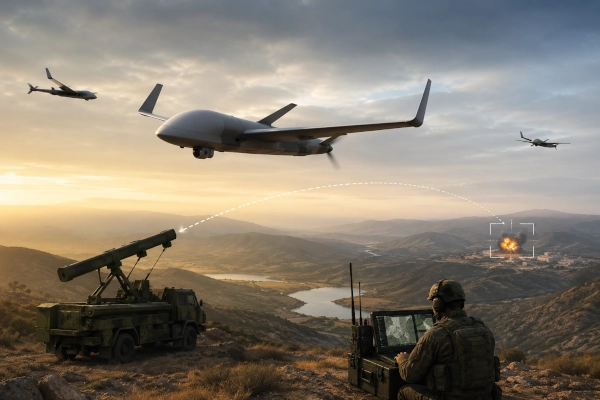
India’s private-sector defence industry is moving deeper into the field of long-range autonomous precision weapons, with Tata Advanced Systems Limited (TASL) confirming that it is developing indigenous strike systems capable of operating at ranges of around 400 kilometres.
The development was disclosed by Sukaran Singh, Chief Executive Officer and Managing Director of Tata Advanced Systems, while discussing the company’s growing portfolio of indigenous loitering-munition systems following a major Indian Army procurement in August 2026.
Singh confirmed that TASL is separately developing systems with a range of 400 km, indicating that the company is working beyond the tactical loitering-munition category in which it has already secured significant orders from the Indian armed forces.
The disclosure is significant because a weapon with a 400-km operational reach would move India’s privately developed loitering-strike technology into a substantially different class. Such systems could potentially allow military formations to engage important targets deep behind an adversary’s forward positions while keeping launch platforms and operators well outside the immediate battlefield.
TASL, however, has not yet publicly revealed the designation, configuration, warhead, endurance, speed or expected induction schedule of the 400-km system. It would therefore be premature to attach specifications to the programme beyond the range figure confirmed by the company.
Tata Confirms 400-km Systems Under Development
The latest disclosure came shortly after the Ministry of Defence awarded major contracts to Tata Advanced Systems and NIBE Private Limited for loitering-munition systems for the Indian Army.
Speaking after the procurement announcement, Sukaran Singh explained that Tata had increasingly moved away from reliance on imported unmanned-system technology and had developed its advanced loitering-munition capabilities within the Indian defence ecosystem.
He also revealed that TASL was working separately on systems capable of reaching approximately 400 km.
That distinction is important. The 400-km weapon should not automatically be treated as identical to the loitering munition covered by the Army’s latest procurement contract. Available reporting describes it as a separate development programme, and Tata has yet to release a formal product designation for it.
Nevertheless, the project appears to form part of a steady expansion of TASL’s indigenous autonomous strike portfolio, which has evolved from comparatively short-range electrically powered systems to much larger internal-combustion-engine platforms offering greater endurance, payload and reach.
₹1,577-Crore Army Loitering-Munition Procurement
The disclosure comes against the backdrop of one of India’s largest acquisitions of domestically produced loitering munitions.
On 14 August 2026, the Ministry of Defence signed contracts with Tata Advanced Systems Limited and NIBE Private Limited for the procurement of Loiter Munition Systems, munitions and associated accessories for the Indian Army, with the total value estimated at approximately ₹1,577 crore.
The acquisition is being conducted under the Buy (Indian) category through the Fast Track Procedure. The Defence Ministry said the systems would strengthen the capabilities of the Army’s artillery regiments and improve their overall operational effectiveness.
Subsequent reporting indicated that the procurement covers 84 loitering-munition system sets along with 840 munitions, with Tata Advanced Systems emerging as the L1 supplier for the larger share of the requirement.
The contract represents an important transition for India’s unmanned strike ecosystem. Rather than limiting domestic companies to licensed manufacture of foreign-designed drones, Indian industry is increasingly developing complete platforms—including airframes, control architecture, guidance systems, software and mission systems—within the country.
From Battery Power to Internal-Combustion Propulsion
One of the most important technological changes highlighted by Tata concerns propulsion.
Singh said the advanced loitering-munition system developed for the Army requirement had moved from battery propulsion to an internal-combustion engine because the operational requirement demanded a larger warhead, greater endurance and longer range. He also described the system as autonomous.
This propulsion transition has major implications for long-range unmanned strike systems.
Electric propulsion provides several advantages for smaller loitering munitions, including low acoustic signatures, simplicity and reduced thermal signatures. Battery energy density, however, places practical limitations on endurance, payload and operating radius as vehicle size and mission requirements increase.
Internal-combustion propulsion can support considerably longer endurance and heavier payloads, making it suitable for larger loitering systems designed to travel hundreds of kilometres before reaching their target area.
TASL’s movement towards this architecture therefore provides a technological pathway towards the much longer-range systems now under development.
The ALS-50 Established Tata’s Loitering-Munition Base
Tata Advanced Systems’ experience in indigenous loitering weapons did not begin with the 2026 Army contract.
The company previously developed the ALS-50, an indigenous vertical take-off and landing loitering munition designed to operate from difficult terrain and high-altitude environments.
The ALS-50 can take off vertically using electrically powered lift motors before transitioning into fixed-wing forward flight. This allows it to combine the deployment flexibility of a VTOL aircraft with the greater efficiency of a conventional fixed-wing platform during its cruise phase.
The system was developed by TASL engineers in India and underwent trials in both high-altitude conditions in Ladakh and desert conditions in Rajasthan.
Tata subsequently delivered 100 ALS-50 systems to the Indian Air Force, providing the service with an indigenous precision loitering-strike capability. Tata Group has confirmed that 100 units were delivered in 2023.
The system has an operating range exceeding 50 km, and TASL’s official description emphasises autonomous operation, electro-optical and infrared surveillance, precision targeting and the ability for an operator to intervene through a live video feed.
Unlike a conventional missile that normally proceeds directly towards predetermined coordinates after launch, a loitering munition can remain airborne while searching for or confirming a target before attacking.
This ability can be particularly valuable when targeting mobile systems whose position may change between initial detection and engagement.
From 50 km to More Than 250 km
Tata’s development trajectory became more visible in February 2025, when the company unveiled a substantially larger Advanced Loitering System with a reported range exceeding 250 km.
The longer-range weapon was designed for deployment from high-altitude airfields and advanced landing grounds, particularly in mountainous environments. Unlike the electrically powered ALS-50, the extended-range system employed an internal-combustion propulsion system, allowing substantially greater range and payload capacity.
The system was also reported to be designed for operations in environments where satellite navigation signals were unavailable or deliberately jammed.
That capability is particularly important for modern strike systems.
A sophisticated adversary can attempt to disrupt Global Navigation Satellite System signals through electronic warfare, potentially degrading weapons that rely heavily on satellite coordinates for navigation and terminal attack.
Consequently, modern long-range unmanned weapons increasingly combine several navigation methods and employ electro-optical targeting or other sensors during the terminal phase.
The 250-km-class Tata system was reported to conduct targeting through visual means and to be capable of carrying different warhead types, including anti-armour payloads.
TASL described the design as indigenous, including its avionics, guidance architecture and ground-control system.
A Clear Technology Evolution
Viewed chronologically, Tata’s work reveals a significant expansion of India’s private-sector loitering-munition capability.
The ALS-50 established an indigenous precision-strike platform with a range exceeding 50 km and demonstrated Tata’s ability to design, test, manufacture and supply an autonomous loitering weapon to the Indian Air Force.
The subsequent 250-km-plus Advanced Loitering System introduced considerably greater reach, internal-combustion propulsion and heavier payload capability.
The latest confirmation that the company is developing 400-km-range systems suggests that TASL is now attempting another major increase in operating radius.
This does not necessarily mean the three systems belong to a single formally designated family. Tata has not made such a claim. Technologically, however, the progression illustrates how experience gained from shorter-range systems can support development of increasingly capable long-range platforms.
Why 400 km Is a Significant Threshold
A 400-km reach transforms the operational possibilities of a loitering strike system.
Short-range loitering munitions primarily support tactical formations by attacking enemy troops, vehicles, artillery positions, communication nodes and other targets relatively close to the battlefield.
A weapon capable of travelling several hundred kilometres can potentially operate at the operational depth of a theatre.
Depending on its payload, sensor package and mission architecture, such a system could potentially be employed against high-value military targets well behind the forward edge of battle.
Possible target classes for long-range precision systems generally include command and control centres, electronic-warfare positions, logistics installations, ammunition facilities, air-defence elements, communications infrastructure, artillery and missile units, radar installations and other operationally important targets.
This does not mean Tata’s 400-km system has been assigned all these missions. The company has not disclosed its target set. Rather, these examples illustrate why armed forces internationally are investing heavily in increasingly long-range loitering weapons.
Loitering Weapons Offer a Different Capability From Conventional Missiles
Long-range loitering munitions occupy an increasingly important space between conventional unmanned aircraft and cruise missiles.
A conventional precision-guided missile is typically launched against a target whose location is already sufficiently established. A loitering munition can instead travel towards a broad target area, remain airborne while receiving sensor information and attack once the intended target has been identified or confirmed.
This provides particular advantages against mobile or relocatable targets.
An air-defence radar, missile launcher or mobile command vehicle, for example, may move after its position has initially been detected. A weapon capable of searching or loitering within the target area has a greater opportunity to reacquire such a system before attacking.
Operator supervision through electro-optical or infrared imagery can also allow the mission to be reassessed before terminal attack, depending on the weapon’s architecture.
TASL’s existing Advanced Loitering System demonstrates this philosophy. The company’s official description says the system supplies live EO/IR imagery to the operator and can be guided as required. It also incorporates mission-abort and re-attack functions.
Whether all these specific features will appear on the new 400-km system remains undisclosed.
Autonomy Is Becoming Increasingly Important
Autonomous operation is another major component of Tata’s unmanned-system development.
TASL describes its existing Advanced Loitering System as completely autonomous, requiring minimal operator intervention for launch, flight and targeting while retaining human access to live sensor imagery.
Autonomy becomes even more important as operating distance increases.
A weapon operating hundreds of kilometres from its launch point can encounter communication limitations, electronic interference and navigation disruption. Reducing dependence on continuous remote piloting therefore increases resilience.
Autonomous navigation also allows unmanned weapons to follow pre-planned routes, manage flight parameters and proceed towards designated mission areas while requiring less continuous operator input.
At the same time, the exact degree of autonomy associated with the new 400-km system has not been publicly specified. It is therefore more accurate at present to describe it as part of Tata’s broader autonomous loitering and strike-system development rather than claim particular artificial-intelligence capabilities that have not been confirmed.
High-Altitude Performance Is a Key Indian Requirement
Tata’s loitering-munition development has also placed considerable emphasis on operations at high altitude.
This reflects India’s unique military geography.
Along the northern borders, forces must operate from locations where low temperatures, thin air, strong winds and difficult terrain can severely affect unmanned aircraft performance.
Reduced air density affects lift and propulsion efficiency, while cold temperatures can degrade batteries. Launching conventional fixed-wing systems can also be difficult where usable runway space is limited.
The ALS-50 addressed part of this challenge by using a VTOL configuration, eliminating the need for a conventional runway or launcher.
Tata’s newer long-range designs have meanwhile been developed with deployment from high-altitude operating locations in mind. The 250-km-class ALS revealed in 2025 was designed to operate from advanced landing grounds located above 10,000 feet.
The company has therefore accumulated relevant experience in designing unmanned strike systems around the demanding operational conditions faced by the Indian armed forces.
Indigenous Control Over the Technology
One of the most consequential aspects of Tata’s programme is ownership of the underlying technology.
Singh highlighted the limitations that can arise when sophisticated drones are imported and subsequently manufactured domestically under foreign technology arrangements. Significant modifications may still require permission or technical support from the overseas original equipment manufacturer.
TASL says its advanced loitering-munition technology has instead been designed, developed and manufactured within the Indian ecosystem.
This gives the developer greater freedom to modify guidance architecture, payloads, propulsion, communications, software and other components in response to Indian military requirements.
It also becomes important during wartime, when dependence on foreign suppliers can expose military systems to restrictions on spare parts, upgrades, source codes or technical support.
Control over design intellectual property therefore provides strategic advantages extending well beyond the percentage of components manufactured domestically.
India’s Armed Forces Accelerate Their Drone Push
The 400-km development also comes as the Indian military significantly increases investment in unmanned warfare.
The ₹1,577-crore procurement for Army loitering munitions is only one element of a broader effort involving surveillance drones, first-person-view strike systems, high-altitude unmanned platforms, counter-drone equipment and longer-range precision weapons.
Recent reporting indicates that the Army is pursuing unmanned and related systems worth roughly ₹20,000 crore as part of a wider modernisation effort.
The emphasis reflects lessons emerging from recent conflicts, where inexpensive unmanned platforms have demonstrated the ability to locate targets, correct artillery fire, strike armoured vehicles, attack logistics networks and saturate air-defence systems.
Long-range loitering weapons extend this concept by combining unmanned flight with precision-strike capability at considerably greater distances.
A Growing Private-Sector Role in Strategic Weapons
Tata Advanced Systems’ progress also illustrates the expanding role of India’s private industry in areas traditionally dominated by government defence organisations and public-sector manufacturers.
Indian private companies are increasingly developing complete systems rather than functioning solely as component suppliers.
TASL’s portfolio now includes unmanned systems, military mobility platforms, missile-related systems, sensors, command-and-control solutions and aerospace manufacturing programmes.
The successful development and induction of the ALS-50 is particularly important because it demonstrates that a private Indian company can take an indigenous precision-strike system from engineering development through military trials and into serial delivery.
The 400-km programme represents a considerably more ambitious technological step.
If successfully developed and accepted by the armed forces, it could establish Indian private industry as a domestic source of long-range autonomous precision-strike systems.
Many Details of the 400-km Weapon Remain Classified or Undisclosed
Despite the significance of the announcement, considerable caution is necessary when describing the new programme.
Tata Advanced Systems has not publicly announced the weapon’s official name.
It has not disclosed whether the system will use vertical take-off, runway launch, catapult launch or another deployment arrangement.
Its cruising speed, endurance, operating altitude, warhead weight, terminal seeker, communication architecture and electronic-warfare resistance have also not been publicly specified.
Nor has Tata announced when prototype testing will begin, whether military user trials have been scheduled, or whether an Indian armed service has formally placed an order for the 400-km weapon.
The confirmed information at present is narrower but nevertheless important: Tata Advanced Systems is developing indigenous systems with approximately 400 km of range, and the effort emerges from a company that already has operational experience developing and supplying autonomous loitering munitions to India’s armed forces.
From Tactical Loitering Munition to Deep-Range Strike Capability
The broader story is therefore not simply that Tata is designing another drone.
India’s indigenous unmanned strike ecosystem is moving rapidly from relatively short-range systems intended for tactical battlefield use towards weapons capable of reaching much deeper into a theatre of operations.
TASL began this progression with the 50-km-plus ALS-50, followed it with an Advanced Loitering System exceeding 250 km, and has now confirmed work on systems reaching approximately 400 km.
Each increase in range creates greater engineering challenges involving propulsion, navigation, communications, endurance, payload capacity, electronic-warfare resilience and autonomous control.
Tata’s ability to pursue these developments using indigenous design expertise is therefore as important as the headline range itself.
If the 400-km programme successfully progresses through development and military evaluation, it could give the Indian armed forces another domestically controlled option for long-range precision engagement while strengthening India’s rapidly expanding ecosystem of autonomous weapons and unmanned combat technologies.
For now, the programme remains under development and several crucial specifications remain undisclosed. But Tata Advanced Systems’ confirmation establishes one important fact: India’s private defence industry is now actively working on indigenous autonomous strike systems capable of reaching targets hundreds of kilometres from their launch point.
References
- Press Information Bureau, Ministry of Defence — “Aatmanirbhar Bharat: MoD inks Rs 1,577 crore contracts for Loiter Munition Systems for Indian Army,” 14 August 2026.
- The Times of India — “In biggest-ever loiter munition system deal in Indian military history, defence ministry inks Rs 1,577-cr contract for Army with TASL, NIBE,” August 2026. Includes comments from TASL CEO & MD Sukaran Singh confirming the separate development of 400-km-range systems.
- The Times of India — “As PM Modi pushes for developing desi drones, Army plans to acquire munitions, surveillance systems worth Rs 20k crore,” 16 August 2026.
- Tata Advanced Systems Limited — Advanced Loitering Systems, official product information. Details indigenous development, autonomous operation, EO/IR imagery, precision targeting and mission-abort/re-attack capability.
- Tata Group — “To Serve and Defend.” Corporate profile confirming development of the ALS-50 and delivery of 100 systems to the Indian Air Force in 2023.
- The Economic Times — “Tata Advanced Systems unveils advanced loitering suicide drone with 250 km range suitable for LAC,” February 2025. Details the earlier 250-km-plus Advanced Loitering System, internal-combustion propulsion and indigenous guidance architecture.
- Janes — “Aero India 2023: IAF to receive 100 loitering munitions from TASL.” Provides technical information on the ALS-50 and its Indian Air Force acquisition.
You may also like
-
Subex Wins $700,000 African Telecom Contract for AI-Powered HyperSense Fraud Management Technology
-
BEML Secures ₹75.58 Crore Export Order for Heavy Mobility Military Vehicles in Southeast Asia
-
Project Seabird Expands at Karwar as Indian Navy Inaugurates New Infrastructure with Over 90% Indigenous Content
-
DRDO Seeks Semi-Autonomous Guided Installation Vehicle and Specialised Pod Storage System
-
JISA Softech Unveils Indigenous QuLens-CryptoBind Quantum-Safe Cybersecurity Platform at Pragati Q-Foundry 2026
