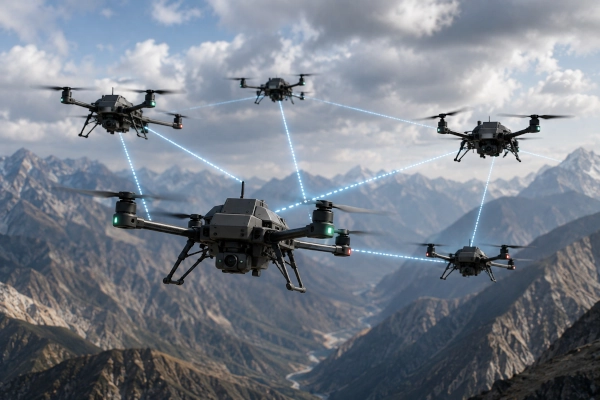
India’s Defence Research and Development Organisation has opened an industry-led development programme aimed at enabling multiple unmanned aircraft to fly together in close formation, adding another important building block to the country’s rapidly expanding autonomous-drone technology ecosystem.
The project, formally titled “Development of Close Formation Flying of Multiple DRONES,” has been launched under the Ministry of Defence’s Technology Development Fund scheme, which is executed by DRDO to bring Indian companies, particularly startups and MSMEs, into the development of advanced defence technologies.
The programme is noteworthy because close-formation flight is considerably more demanding than simply operating several drones in the same general area. Aircraft flying close together must continuously coordinate their position, velocity and direction while maintaining safe separation and rapidly responding to changes in the formation.
Successfully mastering those technologies could provide an important foundation for more sophisticated cooperative unmanned systems in the future.
Making Multiple Drones Behave as a Coordinated Team
A conventional drone is normally controlled as an individual aircraft. Even autonomous drones generally execute missions according to their own navigation and flight-control systems.
Formation flight introduces another layer of complexity.
Each aircraft must know not only where it is in relation to the ground or its destination but also where the other drones in the formation are located. Small variations in speed, altitude or direction have to be corrected quickly so that the formation remains stable.
When several aircraft fly close together, even a minor navigation or communications error can create a collision risk. The system therefore requires highly responsive flight-control algorithms, reliable relative positioning and communication between participating drones.
The objective is ultimately to allow several unmanned aircraft to manoeuvre as a coordinated group rather than as independent machines that happen to be operating simultaneously.
DRDO has not publicly released all of the detailed technical parameters of the project through its announcement page, so the exact number, type and configuration of drones expected in the final demonstration should not be assumed until the complete programme documentation or subsequent development milestones are disclosed.
Close Formation Is Not Automatically a Drone Swarm
The project also needs to be distinguished from the broader concept of a drone swarm.
Close-formation flight is one enabling technology that can support swarm operations, but the two terms are not interchangeable.
A formation normally involves aircraft maintaining defined geometric relationships with one another. A swarm can involve much more decentralised behaviour, in which individual aircraft dynamically redistribute themselves, share tasks, react to threats and collectively make mission-level decisions.
A sophisticated swarm might divide itself into smaller groups, change its geometry, replace a disabled member or allocate different drones to surveillance, communication, electronic-warfare or strike functions.
DRDO’s present project specifically concerns close-formation flying of multiple drones. It therefore represents a technological stepping stone that could eventually contribute to more advanced collaborative autonomous systems without implying that the tender itself is for a complete operational combat swarm.
Why Formation Flight Is Technically Difficult
Humans flying military aircraft in formation continuously make tiny corrections based on visual cues, instruments and radio communication. Autonomous drones must perform similar adjustments using sensors, computers and software.
The challenge becomes increasingly difficult as the distance between aircraft decreases.
The drones must estimate their relative positions accurately and react fast enough to compensate for disturbances caused by wind, turbulence or manoeuvres by neighbouring aircraft. Communication delays can become important because information about another drone’s position may already be outdated by the time it reaches the flight controller.
Formation flying may therefore require combinations of satellite navigation, inertial sensors, machine vision, ranging sensors and inter-drone communications, depending on the architecture ultimately selected by the developer.
Algorithms must simultaneously maintain formation geometry and prevent collisions while allowing the group to accelerate, turn, climb and descend.
Reliability is equally important. A useful military system cannot depend on every aircraft functioning perfectly at all times. Future collaborative systems will increasingly need ways to respond when one member loses communication, suffers a technical failure or leaves the formation.
These challenges make multi-aircraft coordination as much a software and autonomy problem as an aeronautical one.
Applications Beyond Simply Flying Together
Once several drones can reliably maintain coordinated flight, the underlying technology can potentially support a wide range of defence applications.
Multiple surveillance drones could observe a much larger area while retaining a coordinated operating pattern. Aircraft equipped with different sensors could collect complementary information and combine it into a more complete picture of a battlefield.
Formation technology could also support distributed communications, with several drones acting as airborne relay nodes over difficult terrain.
Electronic-warfare payloads could eventually be distributed across different aircraft, allowing a group of relatively small platforms to perform functions that might otherwise require a larger single system.
Cooperative unmanned aircraft could similarly be used for reconnaissance, decoy missions, border surveillance, disaster assessment and search-and-rescue operations.
Future military applications could become more complex as autonomy improves, but the immediate significance of the DRDO project lies in developing the underlying capability for multiple Indian-designed unmanned aircraft to coordinate their movement reliably.
Preparing for Contested Airspace
The military significance of cooperative drones has grown sharply during recent conflicts.
Modern battlefields increasingly contain layered air-defence systems, electronic warfare, counter-drone weapons and dense surveillance networks. Sending a single expensive unmanned aircraft into such an environment creates the risk that one successful interception can eliminate an entire capability.
Distributed unmanned systems offer a different approach.
Instead of concentrating sensors or other functions aboard one aircraft, several smaller platforms can potentially share the mission. Losing one member would not necessarily eliminate the entire capability.
Multiple aircraft can also approach an area from different directions, collect information simultaneously and complicate an opponent’s surveillance and defensive calculations.
Formation flight alone does not provide these capabilities, but reliable coordination between several aircraft is one of the technological foundations required to build them.
A Software-Intensive Defence Technology
Another important aspect of the programme is the growing importance of indigenous software within India’s unmanned-systems ecosystem.
The visible components of a drone — its airframe, motors, propellers and payload — represent only part of the technology. Increasingly, the decisive capabilities reside in algorithms responsible for autonomous navigation, sensor fusion, object recognition, route planning, communication and cooperative behaviour.
Close-formation flying particularly depends on this digital layer.
The participating aircraft must continuously calculate their own trajectories while also accounting for the movement of neighbouring drones. This creates a highly dynamic control problem requiring low-latency processing and robust software.
Developing these technologies domestically could therefore strengthen India’s capabilities not only in drone manufacturing but also in autonomous control systems, artificial intelligence, robotics and distributed computing.
Industry Rather Than DRDO Alone
The manner in which the programme is being pursued is equally significant.
Instead of developing the complete system solely inside a DRDO laboratory, the project has been placed under the Technology Development Fund.
The TDF was established by the Ministry of Defence and is executed by DRDO to promote self-reliance in defence technology. It specifically encourages Indian private industry, particularly MSMEs and startups, to take responsibility for technology development. Companies can also collaborate with academic and research institutions.
Under the existing TDF framework, projects can receive government grant-in-aid, with funding available up to ₹50 crore per project under normal provisions. The programme is designed to advance technologies from relatively early stages toward usable prototypes and eventual defence applications.
The close-formation drone project therefore also represents India’s broader shift toward using private companies as development partners rather than treating defence research exclusively as the responsibility of government laboratories.
Opportunity for India’s Drone Startups
India now possesses a rapidly growing ecosystem of companies working on unmanned aerial systems, autonomy, flight controllers, artificial intelligence, navigation and military robotics.
A project such as this can bring those capabilities together.
The eventual developer may need expertise spanning aircraft design, embedded computing, communications, sensor fusion, autonomous navigation and control algorithms. Collaboration between drone manufacturers, electronics companies and software specialists could therefore be particularly valuable.
The TDF framework is intended precisely for such situations: the Armed Forces and DRDO identify a technology requirement, while Indian industry competes to develop an indigenous solution.
If successful, the intellectual property, engineering experience and production capability created through the programme could also strengthen the wider Indian unmanned-systems sector.
Part of India’s Wider Move Toward Collaborative Unmanned Warfare
DRDO and the Indian Armed Forces have been expanding work across several categories of unmanned technology, ranging from reconnaissance aircraft and logistics drones to loitering systems, autonomous navigation and counter-drone solutions.
Collaborative flight represents the next layer of complexity.
The transition is from one operator controlling one aircraft, toward a model in which a smaller number of humans supervise increasingly autonomous groups of machines.
Such systems could eventually allow a commander to assign a mission to a group of drones while the aircraft themselves determine how best to maintain formation, distribute tasks and react to changing conditions.
That level of autonomy remains a much more advanced objective than the current TDF project. However, dependable close-formation flying provides a practical technological foundation on which increasingly sophisticated cooperative behaviour can be built.
Building the Foundations of Future Drone Teams
The importance of DRDO’s latest TDF project therefore lies less in the spectacle of several drones flying together and more in the technologies required to make that possible.
Reliable relative navigation, inter-drone communication, collision avoidance, synchronised manoeuvring and autonomous flight control are fundamental capabilities for future generations of collaborative unmanned aircraft.
India already possesses a substantial drone-manufacturing ecosystem. The next challenge is enabling those aircraft to coordinate intelligently rather than operate independently.
By moving the close-formation flying requirement into the Technology Development Fund and opening it to domestic industry, DRDO is attempting to build precisely that capability within the country.
The project may ultimately begin with several drones maintaining a stable formation in the sky. The technologies developed to accomplish that task, however, could become building blocks for far more sophisticated autonomous teams operating across the battlefields of the future.
You may also like
-
Colombia Seeks India’s Counter-Drone Technology and Stronger Security Cooperation to Combat Drug Cartels
-
Himachal Startup Tecnod8.AI Develops Industrial AI Copilot for Advanced Manufacturing
-
Skyroot Aerospace Partners with Brazil’s Concert Technologies to Develop New Orbital Launch Vehicle
-
NIS Management Secures ₹6.24 Crore Surveillance Technology Contract for West Bengal Police
-
Subex Wins $700,000 African Telecom Contract for AI-Powered HyperSense Fraud Management Technology
