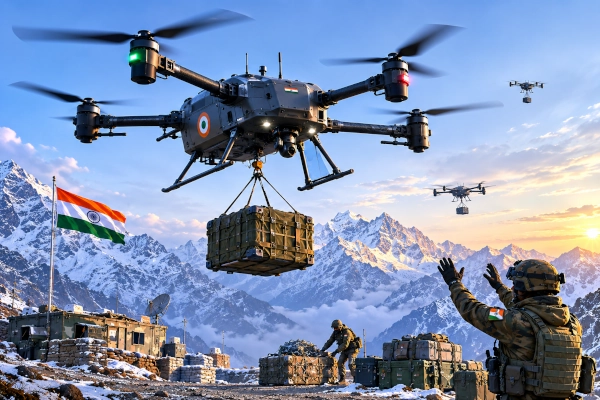
India is reportedly working toward an ambitious new unmanned logistics capability that could transform the way supplies are moved to soldiers stationed in some of the world’s most difficult mountain terrain. The Defence Research and Development Organisation is reported to have set requirements for an indigenous heavy-lift Vertical Take-Off and Landing drone capable of carrying around 200 kilograms of cargo to high-altitude military positions.
The proposed aircraft is significantly more capable than the relatively small logistics drones increasingly used for last-mile military resupply. Reported requirements call for a 50-kilometre one-way operating range, a service ceiling of about 25,000 feet, as many as five sorties per day and operation in temperatures falling to around –40°C. Crucially, the aircraft is also expected to retain autonomous capability when satellite-navigation signals are unavailable or deliberately jammed.
Such specifications point toward a rugged battlefield logistics platform rather than a conventional commercial cargo drone. If successfully developed, the system could transport ammunition, food, medicines, equipment and other essential stores directly between logistics bases and isolated Army positions without requiring a prepared runway.
Built for the Himalayan Battlefield
High-altitude logistics presents an unusual combination of engineering and operational problems. Army posts along India’s northern borders can be separated from major bases by steep mountains, narrow tracks, snowbound passes and rapidly changing weather. Roads may be inaccessible during parts of the year, while conventional helicopter sorties are comparatively expensive and expose aircraft and crews to both environmental and battlefield risks.
The problem becomes more severe at extreme altitude. Thin air reduces the lift generated by rotors while simultaneously affecting engine performance. Batteries also lose efficiency in severe cold, while electronics, lubricants, actuators and mechanical components have to function reliably despite large temperature variations.
The reported DRDO requirement therefore pushes considerably beyond many ordinary cargo-drone designs. A platform capable of lifting 200 kg while operating at a ceiling of 25,000 feet would require careful optimisation of propulsion, rotor efficiency, weight, structural materials and flight-control systems.
Heavy-Fuel Engine Instead of Pure Electric Propulsion
One of the most interesting elements of the proposed platform is its reported use of a heavy-fuel internal-combustion engine.
This approach could offer important advantages for military logistics. Large battery-powered multirotor aircraft face endurance and payload limitations, particularly in freezing Himalayan conditions. An internal-combustion powerplant can potentially provide greater endurance and energy density for repeated heavy-lift missions.
The reported requirement also envisages compatibility with Jet A-1-type fuel, providing potential commonality with fuel already available through military aviation logistics networks. This could simplify forward deployment compared with maintaining a completely separate fuel supply for the unmanned fleet.
DRDO already possesses experience with indigenous engines for unmanned aircraft. Its Vehicles Research and Development Establishment has developed a 180-hp diesel UAV engine incorporating an indigenous Full Authority Digital Engine Control system. DRDO states that the engine has undergone more than 1,100 hours of testing and high-altitude validation, demonstrating the broader domestic technology base available for specialised unmanned propulsion.
200 Kilograms in a Single Flight
A 200-kg payload would represent a substantial step upward in last-mile aerial logistics capability.
Instead of carrying only small packages or emergency medicines, a drone in this class could move meaningful quantities of ammunition, water, food, batteries, communications equipment, fuel containers, engineering stores and replacement components in each sortie.
Several flights per day could allow a small fleet to build a continuous aerial supply chain between a rear logistics point and forward posts.
The requirement reportedly calls for up to five sorties per day, making reliability and rapid turnaround important parts of the design. Such an operational tempo would demand an aircraft capable of repeated take-offs and landings with minimal maintenance between missions.
Vertical take-off and landing would be particularly valuable because forward Himalayan posts rarely possess conventional runways. A VTOL aircraft could potentially operate from relatively confined areas near military positions, reducing the infrastructure needed to establish an aerial logistics route.
DRDO itself identifies specialised VTOL unmanned aerial vehicles among its UAV technology-development areas, illustrating the organisation’s continuing interest in this class of aircraft.
Designed for a Battlefield Where GPS May Disappear
Perhaps the most strategically important requirement concerns navigation.
The proposed drone is expected to operate autonomously even in a GNSS-denied or electronically jammed environment. Modern military forces cannot assume that GPS, NavIC or other satellite-navigation signals will remain continuously available during a conflict.
Electronic warfare systems can jam navigation signals or attempt to spoof receivers with false positioning information. An unmanned cargo aircraft that depends entirely on satellite navigation could therefore become unreliable precisely when frontline troops need it most.
A truly resilient system would need to combine several navigation methods. These could potentially include inertial navigation, onboard terrain or visual referencing, sensor fusion and autonomous flight-control algorithms, although the final architecture of the reported DRDO project has not been publicly disclosed.
The objective is important: the drone should be able to continue its assigned mission even when conventional satellite positioning becomes unreliable.
Operating Down to –40°C
The reported requirement for operation at temperatures reaching –40°C is another indication that the aircraft is intended specifically for India’s harsh northern frontier.
Extreme cold affects almost every subsystem aboard an unmanned aircraft. Batteries deliver less power, lubricants change viscosity, electronic components experience thermal stress and moisture can freeze around exposed mechanisms.
Maintaining a heavy payload while operating in these conditions adds another layer of engineering difficulty. The platform would consequently require cold-weather-qualified electronics, propulsion and fuel systems as well as an airframe designed for repeated use under severe environmental conditions.
Such temperatures are not theoretical for Indian forces. High-altitude deployments in Ladakh and other Himalayan sectors regularly expose personnel and equipment to temperatures around –30°C and, in some locations, approximately –40°C during winter.
Part of a Much Larger Army Push Toward Drone Logistics
The reported DRDO programme comes amid a much broader Indian Army effort to expand unmanned battlefield logistics.
Earlier in August 2026, the Army was reported to have initiated a process for acquiring approximately 2,715 logistics drones covering several altitude categories. The proposed fleet is intended for last-mile movement of ammunition, rations and other supplies to frontline units.
That requirement covers three broad operating bands: up to 6,000 feet, between 6,000 and 12,000 feet, and from 12,000 to 20,000 feet. The Army has also sought autonomous operation, anti-jamming and anti-spoofing protection, indigenous flight-control software and the ability to operate from unprepared locations.
The reported DRDO 200-kg platform would represent a substantially heavier and higher-flying capability. Rather than replacing smaller logistics drones, it could complement them by moving larger loads from rear locations toward remote forward areas, while lighter aircraft conduct shorter last-mile missions.
Together, the different classes could eventually create a layered unmanned logistics network.
Reducing Dependence on Helicopters
Helicopters will remain indispensable for high-altitude warfare, particularly for transporting personnel, evacuating casualties and delivering large or urgent loads. Heavy-lift drones could nevertheless take over a portion of the repetitive resupply workload.
Every routine cargo mission transferred to an unmanned aircraft could reduce flying hours on costly helicopter fleets and decrease the number of aircrew exposed to hazardous terrain, bad weather or enemy fire.
The usefulness becomes particularly apparent for isolated posts requiring regular quantities of ammunition, medicines, food or technical stores but not necessarily enough cargo to justify a helicopter sortie.
A drone does not have to replace the carrying capacity of a helicopter to be operationally valuable. It only needs to remove enough repetitive cargo missions to free manned aircraft for tasks that genuinely require them.
Autonomous Logistics as a Battlefield Capability
Military drones initially gained prominence as surveillance platforms and later became increasingly important for precision strike, loitering-munition and electronic-warfare missions. Logistics is now emerging as another major area of unmanned warfare.
Recent conflicts have demonstrated that the ability to keep small frontline units continuously supplied can be as important as the weapons they carry. Enemy surveillance and precision weapons can make conventional logistics routes increasingly vulnerable, creating demand for distributed and less predictable methods of transporting supplies.
Autonomous aerial systems offer one possible answer. Instead of depending entirely on a small number of roads, convoys or helicopter routes, forces could operate numerous unmanned supply corridors and rapidly redirect aircraft as battlefield conditions change.
For India, the combination of long borders and exceptionally difficult Himalayan geography makes this technology particularly relevant.
A Demanding Indigenous Technology Challenge
Developing the reported DRDO platform will not be straightforward. Combining a 200-kg payload, 50-km one-way range, 25,000-foot ceiling, –40°C operation, repeated daily sorties and autonomous navigation under electronic warfare conditions places several difficult requirements on the same aircraft.
Propulsion, aerodynamics, materials, sensors, navigation, communications and flight-control software will all have to function together under conditions far more demanding than those faced by most civilian cargo drones.
But that difficulty is also what makes the programme significant.
For soldiers occupying remote Himalayan positions, such a capability could eventually mean that ammunition, medicines, food and critical equipment arrive not by road convoy or manned helicopter alone, but through a persistent network of autonomous cargo aircraft designed specifically for India’s high-altitude frontier.
You may also like
-
CISF Partners Drone Federation of India to Build Indigenous Counter-Drone Capabilities for Critical Installations
-
Rolls-Royce Offers India 120+ kN AMCA Engine Scalable to 145 kN With Full IP Rights
-
Indian Army Reportedly Moves to Integrate PRABAL Counter-Drone System on Mahindra Armado ALSV
-
India Moves Ahead With Javelin Anti-Tank Missile Acquisition as US Envoy Confirms Procurement Plan
-
India’s Indigenous Sonar Ecosystem Powers New Generation of Indian Navy Warships
