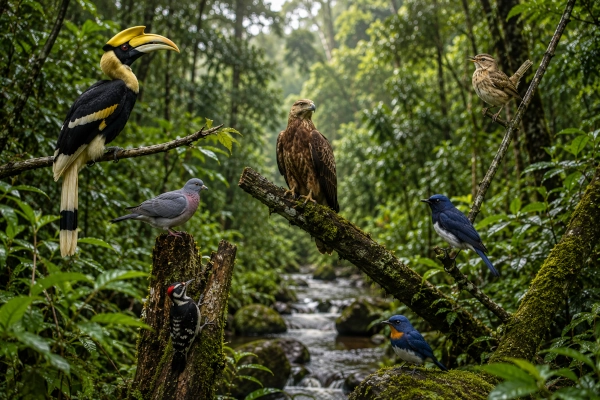
A monsoon biodiversity survey in Kerala’s Peppara Wildlife Sanctuary has documented 124 bird species, including several Western Ghats endemics and species of conservation concern, reinforcing the importance of the sanctuary as a refuge for the distinctive avifauna of the southern Western Ghats.
The survey was conducted jointly by the Thiruvananthapuram Wildlife Division and Warblers and Waders, a collective of birdwatchers involved in systematic monitoring of the protected area. The findings were reported on 26 August 2026 as part of an ongoing programme designed to document seasonal changes in Peppara’s bird communities.
Western Ghats Endemics Stand Out
Among the most significant birds recorded were the White-bellied Sholakili, Broad-tailed Grassbird, Nilgiri Wood Pigeon, White-bellied Treepie, Ashambu Laughingthrush, Nilgiri Flycatcher and White-bellied Blue Flycatcher.
Several of these species have distributions largely or entirely restricted to the Western Ghats, making the forests and high-elevation habitats of southern Kerala particularly important for their conservation.
The Broad-tailed Grassbird (Schoenicola platyurus) is especially significant. It is a Western Ghats endemic associated largely with montane grasslands and is classified as Vulnerable. Habitat alteration, degradation of high-altitude grasslands and invasive vegetation have contributed to concern over its long-term survival.
Active Broad-Tailed Grassbird Nests Recorded
The survey produced more than a simple checklist of species. Observers documented active breeding behaviour and occupied nests of the Broad-tailed Grassbird, providing direct evidence that parts of the Peppara landscape continue to function as breeding habitat for the threatened species.
Breeding records can be particularly valuable in conservation surveys because they show that a site is doing more than temporarily supporting visiting birds. Successful nesting requires suitable vegetation structure, food availability, relatively secure nesting locations and appropriate seasonal conditions.
Protecting such breeding areas can therefore become important to maintaining viable populations of specialised Western Ghats birds.
Eagles, Owls and Hornbills Add to the Diversity
The monsoon survey also recorded an impressive group of raptors and nocturnal birds.
These included the Spot-bellied Eagle-Owl, Brown Wood-Owl, Black Eagle, Eurasian Kestrel, Black-winged Kite, Legge’s Hawk-Eagle and Rufous-bellied Eagle. The White-bellied Woodpecker and the Great Hornbill, Kerala’s state bird, were among the other notable sightings.
The presence of large forest birds such as hornbills and woodpeckers can also provide useful information about habitat structure. Many depend on mature trees for nesting, feeding or roosting and therefore benefit from the persistence of old-growth forest components.
The detection of several raptors further demonstrates the variety of ecological niches present across Peppara’s forests, grasslands and adjoining habitats.
Monsoon Count Lower Than Other Seasons — As Expected
The 124 species recorded during the monsoon should not be interpreted as Peppara’s total bird diversity.
Periodic surveys began in 2025, allowing observers to compare the sanctuary’s avifauna across seasons. The monitoring programme recorded 166 species during a December survey and another 164 during a March survey. The lower monsoon count was expected because many migratory birds present during other parts of the year are absent during Kerala’s rainy season.
This seasonal variation is precisely why repeated surveys are valuable. A single census can provide only a snapshot, whereas observations made through monsoon, winter and other periods can reveal resident populations, migratory arrivals, breeding activity and changes in habitat use.
An earlier systematic survey undertaken within Peppara also demonstrated the sanctuary’s considerable avian richness, recording numerous endemic, migratory and conservation-priority species across habitats ranging from Peppara and Bonacaud to Pandipath and Athirumala.
New Records Emerging Through Continued Monitoring
The continuing survey programme has also produced records of birds not detected during earlier counts.
Among the species newly documented during the periodic monitoring were the Pied Cuckoo, the nocturnal Sri Lanka Frogmouth, and several wetland-associated birds.
The Sri Lanka Frogmouth is particularly characteristic of the humid forests of southwestern India and Sri Lanka. Its cryptic plumage, nocturnal behaviour and tendency to remain motionless during daylight can make the bird easily overlooked during ordinary surveys.
Repeated fieldwork across different times of day and seasons therefore improves the likelihood of detecting such elusive species and building a more complete picture of the sanctuary’s biodiversity.
Survey Goes Beyond Birds
The monsoon fieldwork also recorded Western Ghats-endemic reptiles and amphibians, indicating that the programme is generating useful observations beyond ornithology.
Another notable sighting was the Blue Nawab, a striking forest butterfly regarded as an uncommon record in Kerala.
Amphibian observations are especially relevant during monsoon surveys because many frogs become considerably more active during periods of heavy rainfall. Streams, temporary pools, saturated forest floors and increased humidity create ideal conditions for breeding and calling.
Consequently, monsoon biodiversity surveys can reveal ecological information that would remain difficult to obtain during the dry season.
A Small Sanctuary With Exceptional Habitat Diversity
Peppara Wildlife Sanctuary covers approximately 53 sq km in Thiruvananthapuram district and was established in 1983. Despite its relatively modest size, it encompasses a considerable range of habitats and elevations within the southern Western Ghats.
The sanctuary protects the forested catchment surrounding the Peppara reservoir and Karamana River system, with landscapes ranging from lower-elevation evergreen and semi-evergreen forests to montane environments towards the higher reaches.
This altitudinal variation helps explain the mixture of bird communities recorded within the protected area. Species associated with dense lowland forest can occur within the same wider landscape as highly specialised birds of cooler, high-elevation grasslands and shola forests.
Such habitat transitions are especially important in the Western Ghats, where elevation can dramatically influence rainfall, vegetation and species distribution.
Part of the Agasthyamalai Conservation Landscape
Peppara is not an isolated protected forest. It forms part of the much larger Agasthyamalai Biosphere Reserve, which spans landscapes in Kerala and Tamil Nadu.
Within Kerala, the biosphere reserve includes Peppara along with Neyyar and Shendurney wildlife sanctuaries and several adjoining forest divisions. The Kerala Forest Department lists the Agasthyamalai Biosphere Reserve as extending over 1,828 sq km.
Peppara is also included within the Agasthyamalai sub-cluster of the UNESCO-listed Western Ghats World Heritage Site, alongside Neyyar, Shendurney and neighbouring forest ranges.
This larger landscape context is crucial for wildlife that depends on connected habitats. Birds may move between elevations or forest types according to season, rainfall, food availability or breeding requirements, making connectivity between individual protected areas as important as protection within their formal boundaries.
Peppara’s High-Elevation Habitats Are Particularly Important
Previous systematic work inside the sanctuary has highlighted the ecological importance of Pandipath and the Athirumala–Agasthyarkoodam landscape for montane birds.
Surveys have documented species such as the White-bellied Sholakili, Ashambu Laughingthrush, Nilgiri Wood Pigeon, Nilgiri Flycatcher and other Western Ghats endemics in these high-altitude habitats. Earlier field work also identified a substantial concentration of conservation-priority birds and emphasised the importance of preserving Peppara’s habitat diversity.
Montane shola-grassland ecosystems occupy only a small geographical area compared with lower-elevation forests. Species specialised for these conditions can therefore be particularly vulnerable when grasslands are altered or fragmented.
The fresh breeding observations of Broad-tailed Grassbirds add another reason for sustained monitoring of these upper reaches.
Long-Term Surveys Can Reveal Changes Before They Become Critical
The most important outcome of the Peppara programme may ultimately come not from any individual species count but from building a long-term record of the sanctuary’s wildlife.
Repeating comparable surveys across seasons and years can reveal whether populations of particular birds remain stable, expand or decline. They can also identify changes in migration timing, breeding behaviour and distribution that might be linked to habitat alteration or climatic conditions.
Earlier surveys have already suggested changes in the apparent abundance of some species, demonstrating why consistent monitoring matters.
For endemic birds with naturally restricted ranges, detecting such trends early can be especially valuable. A species confined to the Western Ghats has fewer alternative habitats available if conditions deteriorate in its existing strongholds.
A Living Refuge in the Southern Western Ghats
The monsoon count of 124 species, alongside active nests of the vulnerable Broad-tailed Grassbird, endemic reptiles and amphibians and notable butterfly records, reinforces Peppara’s role as far more than a reservoir catchment surrounded by forest.
It is part of one of India’s most biologically distinctive mountain landscapes and supports wildlife communities ranging from specialised grassland birds to hornbills, forest raptors, nocturnal species and endemic amphibians.
The continuing surveys by the Thiruvananthapuram Wildlife Division and Warblers and Waders are gradually turning isolated sightings into a more systematic ecological record.
For Peppara, that growing body of information could become an important conservation tool — helping identify where vulnerable species breed, how bird communities change with the seasons and which habitats require the greatest protection as the Western Ghats face increasing environmental pressures.
You may also like
-
Himachal Pradesh Achieves Major Success in Rare Cheer Pheasant Conservation
-
Climate History Finds Monsoon Fluctuation Footprints From Sediment Transport to Farming Adaptations
-
Blackbucks to Return to Chhattisgarh’s Gomarda Wildlife Sanctuary After Five Decades
-
IIT Guwahati and IIT Kharagpur Develop Brain-Inspired Vision Device That Uses 500 Times Less Energy
-
Asiatic Lions Return to Barda Wildlife Sanctuary After 144 Years as Scientific Study Confirms Habitat’s Conservation Potential
