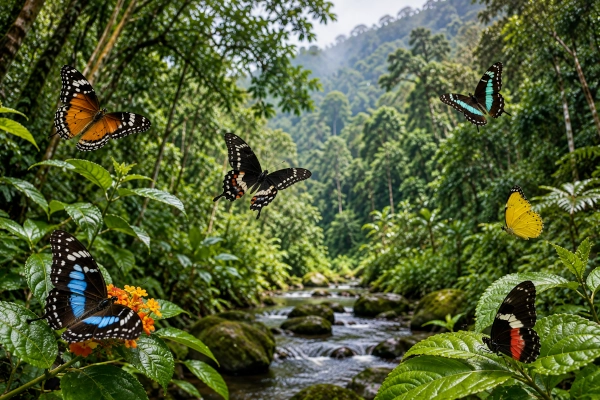
Assam’s Dehing Patkai National Park, one of the last major surviving stretches of lowland tropical rainforest in northeastern India, has drawn fresh attention for its remarkable butterfly diversity after 165 species were recorded in the landscape, including 37 that Assam authorities described as endangered.
The finding was highlighted by Assam Chief Minister Himanta Biswa Sarma on 25 August 2026, followed by Forest and Climate Change Minister Jayanta Malla Baruah, who described the diversity as evidence of the ecological importance of the Dehing Patkai rainforest. Reports based on the state announcement were subsequently published on 26 and 27 August.
165 Species in One Rainforest Landscape
The recording of 165 butterfly species within the Dehing Patkai landscape is significant because butterflies respond rapidly to changes in vegetation, humidity, temperature, availability of host plants and disturbance.
A forest capable of supporting a wide range of butterfly species generally contains numerous ecological niches — from shaded understorey and forest streams to canopy gaps, flowering vegetation and host plants required by caterpillars.
Baruah said the presence of such diversity demonstrates the importance of maintaining healthy and connected natural habitats, describing Dehing Patkai as an ecosystem where forests, large mammals and countless smaller organisms coexist.
Assam officials have stated that 37 of the 165 recorded butterflies belong to endangered categories. Because a detailed species-by-species conservation classification accompanying the announcement has not yet been made publicly available, the figure is best attributed to the state authorities rather than interpreted as meaning that all 37 necessarily carry the IUCN global category of “Endangered.”
That distinction does not diminish the ecological importance of the finding. Earlier scientific work from Dehing Patkai has already demonstrated the presence of butterflies with restricted ranges and legal conservation significance.
Earlier Scientific Study Found 92 Species in Soraipung Alone
A peer-reviewed study of the Soraipung Range of Dehing Patkai National Park documented 92 butterfly species from five families.
Researchers recorded 41 species from Nymphalidae, 17 from Papilionidae, 16 from Lycaenidae, 10 from Hesperiidae and eight from Pieridae. Of the species documented, 13 were protected under schedules of India’s Wildlife (Protection) Act and 11 were restricted to the Eastern Himalayan region.
The study concluded that Soraipung possesses considerable butterfly diversity but remains comparatively poorly documented, calling for additional surveys and research to support effective conservation management.
The much larger number now being reported across Dehing Patkai reinforces that earlier conclusion: substantial parts of this rainforest still have considerable scope for systematic biodiversity documentation.
One of India’s Important Surviving Lowland Rainforests
Dehing Patkai lies across the Dibrugarh and Tinsukia districts of eastern Assam, close to the foothills of Arunachal Pradesh.
The National Park covers approximately 234.26 square kilometres, according to the Dibrugarh district administration, and derives its name from the Dehing River and the Patkai hill range. The area was first declared a wildlife sanctuary in 2004 before being elevated to national-park status in 2021.
Its importance extends well beyond its protected boundary. The larger Dehing Patkai landscape comprises extensive dipterocarp-dominated lowland rainforest, with forest continuing towards adjoining areas of Arunachal Pradesh. Assam government information describes it as containing one of India’s largest remaining stretches of lowland rainforest.
The park represents the Assam Valley tropical wet-evergreen forest ecosystem, a habitat characterised by high rainfall, dense multilayered vegetation and considerable biological richness.
Unlike more open grassland or deciduous protected areas, tropical evergreen rainforest contains numerous vertical layers, from leaf litter and shrubs to the upper canopy. Each can support different insects, birds, reptiles and mammals.
Butterflies Reveal More Than Their Own Diversity
Butterflies are particularly valuable to ecologists because their survival is closely connected to plants.
Adult butterflies may depend on particular flowering plants for nectar, while caterpillars can be considerably more specialised, sometimes feeding on only a narrow group of host plants. Protecting a butterfly community therefore frequently requires protecting a much wider network of vegetation and associated organisms.
Their relatively short life cycles also allow butterfly populations to respond quickly when environmental conditions change.
Forest fragmentation, alteration of the understorey, pesticide exposure, disappearance of host plants, changes in rainfall or temperature and degradation of streams can consequently become visible in butterfly communities before the effects become obvious among larger animals.
Assam’s Environment and Forest Department itself notes that northeastern India is extraordinarily rich in butterflies. Of roughly 1,500 species reported nationally, nearly half have been reported from Assam and the wider Northeast, while the region has also been recognised internationally for its richness in swallowtail butterflies.
Dehing Patkai therefore sits within one of India’s most important geographical centres of butterfly diversity.
A Forest Better Known for Elephants and Primates
Much public attention around Dehing Patkai traditionally centres on its larger mammals. The landscape supports elephants, primates and several carnivores, while its forests are also important for threatened birds.
Official district information records approximately 42 mammal species, 40 reptile species and more than 200 bird species, alongside the park’s rich butterfly fauna.
The wider forest was identified as biologically important during primate surveys in the late 1980s. Subsequent investigations involving the White-winged Wood Duck — one of Northeast India’s most threatened forest birds — added to the case for stronger protection.
The latest butterfly findings broaden the conservation story.
Protection of Dehing Patkai cannot be measured solely by whether elephants, big cats or primates remain present. The functioning of the rainforest also depends on insects, fungi, plants, amphibians, reptiles and countless other organisms that sustain pollination, decomposition, nutrient cycling and food webs.
Connected Forests Are Critical
One of the most important messages emerging from the state government’s announcement is the need for habitat connectivity.
Butterflies may appear highly mobile because they fly, but many forest specialists have surprisingly narrow ecological requirements. Open areas, degraded vegetation or large-scale alterations to forest structure can effectively become barriers for species adapted to shaded and humid rainforest conditions.
Maintaining connections between different sections of Dehing Patkai and the adjoining forests of eastern Assam and Arunachal Pradesh can therefore benefit organisms ranging from insects to elephants.
Connectivity also becomes increasingly important as climatic conditions change. Species need opportunities to shift their distributions as temperature and rainfall patterns alter, something fragmented populations may find difficult.
Dehing Patkai Still Has More to Reveal
The latest record of 165 species is consequently valuable not merely because it produces an impressive biodiversity number.
It strengthens the argument for long-term monitoring of Dehing Patkai’s smaller fauna, particularly butterflies and other insects that receive far less attention than mammals and birds.
Repeated surveys conducted across different seasons could reveal whether particular species are increasing or declining, identify especially important breeding habitats and document changes associated with vegetation, rainfall and climate.
The contrast between the latest 165-species assessment, earlier intensive surveys of individual ranges and the official record of more than 200 butterfly species from the park also illustrates why biodiversity inventories should be treated as evolving datasets rather than final counts.
New surveys can add species, while seasonal conditions determine which butterflies are visible during any particular assessment.
For Dehing Patkai, that continuing process of discovery may be one of the rainforest’s most important characteristics. Beneath a canopy better known for elephants, gibbons and rare birds exists an extraordinarily complex community of smaller species.
The latest butterfly records provide another reminder that conserving the Dehing Patkai rainforest means protecting an entire living system — from its largest mammals to some of its most delicate insects.
You may also like
-
BHU Opens 70-Year-Sealed Rajghat Collection, Revealing Over 10,000 Artefacts From Ancient Kashi
-
Century-old limit on Turning Heat Into Electricity Surpassed, Enabling Ultrasensitive Temperature Sensing
-
From Human Digital Twins to Indigenous 5G Radios: Technologies Emerging from India’s Cyber-Physical Systems Mission
-
New Freshwater Crab Ghatiana karnataka Reveals Hidden Biodiversity of the Western Ghats
-
White-Hooded Babbler Recorded in North Bengal After 95 Years
