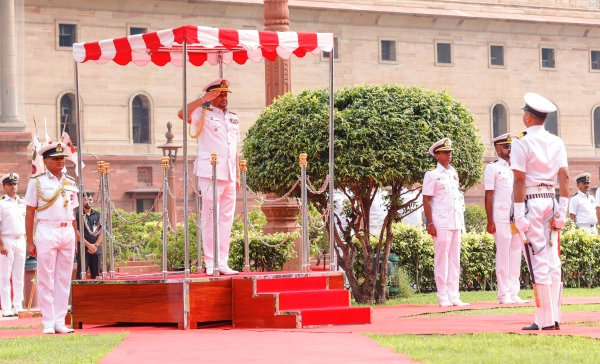
India and Sri Lanka are strengthening their longstanding naval partnership as Vice Admiral Damian Fernando, Commander of the Sri Lanka Navy, undertakes an official visit to India from 26 to 29 August 2026. The four-day engagement is focused on expanding operational cooperation, professional exchanges, maritime security coordination, training links and interaction with India’s growing defence-industrial ecosystem.
The visit is particularly significant as it is Vice Admiral Fernando’s first official visit to India after assuming command of the Sri Lanka Navy. It comes at a time when both countries are placing greater emphasis on maritime security in the Indian Ocean, where the safety of sea lanes, illegal maritime activity, humanitarian contingencies and emerging security challenges increasingly require close coordination between neighbouring naval forces.
Ceremonial Welcome in New Delhi
Vice Admiral Fernando was accorded a ceremonial Guard of Honour at South Block in New Delhi on 27 August 2026, marking the formal beginning of his engagements in the national capital.
He also visited the National War Memorial, where he laid a wreath in tribute to fallen soldiers. The ceremony reflected the established military traditions that form part of senior-level defence exchanges between India and its partner countries.
The centrepiece of the New Delhi programme was a meeting between Vice Admiral Fernando and Admiral Krishna Swaminathan, Chief of the Naval Staff of the Indian Navy.
Their discussions covered a broad spectrum of issues intended to deepen the operational relationship between the two navies.
Focus on Joint Operations and Maritime Security
The two naval chiefs discussed strengthening bilateral maritime cooperation through joint operations, capacity building, professional training and maritime-security initiatives.
These areas have become increasingly important for India and Sri Lanka because of their geography. Sri Lanka sits close to some of the busiest shipping routes in the Indian Ocean, while India possesses an extensive coastline and major maritime interests extending across the wider region.
Security challenges at sea can rarely be addressed by one country acting alone. Smuggling, trafficking, illegal fishing, maritime accidents, piracy-related threats, environmental emergencies and natural disasters often cross national maritime boundaries.
Closer coordination between the Indian and Sri Lankan navies can therefore improve maritime-domain awareness while enabling faster exchanges of operational information and more effective responses to contingencies.
Joint activities also allow personnel from both forces to become familiar with each other’s procedures, communications practices and operational methods, creating the interoperability required when ships and sailors must work together during real-world missions.
Training Emerging as a Major Pillar
Training cooperation forms another important component of Vice Admiral Fernando’s visit.
As part of his programme, the Sri Lankan naval chief is scheduled to travel to Kochi, one of the Indian Navy’s most important centres for professional naval education and training.
He will visit Indian Naval training establishments and the Headquarters Southern Naval Command, with discussions expected to focus on strengthening institutional training links and expanding professional exchanges between the two navies.
Southern Naval Command plays a particularly important role in India’s naval training architecture. Engagement at Kochi therefore provides the Sri Lankan delegation with an opportunity to examine Indian training systems and identify areas where cooperation could be expanded.
Military training exchanges have long-term strategic value because they build relationships between officers and sailors that can endure throughout their careers. Personnel who have trained together or attended each other’s institutions are generally better positioned to cooperate during exercises, operational deployments or maritime emergencies.
For a partnership between two neighbouring navies, such professional familiarity can become an important foundation for deeper operational trust.
Capacity Building for a Shared Maritime Environment
Capacity building is closely connected with training but extends further into the ability of maritime forces to maintain vessels, operate specialised systems and respond effectively to emerging security challenges.
India possesses an expanding network of naval institutions, shipyards, defence companies and technology developers. Cooperation in this field can allow Sri Lanka to benefit from Indian experience while also creating opportunities for bilateral programmes tailored to the island nation’s maritime requirements.
Vice Admiral Fernando is consequently scheduled to meet senior Indian defence officials during his visit.
These engagements are expected to examine practical opportunities for expanding existing defence and maritime cooperation rather than limiting the relationship to ceremonial or diplomatic exchanges.
Sri Lankan Navy Chief to Engage Indian Defence Industry
An especially noteworthy element of the visit is Vice Admiral Fernando’s planned interaction with representatives of the Indian defence industry.
The engagement is intended to explore possibilities for cooperation and collaboration.
India’s defence-industrial ecosystem has expanded considerably, particularly in naval shipbuilding, maritime electronics, surveillance systems, communications, unmanned technologies and ship-support equipment.
Indian shipyards today manufacture a wide variety of vessels ranging from frontline warships to patrol craft, survey ships, diving support vessels and other specialised maritime platforms. At the same time, Indian companies are developing increasingly sophisticated radar, sonar, electro-optical, communication and electronic-warfare systems.
For Sri Lanka, engagement with this ecosystem could potentially provide additional options for acquiring, maintaining or upgrading maritime capabilities suited to its particular operational environment.
Defence-industrial interaction can also broaden a military relationship by creating longer-term connections involving training, maintenance, logistics and technical support.
Sri Lanka’s Strategic Maritime Position
Sri Lanka occupies an exceptionally important geographical position in the Indian Ocean.
Major international shipping routes connecting the Middle East, Africa, Europe and East Asia pass close to the island. Maritime activity around Sri Lanka therefore has consequences extending far beyond its territorial waters.
For India, stability around Sri Lanka is directly connected to security in the southern Indian Ocean approaches and to the protection of commercial sea lanes that sustain a large proportion of the country’s external trade.
This geography makes close cooperation between the two navies a strategic necessity as much as a reflection of historical ties.
Information sharing, coordinated surveillance and regular professional interaction can help both countries maintain better awareness of developments in the surrounding maritime environment.
Cooperation Beyond Traditional Naval Warfare
Modern India-Sri Lanka naval cooperation is not confined to preparations for conventional military operations.
Both countries face a range of non-traditional maritime-security challenges. These include illegal fishing, narcotics trafficking, smuggling, search-and-rescue emergencies, marine pollution and natural disasters.
Naval forces and coast-guard organisations frequently become the first responders during such incidents because they possess ships, aircraft, trained personnel and communication networks capable of operating offshore.
India has also repeatedly employed its naval capabilities for humanitarian assistance and disaster relief across the Indian Ocean.
Closer interoperability between India and Sri Lanka therefore strengthens the ability of both countries to cooperate rapidly when civilian lives or maritime infrastructure are threatened.
Building Confidence Through Regular Engagement
High-level visits such as that of Vice Admiral Fernando play an important role in maintaining strategic communication between neighbouring navies.
Operational relationships at sea are strengthened when they are supported by regular engagement between senior commanders, training establishments and defence institutions.
Such interaction allows both sides to discuss concerns directly, understand each other’s priorities and identify areas in which cooperation can deliver practical benefits.
The Indian and Sri Lankan navies already share a longstanding relationship, making the current visit part of a broader process rather than a standalone diplomatic event.
The emphasis on joint operations, capacity building, training, maritime security and defence-industry interaction demonstrates that the partnership is gradually becoming more multidimensional.
India and Sri Lanka in the Indian Ocean
The broader importance of the visit lies in the evolving security environment of the Indian Ocean Region.
The ocean is becoming increasingly important to global trade, energy flows and geopolitical competition. At the same time, maritime threats are becoming more diverse, ranging from conventional military challenges to trafficking networks, cyber-enabled vulnerabilities, illegal exploitation of marine resources and climate-related disasters.
Regional stability therefore increasingly depends on countries developing the capacity to cooperate rather than operating entirely in isolation.
India has consistently sought stronger maritime partnerships with neighbouring Indian Ocean countries, while Sri Lanka’s geography gives it an important role in any regional maritime-security architecture.
A stable and capable Sri Lankan maritime establishment is consequently in India’s interest, just as a cooperative relationship with India provides Sri Lanka with access to training, expertise, technology and broader maritime-security networks.
A Partnership Moving Towards Greater Operational Depth
Vice Admiral Damian Fernando’s visit from 26 to 29 August 2026 underlines the growing operational depth of India-Sri Lanka naval relations.
The combination of talks between the naval chiefs, interaction with defence officials, engagement with Indian industry and visits to naval training institutions shows that the relationship is developing simultaneously at the strategic, operational, technological and personnel levels.
For both countries, the objective extends beyond maintaining cordial naval ties. It is about creating the institutional familiarity and capabilities required to work together when circumstances at sea demand it.
As India and Sri Lanka confront an increasingly complex maritime environment, stronger Navy-to-Navy cooperation can contribute not only to their respective national security interests but also to greater safety, stability and resilience across the wider Indian Ocean Region.
You may also like
-
Bengaluru Startup Paar Autonomy Develops AI-Powered Drone Systems for GPS-Denied Environments
-
Sigma Advanced Systems Secures Fresh ₹973 Crore NATO Artillery Ammunition Order
-
India Advances Indigenous Defence and Space Technologies Through Naval Innovation, Drones and Advanced Electronics
-
Thales Seeks Indian Partnerships for Next-Generation Missiles, Radars and Electronic Warfare Systems
-
Indian and Australian Armies Conduct Jungle and Coastal Warfare Drills in AUSTRAHIND 2026
