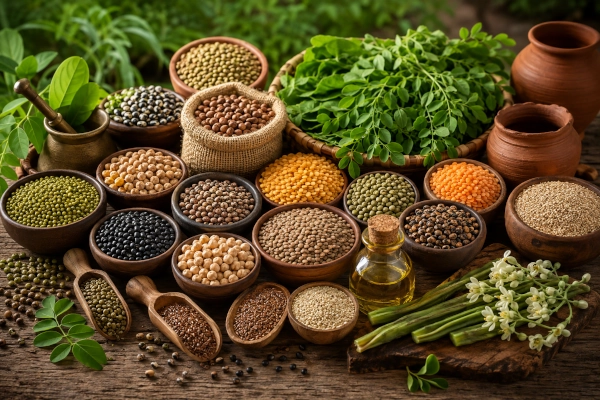
The modern search for protein has created an enormous market for powders, isolates, bars, fortified foods and imported “superfoods.” Yet centuries before protein became a nutritional buzzword, Ayurveda had already identified an extensive group of pulses, seeds and edible plants as valuable components of the human diet.
Green gram, black gram, chickpea, horse gram, lentil, pigeon pea, moth bean, sesame, flax and several other traditional foods appear throughout India’s Ayurvedic dietary culture. Modern nutritional science now reveals something remarkable about many of them: when measured in their dry state, several contain around one-fifth to more than one-quarter of their weight as protein.
That puts some traditional Indian pulses in the same protein-density range as raw meat.
The comparison requires care. A cooked bowl of dal does not necessarily contain more protein per 100 grams than cooked chicken because pulses absorb considerable water during cooking, while meat generally loses water. But when raw dry ingredients are compared, the protein concentration of several Indian pulses can be surprisingly close to — and in some varieties even higher than — that of common meats.
Ayurveda therefore offers something more interesting than a list of vegetarian protein sources. It presents an ancient dietary system that differentiated these foods according to digestibility, heaviness, strength-building capacity, Dosha effects and method of preparation, long before proteins or amino acids could be identified in a laboratory.
Ayurveda Knew an Entire Family of Nutrient-Dense Pulses
Classical Ayurvedic dietetics places considerable importance on legumes and pulses. Modern Ministry of Ayush dietary guidance continues to identify traditional foods including Mudga or green gram, Kulattha or horse gram, Masura or lentil, Chanaka or chickpea, Adhaki or pigeon pea and Makushtha or moth bean. Shigru leaves and fruits, Tanduliyaka or amaranth greens, and Atasi or flax also appear within Ayurvedic dietary recommendations.
ICMR-National Institute of Nutrition similarly places Bengal gram, black gram, green gram, horse gram, lentil, moth bean, dry peas, red gram and soybean within India’s pulse food group.
The overlap is important. Many foods recognised today as valuable sources of plant protein were already established components of India’s traditional medical and culinary systems.
Mudga — Green Gram: Protein With Ayurvedic Lightness
Mudga, the green gram or mung bean (Vigna radiata), is perhaps the ideal starting point.
Dry green gram generally contains roughly 23–25 grams of protein per 100 grams, although the concentration varies with cultivar. Some Indian varieties analysed by nutritional researchers have approached or exceeded 26 grams per 100 grams.
That means roughly one-quarter of the dry seed may consist of protein.
What makes Mudga particularly interesting, however, is not simply its protein content. Ayurveda distinguishes it from many other pulses because of its comparatively light character.
Mudga is traditionally associated with Laghu, meaning light or relatively easy to digest, and is commonly described as favourable where a pulse is desired without the heaviness associated with some other legumes. Ayurvedic dietary traditions consequently use green gram in preparations ranging from ordinary dal to the much lighter Mudga Yusha, a thin pulse soup.
Modern nutrition sees protein, fibre and complex carbohydrate. Ayurveda adds another question: how easily can the individual digest and assimilate that nourishment?
This combination makes Mudga one of the most important bridges between ancient Ayurvedic dietetics and modern plant-protein science.
Masha — Black Gram: Ayurveda’s Heavy Strength-Building Pulse
If Mudga represents comparatively light nourishment, Masha, or black gram/urad (Vigna mungo), represents almost the opposite end of Ayurvedic pulse nutrition.
Black gram is extremely protein-rich, normally providing around 23–25 grams of protein per 100 grams of dry grain.
Ayurveda traditionally regards Masha as much heavier, richer and more strengthening than Mudga. It is associated with nourishment, bulk and strength-building qualities, but its heaviness also means that digestive capacity becomes important.
This distinction is remarkably sophisticated.
Modern nutrition might place Mudga and Masha next to each other because both contain roughly similar amounts of protein. Ayurveda would not consider them interchangeable. One is comparatively light; the other is distinctly Guru, or heavy.
Thus two foods with similar macronutrient profiles can produce quite different digestive experiences.
Traditional Indian preparations also reveal how culinary processing addresses this problem. Urad is soaked, ground, fermented, combined with rice, cooked into dal or prepared with spices and fats rather than simply eaten as an untreated dry pulse.
The food and its preparation are treated as a single nutritional system.
Chanaka — Chickpea: One of India’s Great Plant Proteins
Chanaka, the chickpea or Bengal gram (Cicer arietinum), is another major Ayurvedic pulse that modern nutrition strongly supports.
Dry chickpeas commonly provide approximately 19–22 grams of protein per 100 grams, making them among the most accessible concentrated plant-protein foods.
The chickpea also demonstrates how one plant can produce several nutritionally different foods. Whole chana, split Bengal gram, roasted gram, sprouted chickpeas and chickpea flour all originate from essentially the same crop but undergo different processing.
Ayurveda pays considerable attention to such transformations because roasting, soaking, grinding and cooking can alter the perceived qualities and digestibility of food.
Modern food science reaches a similar conclusion through different terminology. Processing alters water content, starch structure, antinutritional compounds and protein digestibility.
Chanaka is therefore far more than an inexpensive substitute for animal protein. It is one of India’s oldest examples of a highly concentrated, transportable and storable plant source of nourishment.
Kulattha — Horse Gram: The Forgotten Protein Powerhouse
Among India’s traditional pulses, Kulattha, or horse gram (Macrotyloma uniflorum), deserves far more attention than it receives.
Dry horse gram generally contains around 22–25 grams of protein per 100 grams. In protein concentration alone, that puts it comfortably within the range of many better-known pulses.
Yet horse gram remained associated for generations with rural diets, dryland agriculture and regional cuisine rather than fashionable nutrition.
Ayurveda knew it well.
Kulattha appears repeatedly in traditional dietary and therapeutic contexts. Ministry of Ayush material continues to list horse gram among traditional pulse recommendations, while Ayusoft records both Mudga and Kulattha as dietary foods in specific classical treatment contexts and refers to preparations such as Kulattha Yusha.
Horse gram’s importance extends beyond nutrition. It is a hardy crop capable of growing under relatively difficult agricultural conditions. Modern India therefore has reason to reconsider Kulattha not merely as a traditional food but as a combination of protein security, agricultural resilience and indigenous food heritage.
Masura — Lentil: Small Seed, Dense Nutrition
Masura, the lentil (Lens culinaris), is another extraordinarily concentrated plant food.
Dry lentils generally supply around 24–26 grams of protein per 100 grams, placing them close to the upper end of common pulse protein concentrations.
This makes lentils one of the clearest examples of why comparisons with meat attract attention. Some dry lentils can contain as much protein by weight as certain raw meats.
But the comparison needs context.
Lentils contain substantial carbohydrate and fibre alongside their protein, whereas meat derives much of its weight from water, protein and fat and contains no dietary fibre. The two foods therefore cannot be treated as nutritionally identical merely because their protein numbers overlap.
Ayurveda approaches Masura according to its own framework of Rasa, Guna, digestive influence and suitability. Modern Ministry of Ayush recommendations continue to recognise Masura among traditional pulses.
The convergence is noteworthy: a pulse preserved in traditional Indian dietetics remains one of the world’s most concentrated everyday plant sources of protein.
Adhaki — Pigeon Pea: The Protein Behind India’s Dal
Adhaki, commonly represented today by pigeon pea or red gram (Cajanus cajan), occupies an especially important place because it is the source of toor/arhar dal, one of the staples of Indian cooking.
Dry pigeon pea generally provides around 21–23 grams of protein per 100 grams.
Its familiarity can obscure how nutritionally significant it actually is. Dal is often treated simply as an accompaniment to rice or roti, yet the pulse portion of such a meal contributes much of its protein and lysine.
The Ministry of Ayush specifically identifies Adhaki or red gram among traditional pulse foods.
Modern agriculture similarly recognises pigeon pea, chickpea, lentil, black gram and green gram as major components of India’s pulse economy. ICAR continues to emphasise these crops as central to nutritional security and agricultural sustainability.
The ordinary Indian dal bowl is therefore not nutritionally ordinary at all. It represents one of the country’s oldest and most effective mechanisms for incorporating plant protein into daily food.
Makushtha — Moth Bean: An Underappreciated Desert Protein
Makushtha, generally identified with moth bean (Vigna aconitifolia), is less famous nationally than mung or chickpea but deserves inclusion in the same protein-rich family.
Dry moth bean contains roughly 22–24 grams of protein per 100 grams and has a long association with the dry regions of western India.
The Ministry of Ayush includes Makushtha among traditional pulses alongside Mudga, Masura, Kulattha and Chanaka.
Its significance is particularly relevant today because nutritional security cannot depend only on crops requiring abundant water and intensive inputs. Traditional drought-adapted pulses such as moth bean and horse gram may become increasingly important as India confronts climatic variability.
Ayurvedic food history and climate-resilient agriculture unexpectedly meet in the same humble seed.
Kalaya — The Pea Family and Another Concentrated Protein Source
Peas have also belonged to India’s wider legume tradition. Dried peas differ greatly from fresh green peas because removal of water dramatically concentrates their nutrients.
Fresh peas are useful sources of plant protein, but dried peas can provide protein levels approaching 20–24 grams per 100 grams.
This illustrates one of the most important rules for understanding claims that plants contain “more protein than meat”: water content changes everything.
A fresh leaf, vegetable or sprout may have an impressive nutritional profile without containing enormous amounts of protein per 100 grams because most of its weight is water. A dried pulse seed contains little water, so protein becomes highly concentrated.
Any serious comparison must therefore distinguish fresh, dry, soaked and cooked foods.
Tila — Sesame: Protein Hidden Inside an Oilseed
Ayurvedic plant protein does not stop with pulses.
Tila, sesame (Sesamum indicum), is one of India’s most important traditional oilseeds. Sesame seeds contain approximately 17–20 grams of protein per 100 grams.
That is lower than the richest pulses, but still remarkably high for a food primarily known as a source of oil.
Ayurveda gives Tila an important place not merely as food but also as the source of sesame oil, which became one of the great oils of Ayurvedic practice.
Nutritionally, sesame provides something pulses do not provide in such abundance: a combination of protein and fat in the same seed.
This makes sesame exceptionally energy-dense. It also helps explain why traditional foods often combine sesame with grains, pulses or jaggery rather than consuming large quantities of the seed alone.
Atasi — Flaxseed: Protein, Oil and an Ancient Seed
Atasi, identified with flax or linseed (Linum usitatissimum), provides another example of a seed in which protein and oil coexist.
Flaxseed typically contains around 18 grams of protein per 100 grams, along with substantial quantities of fat and fibre.
The Ministry of Ayush continues to list Atasi within Ayurvedic dietary recommendations.
Modern attention to flax concentrates heavily on its alpha-linolenic acid and fibre, but its protein contribution should not be overlooked.
It does not contain more protein than the richest meats on an equal-weight basis, but it belongs to a broader Ayurvedic dietary ecosystem in which protein is supplied not by one miraculous ingredient but by cereals, pulses, seeds, vegetables, milk products and other foods consumed together.
Chandrashura — Garden Cress: Tiny Seeds With Dense Nutrition
Chandrashura, commonly identified with garden cress or halim (Lepidium sativum), is another traditional seed that deserves greater nutritional recognition.
Garden cress seeds contain approximately 20–25 percent protein in many analyses, along with fat, fibre and minerals.
In many Indian households, halim seeds survive in specialised preparations associated with nourishment and convalescence rather than ordinary daily meals.
Their nutrient density demonstrates why traditional culinary knowledge often attached particular importance to small seeds. A spoonful may look insignificant, but the dry seed is a highly concentrated package of stored plant nutrients designed to support the early growth of a new plant.
Shigru — Moringa: The Protein Story Moves From Seeds to Leaves
Shigru, the drumstick tree or moringa (Moringa oleifera), requires a different kind of comparison.
Fresh moringa leaves do not contain more protein per 100 grams than meat. They contain substantial water. Once dried, however, the water is removed and the nutrients become dramatically concentrated; dried moringa leaf powder can contain protein levels exceeding 20 percent depending on source and processing.
The distinction between fresh and dried material is therefore essential.
Ayurveda has long recognised Shigru, and contemporary Ministry of Ayush dietary material specifically includes Shigru fruits and leaves among traditional vegetables.
Moringa’s significance is not simply that it can be turned into a high-protein powder. Unlike pulses, its edible leaves also contribute carotenoids, minerals and numerous phytochemicals.
It represents a different nutritional strategy: protein combined with the micronutrient density of a green leaf.
Tanduliyaka — Amaranth Greens: Valuable, but Don’t Exaggerate the Protein Claim
Tanduliyaka, associated with amaranth greens, also deserves inclusion, though it illustrates why the “more protein than meat” headline must be handled responsibly.
Fresh amaranth leaves contain useful protein for a vegetable, but they are mostly water and therefore cannot compete with meat or dry pulses gram-for-gram in their fresh form.
Their importance lies instead in nutritional diversity. They provide plant protein alongside minerals, fibre, carotenoids and other micronutrients.
The Ministry of Ayush identifies Tanduleyaka, including Amaranthus spinosus, among traditional leafy vegetables.
This also warns against confusing amaranth greens with modern commercial amaranth grain or rajgira. They belong to related botanical groups but should not automatically inherit identical classical Ayurvedic descriptions.
So Which Ayurvedic Foods Can Actually Rival Meat?
The answer depends entirely on how the comparison is made.
On a raw dry-weight basis, several traditional Indian pulses occupy roughly this protein range:
| Ayurvedic food | Common identity | Approximate protein in dry/raw food |
|---|---|---|
| Mudga | Green gram / mung | 23–25+ g/100 g |
| Masha | Black gram / urad | 23–25 g/100 g |
| Masura | Lentil | 24–26 g/100 g |
| Kulattha | Horse gram | 22–25 g/100 g |
| Chanaka | Chickpea | 19–22 g/100 g |
| Adhaki | Pigeon pea / tur | 21–23 g/100 g |
| Makushtha | Moth bean | 22–24 g/100 g |
| Dried peas | Pea | Around 20–24 g/100 g |
| Tila | Sesame | Around 17–20 g/100 g |
| Atasi | Flaxseed | Around 18 g/100 g |
| Chandrashura | Garden cress seed | Roughly 20–25 g/100 g |
By comparison, many raw lean meats fall broadly in the range of approximately 20–24 grams of protein per 100 grams.
This means the striking statement is true in a limited but meaningful sense: some dry traditional Indian pulses can equal or exceed the protein concentration of some raw meats.
But that does not mean 100 grams of cooked dal contains more protein than 100 grams of cooked chicken.
Cooking changes the comparison dramatically.
Why Cooked Dal Appears to Have Less Protein
Suppose 100 grams of dry lentils contains around 25 grams of protein.
During cooking, the lentils absorb water and may more than double in weight. The original protein is still largely present, but it is now distributed through perhaps 250–300 grams of cooked food.
Consequently, 100 grams of cooked lentils may contain only around 8–10 grams of protein.
Meat behaves in the opposite direction. It loses water during cooking, so 100 grams of cooked meat can contain considerably more protein than 100 grams of the raw meat from which it came.
This is why internet headlines declaring that a particular vegetable “contains more protein than steak” can be misleading if one food is measured dry and another cooked.
The Ayurvedic foods do not need such exaggeration.
Their genuine nutritional achievement is impressive enough.
Protein Quantity Is Not the Same as Protein Quality
Another important difference concerns amino acids.
Animal proteins generally provide all essential amino acids in favourable proportions and are highly digestible.
Most pulses are rich in lysine but comparatively lower in sulphur-containing amino acids such as methionine.
Cereals show almost the reverse pattern. Rice and wheat are relatively weaker sources of lysine but can complement pulse proteins.
This gives enormous nutritional importance to traditional combinations such as dal and rice, khichadi, dal and roti, and other cereal-pulse meals.
Neither food needs to provide a perfect amino-acid pattern independently. Together they improve the overall quality of dietary protein.
Indian culinary tradition therefore developed something far more sophisticated than simply finding the food with the highest protein number.
It built complementary foods into complete meals.
Ayurveda Looked Beyond the Protein Number
Perhaps the most important lesson comes from Ayurveda itself.
Ayurveda did not treat all protein-rich pulses as equivalent.
Mudga could be comparatively light.
Masha could be heavy and strongly nourishing.
Kulattha possessed a distinctly different therapeutic and dietary character.
Chanaka, Masura and Adhaki had their own qualities and appropriate uses.
Sesame provided oiliness and concentrated nourishment, while leafy plants such as Shigru and Tanduliyaka occupied still different nutritional roles.
This reflects the Ayurvedic principle that food is defined not merely by what it contains but by what it does after entering the body.
Rasa considers taste. Guna considers qualities such as lightness, heaviness, dryness and unctuousness. Virya considers functional potency. Vipaka concerns post-digestive effects. Dosha interactions and the strength of Agni further influence whether a food is suitable for a particular person.
Modern nutrition asks how many grams of protein enter the digestive system.
Ayurveda asks an additional question: can the person properly digest and utilise that food?
The two questions are not mutually exclusive.
Together, they provide a more complete way to think about nourishment.
Soaking, Sprouting, Fermentation and Cooking Matter
India’s traditional treatment of pulses also deserves attention.
Most pulses are not simply eaten raw. They are soaked, dehulled, split, cooked, roasted, sprouted, ground or fermented.
These processes change the food.
Soaking can remove some soluble compounds. Cooking softens cellular structures and makes starch and protein more accessible to digestive enzymes. Dehulling removes part of the fibre-rich outer layer. Fermentation can modify acidity and digestibility. Sprouting activates enzymes within the seed and changes its biochemical composition.
Ayurveda describes this transformative role of preparation through the broader idea that Samskara — processing — can modify the qualities of a substance.
The concept is extraordinarily relevant to modern nutritional debates. Asking whether a food is healthy without asking how it is prepared can be almost meaningless.
Deep-fried urad, thin Mudga Yusha, sprouted mung and fermented urad-rice batter may begin with pulses, yet they are not nutritionally or digestively identical foods.
India’s Traditional Protein System Was Never Built Around a Single Superfood
Perhaps the greatest lesson from these plants is that Indian dietary tradition did not depend upon one miraculous source of protein.
It created a network.
Rice was eaten with dal. Wheat was accompanied by pulses. Sesame appeared in seasonal foods. Green gram became soups and khichadi. Black gram entered fermented foods. Chickpeas were roasted, cooked and ground. Horse gram became regional dishes. Moringa leaves entered vegetables and curries.
Protein arrived from many directions.
ICMR-NIN’s current Dietary Guidelines for Indians continue to emphasise pulses, legumes, nuts, seeds and diverse food groups as parts of balanced dietary patterns rather than promoting reliance on a single nutrient-dense food.
This is remarkably close to the practical wisdom of traditional Indian eating.
An Ancient Protein Heritage Worth Rediscovering
The most surprising thing about Ayurveda’s protein-rich plants is not that ancient physicians somehow “discovered protein.”
They did not.
Protein as a biochemical concept belongs to modern science.
What Ayurveda and India’s traditional food culture did discover was something equally valuable: which plant foods could provide substantial nourishment, which were heavy or light, how they should be prepared, and how different foods could be combined within a sustainable diet.
Modern nutritional analysis now allows us to see these plants through another lens.
Mudga, Masha, Masura, Kulattha, Chanaka, Adhaki and Makushtha are not merely traditional dals. Their dry seeds can contain around one-fifth to more than one-quarter protein by weight.
Tila, Atasi and Chandrashura add concentrated seed protein together with beneficial fats and other nutrients.
Shigru and Tanduliyaka extend the picture into nutrient-dense green leaves.
Together they reveal an extraordinary indigenous plant-food tradition.
Some can genuinely rival the protein concentration of meat when compared in equivalent raw dry conditions. Others contribute smaller amounts of protein while providing fibre, minerals, beneficial fats and phytochemicals absent from meat.
Their value therefore does not depend upon proving that plants are “better than meat.”
The more compelling story is that India possessed an extensive, sophisticated and remarkably protein-rich plant food culture long before modern society began searching for alternative proteins.
Ayurveda preserved not simply a collection of plants, but an entire philosophy of nourishment — one in which protein-rich food, digestive capacity, preparation and individual suitability were inseparable.
The modern protein revolution may therefore have something important to learn from an ancient Indian kitchen.
You may also like
-
Stryker and IAGE Launch India-Wide Initiative to Expand Fluorescence-Guided Gynaecological Surgery
-
Jangli Badam (Terminalia catappa): Indian Almond in Traditional Medicine, Nutrition and Tropical Healing
-
Udumbara — Ayurveda’s Cluster Fig for Wounds, Bleeding and Pitta-Kapha Balance
-
India Cuts Malaria Cases and Deaths by Nearly 80% as 160 Districts Report Zero Indigenous Transmission
-
Karanja — Ayurveda’s Bitter Oil Tree for Skin, Wounds and Kapha-Vata Balance
