India is opening another specialised defence technology to domestic manufacturing, with the Defence Research and Development Organisation offering its Infrared Transmissive Sapphire Optical Component with Hard Coating to qualified Indian companies through Transfer of Technology.
At the heart of the technology is a sapphire optical panel carrying a thin coating engineered to improve the transmission of infrared radiation while retaining the durability required for demanding aeronautical applications.
That combination is technically challenging. An optical window protecting an infrared sensor cannot simply be strong. It must remain sufficiently transparent to the infrared wavelengths used by the sensor behind it while surviving the harsh physical environment encountered by aircraft, UAVs and missiles.
DRDO has therefore developed a process for depositing specialised infrared-transmissive coatings onto sapphire substrates so that the finished component can combine optical performance with mechanical durability.
Why Sapphire Matters for Defence Optics
Infrared sensors cannot operate effectively if the protective material in front of them substantially blocks the incoming infrared energy. At the same time, highly sensitive cameras and detectors require protection from the external environment.
This creates a demanding engineering problem. The protective optical element must transmit the required radiation while tolerating vibration, temperature variations, high-speed airflow and other environmental stresses associated with aerospace operations.
Sapphire is attractive for such applications because it combines optical utility with exceptional physical hardness and durability. When appropriately processed and coated, it can act as a robust transparent barrier between a sensitive electro-optical sensor and the external environment.
However, simply manufacturing a sapphire window is not enough. Reflections from its surfaces can reduce the amount of useful infrared radiation reaching the detector. Specialised coatings are therefore needed to optimise transmission while preserving the durability of the optical component.
DRDO’s technology addresses this interface between optical performance, coating science and ruggedisation.
Applications Across Missiles, Fighters and UAVs
The range of applications identified for the technology makes the Transfer of Technology particularly significant.
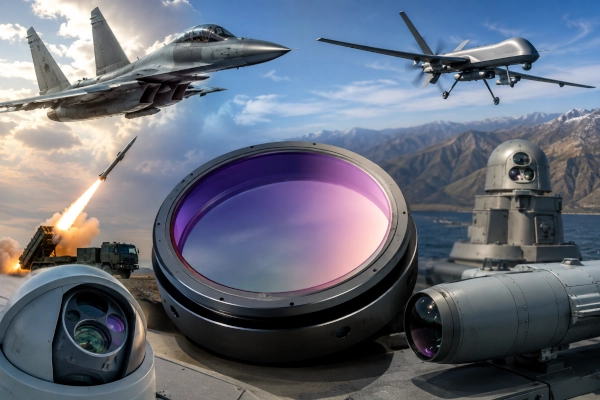
DRDO envisages the coated sapphire panels being used as protective outer lenses for electro-optical/infrared cameras. Such cameras are increasingly important across military aviation, unmanned systems, surveillance platforms and precision weapons.
Another application is the manufacture of EO/IR-transparent sensor domes. A sensor installed inside a missile or airborne system needs an optical enclosure through which it can observe the external environment without unacceptable degradation of the infrared signal.
DRDO specifically identifies EO/IR-transparent domes for missile systems among the potential applications.
This has direct relevance to modern precision weapons. Many guided missiles use electro-optical or infrared sensors during navigation, target acquisition or terminal guidance. The sensor aperture at the front of the system must remain optically transparent while enduring aerodynamic heating, vibration and environmental exposure.
The technology can also be used in forward-looking infrared surveillance pods. Such systems allow aircraft to detect and observe targets through their thermal signatures, including in darkness and other conditions where ordinary visible-light cameras are less effective.
A further application identified by DRDO is passive missile-approach warning systems installed aboard UAVs and fighter aircraft.
These systems monitor the environment around an aircraft for signatures associated with approaching missiles and can provide warnings that allow countermeasures or evasive action to be initiated. The performance of the optical sensor depends partly on the quality of the transparent protective window through which it observes the surrounding environment.
The same underlying materials technology can therefore support several very different defence systems.
Building the Manufacturing Process in India
The Transfer of Technology is significant because DRDO is not simply offering Indian companies a finished optical component. It is transferring the manufacturing process required to deposit the infrared-transmissive coating onto sapphire panels.
Companies seeking the technology must possess specialised infrastructure.
DRDO requires prospective manufacturers to have a clean room meeting ISO Class 8 standards or better, reflecting the extremely controlled environment necessary for precision optical-coating work.
Industries must also possess Physical Vapour Deposition equipment, or an equivalent system, for coating deposition. PVD technologies allow very thin layers of material to be deposited onto a substrate under controlled conditions.
The quality of these microscopic layers can have a major effect on optical transmission, making the coating process itself an important part of the intellectual and manufacturing know-how being transferred.
Manufacturers must additionally have an FTIR spectrometer, which can be used to characterise infrared optical performance, as well as equipment including a profilometer for measuring thin-film thickness.
This demonstrates that the technology is aimed at companies possessing genuine precision-optics and advanced-manufacturing capabilities rather than conventional component assemblers.
A Critical but Often Invisible Defence Technology
Optical windows and sensor domes rarely attract the attention given to the missile or aircraft carrying them, yet they can be mission-critical components.
A sophisticated infrared detector cannot perform effectively if the optical material protecting it substantially attenuates, distorts or reflects the radiation it is intended to detect.
Similarly, an ideal optical material would have little operational value if it could not survive the environmental stresses experienced by an aircraft or missile.
Creating components that satisfy both requirements involves expertise in materials science, precision optics, thin-film coatings, surface engineering and aerospace qualification.
These are technologies with high barriers to entry, making indigenous manufacturing capability strategically valuable.
Strengthening India’s Electro-Optical Supply Chain
India is steadily increasing indigenous production of missiles, UAVs, aircraft sensors, seekers and airborne surveillance systems. As these larger platforms become increasingly domestic, localisation of the specialised components inside them becomes equally important.
A missile described as indigenous can still depend on imported optical windows, detectors, coatings or other specialised materials if a domestic supply chain does not exist.
Transferring the sapphire coating process to multiple Indian manufacturers can help address this vulnerability by establishing production capacity within the country.
Having five licences available is particularly relevant. Instead of restricting the technology to a single production agency, DRDO can potentially create several qualified manufacturers capable of supplying India’s expanding defence-electronics and aerospace sectors.
Greater supplier depth can improve production resilience while creating competition and allowing manufacturing capacity to increase as requirements grow.
It could also provide Indian optical companies with experience that can eventually be applied to more advanced sensor windows, domes and specialised coatings.
Part of a Wider Indigenous Infrared Optics Push
The sapphire technology is not an isolated initiative.
DRDO has also opened an Infrared Transmissive Germanium Optical Component with Hard Coating for industry Transfer of Technology. That technology was listed in July 2026 and similarly supports the wider localisation of specialised infrared optics.
Sapphire and germanium have different optical and physical characteristics, allowing them to serve different roles within electro-optical systems.
Making both technologies available to domestic companies suggests a broader effort to develop an Indian industrial base capable of supplying advanced infrared optical components rather than relying on overseas manufacturers for these specialised materials.
This becomes increasingly important as India expands production of infrared seekers, electro-optical targeting systems, missile-warning equipment, reconnaissance payloads and unmanned aircraft sensors.
From Laboratory Process to Industrial Capability
The importance of the August 6 offering lies ultimately in converting a specialised DRDO laboratory capability into a repeatable Indian industrial process.
India’s defence indigenisation programme is increasingly moving beyond the visible platforms — aircraft, missiles, warships and drones — towards the specialised materials and manufacturing technologies hidden inside them.
Infrared-transmissive sapphire optics are a good example of that transition.
The finished component may be relatively small compared with the aircraft or missile carrying it, but its successful operation can directly influence whether an infrared sensor can detect, track or identify its target.
By transferring the coating technology from ADE to qualified manufacturers, DRDO is creating the possibility of an indigenous supply chain extending from sapphire processing and precision coating to testing, qualification and production of military-grade infrared optical components.
It is precisely this type of specialised manufacturing capability that determines whether defence self-reliance extends beyond assembling complete platforms to mastering the critical technologies within them.
The opening of DRDO’s infrared sapphire technology to Indian industry therefore represents a small but technologically significant addition to India’s Make in India defence ecosystem — one capable of supporting future missiles, fighter aircraft, UAVs and advanced electro-optical surveillance systems.
You may also like
-
India and UK Advance Full Electric Propulsion Partnership for Indian Navy’s Four Next-Generation Landing Platform Docks
-
Hindalco Brings Superfine PPT ATH Manufacturing to India With 30,000-Tonne Belagavi Plant
-
India Certifies First 15-Metre Multi-Axle Sleeper Bus as Domestic Coach Engineering Advances
-
Dhaksha Opens New Drone Manufacturing Facility in Tamil Nadu, Unveils Indigenous Agricultural UAVs
-
India Moves Closer to Major UK-Made Thales LMM Missile Deal for Indian Army
