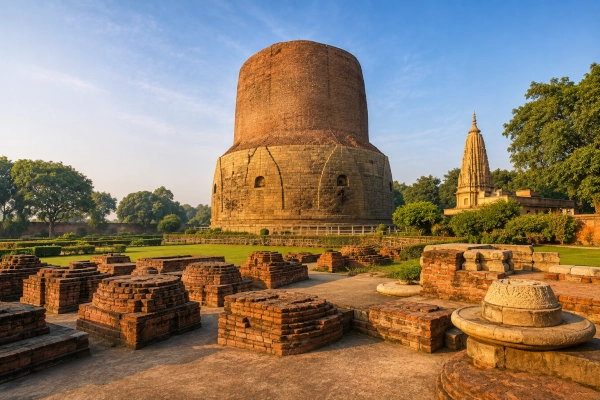
India’s ancient Buddhist heritage has received another major international recognition with the Ancient Buddhist Site of Sarnath in Uttar Pradesh becoming the country’s 45th UNESCO World Heritage property. The inscription was approved on 25 July 2026 during the 48th Session of the World Heritage Committee in Busan, South Korea, while a detailed Government of India backgrounder released on August 26 has highlighted the historical and civilisational importance of the recognition.
Situated near Varanasi, Sarnath occupies a unique place in the history of Buddhism. It is traditionally identified as the location where Gautama Buddha delivered his first sermon after attaining enlightenment at Bodh Gaya, setting in motion the teaching of the Dharma. The event is remembered as Dharmachakra Pravartana — the Turning of the Wheel of Dharma — and marked the beginning of the Buddhist Sangha.
The UNESCO property is a serial site comprising two archaeological components: the Chaukhandi Stupa and the Archaeological Remains of Sarnath. Within the principal archaeological complex are some of India’s most important Buddhist monuments, including the Dhamek Stupa, Dharmarajika Stupa, Mulagandhakuti Vihara and the remains of the Ashokan Pillar, together with numerous monasteries, shrines and other structures built over successive centuries.
The Chaukhandi Stupa is traditionally associated with the place where Buddha met his first five disciples after arriving at Sarnath. The monumental Dhamek Stupa subsequently became one of the most recognisable surviving structures at the site, marking the landscape connected with his first teaching. The remains collectively demonstrate how Sarnath evolved from a sacred location associated with Buddha’s life into one of the great centres of Buddhist learning, worship and pilgrimage.
Known in ancient Buddhist traditions by names including Rishipatana, Ishipatana and Mrigadava, Sarnath developed for centuries under royal, monastic and lay patronage. Its archaeological record extends from the pre-Mauryan period through the Mauryan, Kushan, Gupta and later periods, reflecting nearly sixteen centuries of religious and architectural development before the site declined during the 12th century.
The Mauryan emperor Ashoka played an especially important role in the history of Sarnath. His patronage helped transform locations associated with Buddha’s life into monumental centres of pilgrimage. The famous Ashokan pillar erected at Sarnath originally carried the celebrated lion capital that later became the State Emblem of India, giving the ancient site a direct symbolic connection with the modern Republic.
UNESCO has inscribed Sarnath under World Heritage criteria (iii) and (vi). The recognition acknowledges both the site’s enduring testimony to Buddhist religious tradition and its direct association with events and ideas of exceptional spiritual significance, particularly Buddha’s first sermon and the emergence of the Buddhist community.
The World Heritage property covers approximately 8.05 hectares, surrounded by a buffer zone of about 72.2 hectares. UNESCO describes Sarnath as a place that developed over centuries through royal, monastic and lay patronage, producing a remarkable concentration of stupas, temples and viharas before its decline and later rediscovery.
Sarnath was placed on India’s Tentative List for World Heritage status in 1998, beginning a long journey towards inscription. India submitted the formal nomination for consideration in January 2025, followed by technical consultations and an evaluation process involving UNESCO’s advisory mechanisms before the World Heritage Committee approved the inscription in Busan.
The recognition also gives Sarnath a stronger position within the international network of Buddhist heritage sites. Three of the four principal pilgrimage destinations associated with Buddha’s life — Lumbini in Nepal, Bodh Gaya in Bihar and Sarnath in Uttar Pradesh — are now UNESCO World Heritage properties. Sarnath also joins major Buddhist heritage sites in India such as Sanchi, Nalanda and Ajanta.
For India, the significance goes beyond archaeology. Sarnath continues to attract Buddhist pilgrims from Sri Lanka, Thailand, Myanmar, Japan, Vietnam, South Korea, Cambodia, Mongolia and numerous other countries. The site therefore serves simultaneously as a place of worship, an archaeological landscape and an important instrument of India’s cultural engagement with the wider Buddhist world.
With Sarnath’s inscription, India now has 45 UNESCO World Heritage properties — 37 cultural, seven natural and one mixed site. The country ranks sixth globally and second in the Asia-Pacific region by number of World Heritage properties. India also has 69 sites on its Tentative List, providing a substantial pipeline for future nominations.
The latest recognition follows the inscription of the Maratha Military Landscapes of India in 2025 and continues India’s recent expansion on the World Heritage List. It also places greater responsibility on conservation authorities to protect Sarnath’s archaeological integrity, control development around its buffer zone and manage increasing visitor numbers without disturbing its historic character.
More than 2,500 years after Buddha’s teaching began to spread from Sarnath, the site remains a living centre of pilgrimage and a symbol of ideas that travelled from India across much of Asia and eventually the world. UNESCO recognition now formally places this landscape among humanity’s most significant cultural properties, preserving not only its stupas and monasteries but also the memory of the moment when one of history’s most influential philosophical and spiritual traditions began its public journey.
You may also like
-
Ancient Bazira-Barikot of Gandhara Gains UNESCO Recognition as 3,000 Years of Urban History Emerge From Swat
-
Vaidisha in the Mahabharata-Era Geography: The Ancient Vidisha Region of Central Madhya Pradesh
-
How a Rock Shelter in Nagaland Is Rewriting Northeast India’s Prehistory
-
Dasharna in the Mahabharata: The Ancient Kingdom of Vidisha and Eastern Malwa
-
13th-Century Tamil Inscription Reveals Jewish Merchants Helped Build Hall at Shiva Temple in Krishnagiri
